
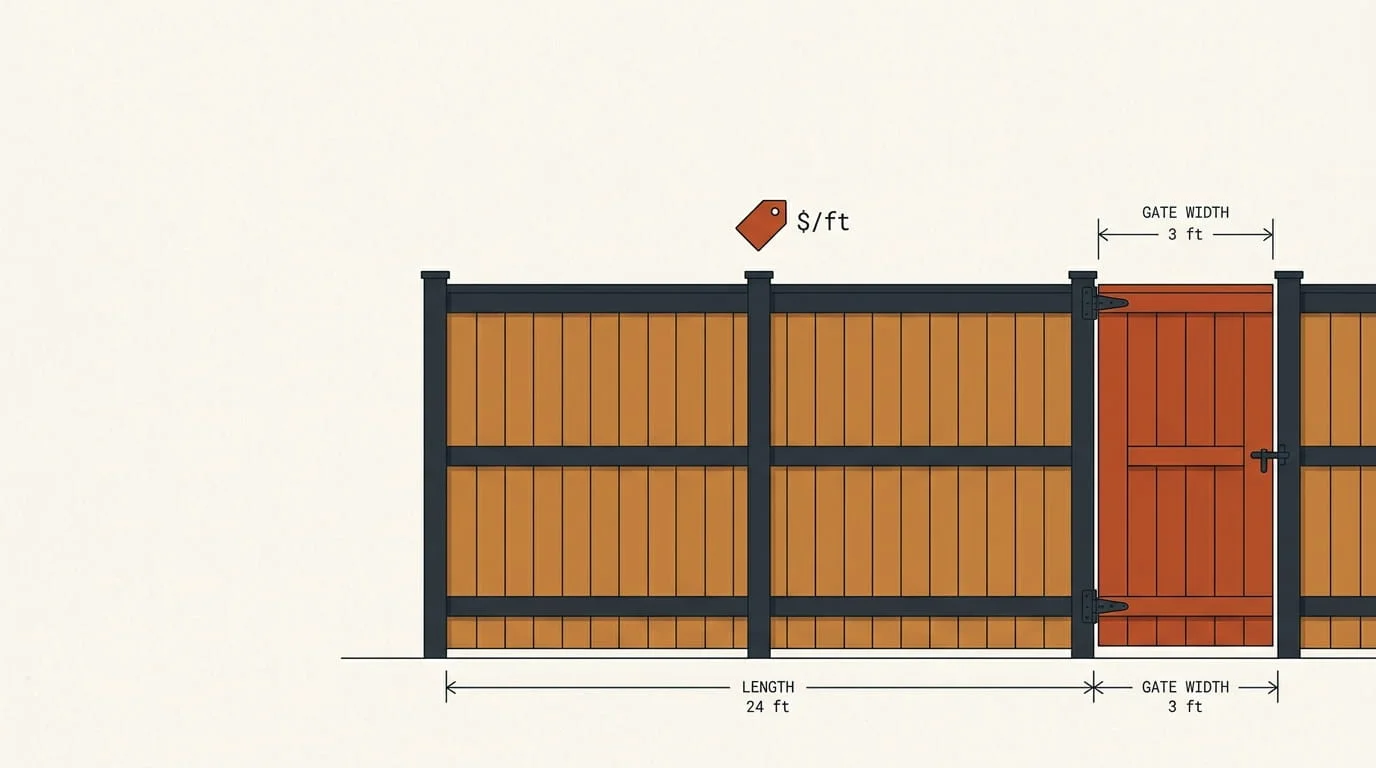
Wood Fence Cost Calculator
Estimate a professionally installed fence using measured linear feet and an itemized project scope.
A wood fence cost calculator turns boundary measurements into a real budget figure. Because fencing is priced by linear foot rather than by yard size, any estimate built on lot area will be wrong before you begin.
Below, you’ll find researched 2026 installed rates, the gate maths most people get wrong, and a free tool that builds your range instantly.
How Much Does a Wood Fence Cost?
Installed pricing depends on height, style and species. Based on 2026 contractor data:
| Fence specification | Installed per ft | 150 ft run |
|---|---|---|
| 3–5 ft wood picket | $20 – $40 | $3,000 – $6,000 |
| 6 ft wood privacy | $25 – $50 | $3,750 – $7,500 |
| Standard cedar privacy | $35 – $40 | $5,250 – $6,000 |
| Common-grade redwood privacy | $35 – $50 | $5,250 – $7,500 |
| 8 ft wood privacy | $50 – $75 | $7,500 – $11,250 |
These rates include both materials and installation labour, so no separate labour charge applies on top.
Consequently, height matters more than most people expect. Moving from 6 ft to 8 ft roughly doubles the per-foot cost, since taller fences need deeper posts, heavier framing and more material throughout.
Figures come from HomeGuide’s December 2025 wood fence cost guide, cross-checked against contractor pricing guides.
Why Yard Area Doesn’t Work
This is the most common estimating mistake. Lot size tells you nothing useful about fence length.
What actually determines your run:
- Boundary shape — an irregular lot has more perimeter than a square one
- Sides being fenced — many projects fence three sides, not four
- Existing sections — usable fencing reduces new footage
- Buildings on the line — garages and sheds break up runs
- Gate openings — deducted from the fenced length
Therefore, walk your boundary with a measuring wheel. Then sum only the runs receiving new fence.
👉 Try the free Wood Fence Cost Calculator
How Gates Change the Calculation
Gates work differently from fencing, and getting this wrong inflates budgets noticeably.
Net run = Total route − Gate openings
Because a gate occupies space where fence panels would otherwise sit, that footage gets deducted rather than double-charged. Gates are then priced individually as quoted items.
For example, a 150 ft route with two 4 ft gates:
- Gate openings = 8 ft
- Net fence run = 142 ft
- Gates quoted separately at their installed price
What a gate quote should include:
- The gate leaf itself
- Hinges, latch and hardware
- Reinforced gate posts, which are heavier than line posts
- Installation labour
Notably, gate posts carry far more stress than standard posts. Consequently, they need deeper footings and often larger dimensions, which is why gates cost more than an equivalent length of fence.
Cedar vs Redwood vs Pressure-Treated Pine
Species selection affects both price and lifespan.
| Wood | Rough installed rate | Lifespan | Character |
|---|---|---|---|
| Pressure-treated pine | $25 – $50 / ft | 15 – 20 years | Cheapest, greenish tint, can warp |
| Cedar | $35 – $40 / ft | 20 – 30 years | Natural rot resistance, stable |
| Redwood | $35 – $50 / ft | 25 – 30 years | Premium appearance, regional pricing |
Cedar is the practical middle ground for most homeowners. Since it resists rot and insects naturally, it holds up well without chemical treatment and warps less than pine.
Redwood pricing varies enormously by region. On the West Coast it’s competitive, whereas eastern states pay significant freight premiums.
Importantly, premium grades of either cedar or redwood cost considerably more than the benchmark ranges shown. Get species-specific quotes rather than assuming the published rate covers clear-grade material.
Wood Fence Styles
Style affects material volume and labour hours.
| Style | Description | Relative cost |
|---|---|---|
| Picket | Spaced vertical boards, 3–5 ft | Lowest |
| Privacy (stockade) | Butted boards, no gaps | Moderate |
| Shadowbox | Alternating boards both sides | Moderate to high |
| Board on board | Overlapping boards | High |
| Horizontal | Boards run sideways | High |
Board-on-board and shadowbox use roughly 30–50% more material than standard privacy fencing, since boards overlap rather than sitting edge to edge.
Horizontal fencing has become popular for its modern look. However, it requires more posts to prevent sagging, so budget accordingly.
Cost to Replace a Fence
Replacement adds a removal line to your budget.
Removal and disposal: $10 – $20 per linear foot
On 150 ft, that’s $1,500 to $3,000 — a substantial addition many homeowners overlook entirely.
Some contractors bundle removal into their installed rate, so confirm before adding it separately.
Signs you need replacement rather than repair:
- Multiple posts loose or rotted at ground level
- Leaning sections that won’t stay plumb
- Widespread board rot or splitting
- The fence exceeds its expected lifespan
- Repairs would exceed a third of replacement cost
Since crew mobilisation is a fixed cost, replacing the whole run at once beats three separate repair visits.
How to Use the Wood Fence Cost Calculator
Follow these steps for an accurate budget.
1 — Measure your total route
Include gate openings in this figure, since the tool deducts them automatically.
2 — Select your fence specification
Pick the closest match by height and species, or switch to custom with a contractor’s rate.
3 — Apply an adjustment if warranted
Leave at 0% unless slopes, difficult access or local pricing genuinely justify a change.
4 — Enter gate details
Add the count, average opening width, and your quoted installed price per gate.
5 — Add removal footage
Enter old fence length, or leave at zero if bundled into your rate.
6 — Include other quoted work
Staining, surveys, permits and site prep go here.
7 — Check the net run figure
Verify the calculator’s net footage matches your expectation before comparing bids.
Before You Build: Three Things to Check
Fencing has legal dimensions that other projects don’t.
1. Property boundaries
Never assume the existing fence sits on the line. Furthermore, building even inches over a boundary can force removal at your expense. A land survey resolves this definitively.
2. Utility locations
Call 811 before any digging. Since post holes go 2–3 feet deep, striking a gas or utility line is a genuine risk.
3. Local requirements
Height limits, setbacks, permits and HOA rules all vary. Additionally, many jurisdictions restrict front-yard fence height more tightly than rear boundaries.
Above all, talk to your neighbours before starting. Shared boundary fences sometimes involve cost-sharing obligations, and the conversation is far easier before installation than after.
What the Estimate Excludes
Your figure covers fencing, gates, removal and entered extras. Budget separately for:
- Staining or sealing — $2 to $5 per linear foot
- Land survey — where boundaries are uncertain
- Permits — $50 to $500 by jurisdiction
- Grading or slope work — stepped installations cost more
- Tree or root removal — obstructing the fence line
- Minimum job charges — common on short runs
- Sales tax — depending on how your contractor bills
Regarding staining, plan it for a few months after installation. Because new timber needs to dry out first, sealing immediately traps moisture.
Frequently Asked Questions
How much does a 6-foot privacy fence cost per foot?
Installed pricing runs $25 to $50 per linear foot. On a typical 150 ft run, that’s $3,750 to $7,500 before gates and removal.
Is the wood fence cost calculator free?
Yes, entirely free with no sign-up. Moreover, you can copy the estimate or save a PDF for comparing contractor bids.
How much does fence removal cost?
Published allowances run $10 to $20 per linear foot. Some installers bundle it, so always ask before budgeting separately.
Is cedar worth the extra cost?
Usually, yes. Cedar resists rot naturally and warps less than pressure-treated pine, typically lasting five to ten years longer.
Can I install a wood fence myself?
Short, level runs are DIY-feasible. However, post setting is physically demanding, and slopes or long runs benefit considerably from professional equipment.
How long does a wood fence last?
Pressure-treated pine lasts 15 to 20 years, cedar 20 to 30, and redwood up to 30 with maintenance. Regular sealing extends all three.
Budget Your Fence Now
Rather than guessing from yard size, measure your boundary runs and enter them for a costed breakdown immediately. Afterwards, you’ll know whether a contractor’s bid sits within a reasonable range.
4 thoughts on “Wood Fence Cost Calculator: Price Per Linear Foot”