
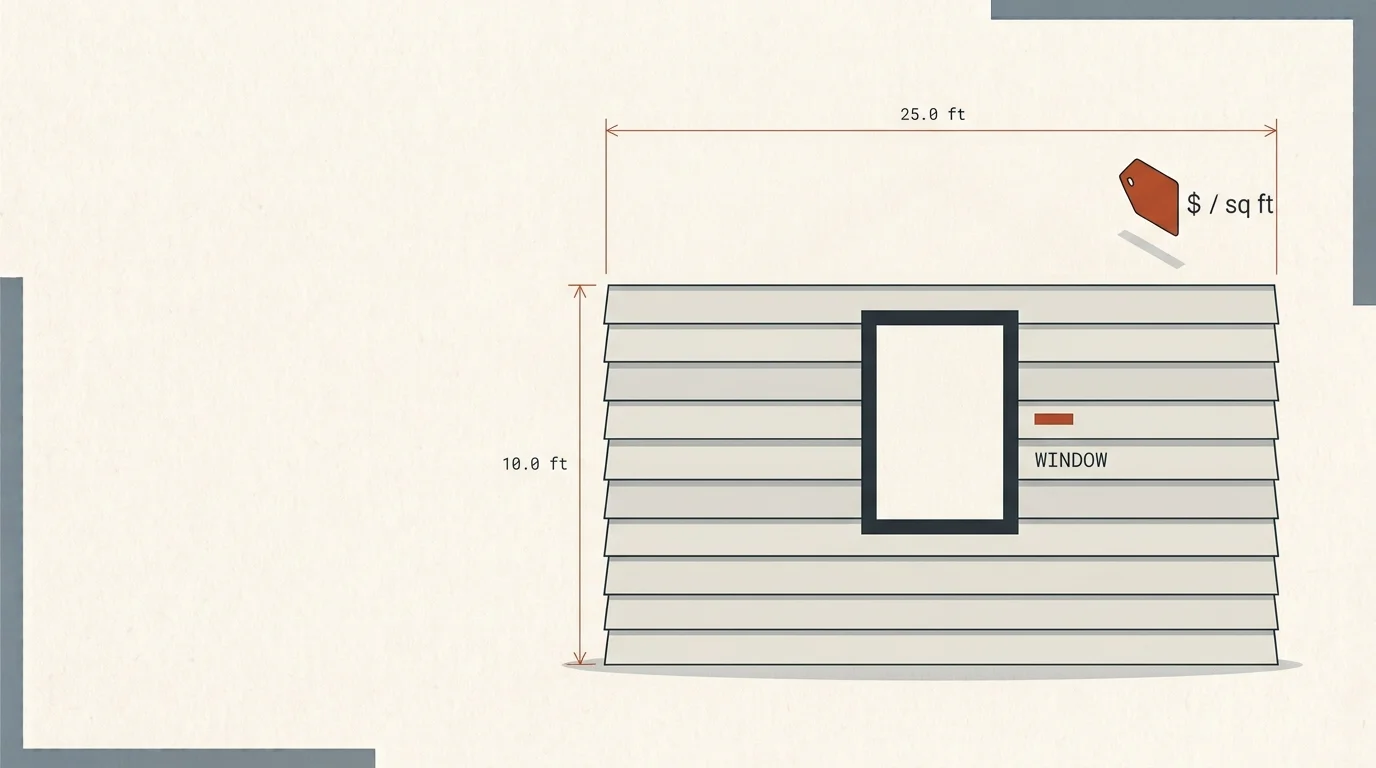
How this vinyl siding estimate works
The style presets use HomeGuide’s U.S. vinyl siding guide: vinyl siding averages $4–$12 per square foot installed overall, with style-specific ranges from $4–$7 for traditional or Dutch lap to $6–$12 for insulated vinyl. HomeGuide lists old-siding removal at $0.70–$2.00 per square foot. A second reference, This Old House, reports that removal can add about $1–$2 per square foot and emphasizes measuring exterior wall area rather than relying on a home’s interior square footage.
| Component | Calculator treatment |
|---|---|
| Billable siding area | Gross wall area minus entered windows and doors |
| Installed vinyl siding | Net area × selected published or custom rate |
| Material order area | Net area plus editable waste; informational only |
| Old siding removal | Optional net area × $0.70–$2.00/sq ft |
| Repairs and other extras | User-entered written quotes |
| Contingency | User percentage applied after all included costs |
How do I measure exterior siding area?
Measure each exterior wall’s length and height and add the areas. For a simple rectangular house, use perimeter × average wall height × stories. Then subtract the measured area of windows and doors. Gables, dormers, bump-outs, and attached garages should be measured separately if the simple footprint does not capture them.
What does one “square” of siding mean?
In siding terminology, one square covers 100 square feet. The result shows an order quantity with your waste allowance, but the cost calculation uses net installed area so waste is not automatically charged at a full material-and-labor rate.
Does the installed rate include trim and house wrap?
Published installed rates describe broad project costs, but contractor scopes differ. Confirm whether corner posts, starter strips, J-channel, house wrap, foam board, soffit, fascia, gutters, disposal, permits, taxes, and repairs are included. Add only excluded written quotes.
Why is ZIP code not used automatically?
A ZIP code alone does not provide a reliable live contractor price. Use the local-adjustment field only after comparing local quotes, or switch to custom pricing and enter comparable installed rates directly.
What should I compare in contractor bids?
Compare the same siding manufacturer, product line, thickness, color, insulation, wall preparation, flashing, trim, ventilation details, removal, disposal, warranty, permits, payment schedule, and change-order terms. Ask whether hidden sheathing damage is an allowance or an extra.
A vinyl siding cost calculator turns wall measurements into a real project budget. Because siding is priced by exterior wall area rather than by interior floor space, estimates built on house square footage will miss badly in both directions.
Below, you’ll find researched installed rates by style, how to measure your walls properly, and a free tool that produces your range instantly.
How Much Does Vinyl Siding Cost?
Installed pricing depends heavily on style, since profile complexity affects both material and labour.
| Siding style | Installed per sq ft |
|---|---|
| Clapboard / traditional lap | $4 – $7 |
| Dutch lap | $4 – $7 |
| Vinyl log | $4 – $8 |
| Vertical vinyl | $4 – $9 |
| Vinyl shake | $4 – $10 |
| Board-and-batten | $5 – $9 |
| Vinyl brick look | $5 – $11 |
| Vinyl stone look | $5 – $11 |
| Insulated vinyl | $6 – $12 |
Overall, vinyl siding averages $4 to $12 per square foot installed across all styles.
On a typical 1,800 sq ft wall area with 200 sq ft of openings, traditional lap siding therefore costs roughly $6,400 to $11,200.
Figures come from HomeGuide’s US vinyl siding guide, cross-checked against This Old House.
Why Interior Square Footage Doesn’t Work
This is the core estimating mistake, and it’s worth being direct about.
Your home’s floor area tells you almost nothing about wall area. A 2,000 sq ft single-storey ranch has far more roof and less wall than a 2,000 sq ft two-storey home with the same footprint.
What determines siding area:
- Perimeter length, not floor area
- Number of storeys receiving siding
- Wall height per storey
- Gables, dormers and bump-outs
- Attached garages
- Window and door openings to subtract
Therefore, measure exterior walls directly. Perimeter × wall height × storeys gives you a workable starting figure for a simple rectangular house.
👉 Try the free Vinyl Siding Cost Calculator
How to Measure Your Siding Area
Accuracy here drives every downstream number.
Step one — measure gross wall area
For a simple rectangle: 2 × (length + width) × wall height × storeys
A 50 × 30 ft two-storey home at 9 ft per storey gives 2,880 sq ft gross.
Step two — measure gables and dormers separately
Gable area = ½ × base width × height. Since the simple formula misses these entirely, add them in.
Step three — subtract openings
Measure each window and door, then total the area. Most homes have 150 to 300 sq ft of openings.
Crucially, the calculator prices your net area — gross minus openings. Consequently, you aren’t paying installed rates for space where no siding goes.
Understanding Squares and Waste
Siding is ordered in “squares,” and the terminology trips people up.
One square = 100 square feet
A 1,600 sq ft net area therefore needs 16 squares before waste.
Waste allowance: 10% typical
Waste covers cuts, corners, angles and defects. Complex rooflines with multiple gables often need 15% or more.
Notably, the calculator applies waste to your order quantity only, not to the installed cost. Since waste is offcut material rather than additional installed surface, charging it at the full labour-inclusive rate would overstate your budget.
Cost to Replace Existing Siding
Replacement adds a removal line.
Old siding removal: $0.70 – $2.00 per square foot
On 1,600 net sq ft, that’s $1,120 to $3,200.
Removal cost varies with the existing material. Wood and aluminium come off easily, whereas stucco or multiple layers take considerably longer.
Always confirm disposal separately. Some quotes cover removal but bill dumpster fees on top, so ask directly whether hauling is included.
Signs you need replacement rather than repair:
- Widespread cracking, warping or fading
- Panels loose or missing after storms
- Moisture or rot in the sheathing beneath
- Rising energy bills suggesting failed insulation
- Siding more than 25 years old
Insulated vs Standard Vinyl
Insulated vinyl costs more upfront, so the comparison matters.
| Standard vinyl | Insulated vinyl | |
|---|---|---|
| Installed cost | $4 – $7 / sq ft | $6 – $12 / sq ft |
| R-value added | Negligible | R-2 to R-4 |
| Rigidity | Flexible | Stiffer, straighter appearance |
| Sound dampening | Minimal | Noticeably better |
| Impact resistance | Lower | Higher |
On 1,600 sq ft, upgrading adds roughly $3,200 to $8,000.
Whether that pays back depends on your climate and existing wall insulation. In cold regions with poorly insulated walls, the case is stronger. Meanwhile, in mild climates with good existing insulation, the aesthetic and durability benefits usually matter more than the energy saving.
Costs Not Covered by a Per-Square-Foot Rate
Installed rates describe broad project costs, though contractor scopes vary considerably.
| Item | Why it’s separate |
|---|---|
| Sheathing / moisture repairs | Hidden until old siding comes off |
| House wrap or foam board | Sometimes included, often not |
| Soffit, fascia and trim | Priced by linear foot |
| Gutters | Usually a separate trade |
| Permits and taxes | Vary by jurisdiction |
Sheathing repair is the big unknown. Because rot stays hidden until the old siding is removed, ask whether your contractor treats it as an allowance or an extra. That single question prevents the most common siding budget shock.
Rather than assuming, enter only written quote amounts for excluded items. Otherwise you’ll double-count work the installer already includes.
How to Use the Vinyl Siding Cost Calculator
Follow these steps for an accurate budget.
1 — Choose your measurement method
Enter known wall area, or let the tool calculate from house dimensions.
2 — Enter dimensions if needed
Provide length, width, wall height per storey and storey count.
3 — Subtract your openings
Measure windows and doors, then enter the combined area.
4 — Set your waste allowance
Leave at 10%, or raise it for complex rooflines.
5 — Select your siding style
Each style carries its own published installed range.
6 — Choose your pricing basis
Use the published range, or enter custom rates from comparable quotes.
7 — Add removal if replacing
Tick removal, then confirm whether disposal is included.
8 — Enter quoted extras and contingency
Add written quotes only, then set a planning reserve.
Comparing Siding Contractor Bids
Siding quotes are hard to compare because product lines and scope differ so much.
Ask each contractor to specify:
- Manufacturer and product line
- Panel thickness (measured in mils)
- Colour and whether it carries a fade warranty
- Insulation type and R-value if applicable
- Wall preparation and flashing details
- Corner posts, starter strips and J-channel
- House wrap or weather barrier
- Ventilation details
- Removal, disposal and cleanup
- Warranty on both product and labour
- Permits, taxes and payment schedule
- Change-order rules for hidden damage
Above all, clarify how hidden sheathing damage is handled. Whether it’s an allowance or an open-ended extra can swing your final invoice by thousands.
Frequently Asked Questions
How much does it cost to side a house?
Expect $4 to $12 per square foot installed. A typical home with 1,600 net sq ft of wall costs $6,400 to $19,200 depending on style.
Is the vinyl siding cost calculator free?
Yes, entirely free with no sign-up. Moreover, you can download a PDF or copy the summary for comparing contractor bids.
How many squares of siding do I need?
Divide your net wall area by 100, then add your waste allowance. A 1,600 sq ft area at 10% waste needs about 17.6 squares.
Does the cost include removing old siding?
Not in the base rate. Removal adds $0.70 to $2.00 per square foot, and disposal is sometimes billed separately again.
Is insulated vinyl siding worth it?
It depends on your climate and existing wall insulation. The upgrade adds $2 to $5 per square foot, delivering R-2 to R-4 plus better rigidity and sound dampening.
How long does vinyl siding last?
Most vinyl siding lasts 20 to 40 years. Thicker panels and quality installation both extend that considerably.
Price Your Siding Now
Rather than guessing from house size, measure your exterior walls and enter them for a costed breakdown immediately. Afterwards, you’ll know both your budget range and how many squares to order.