
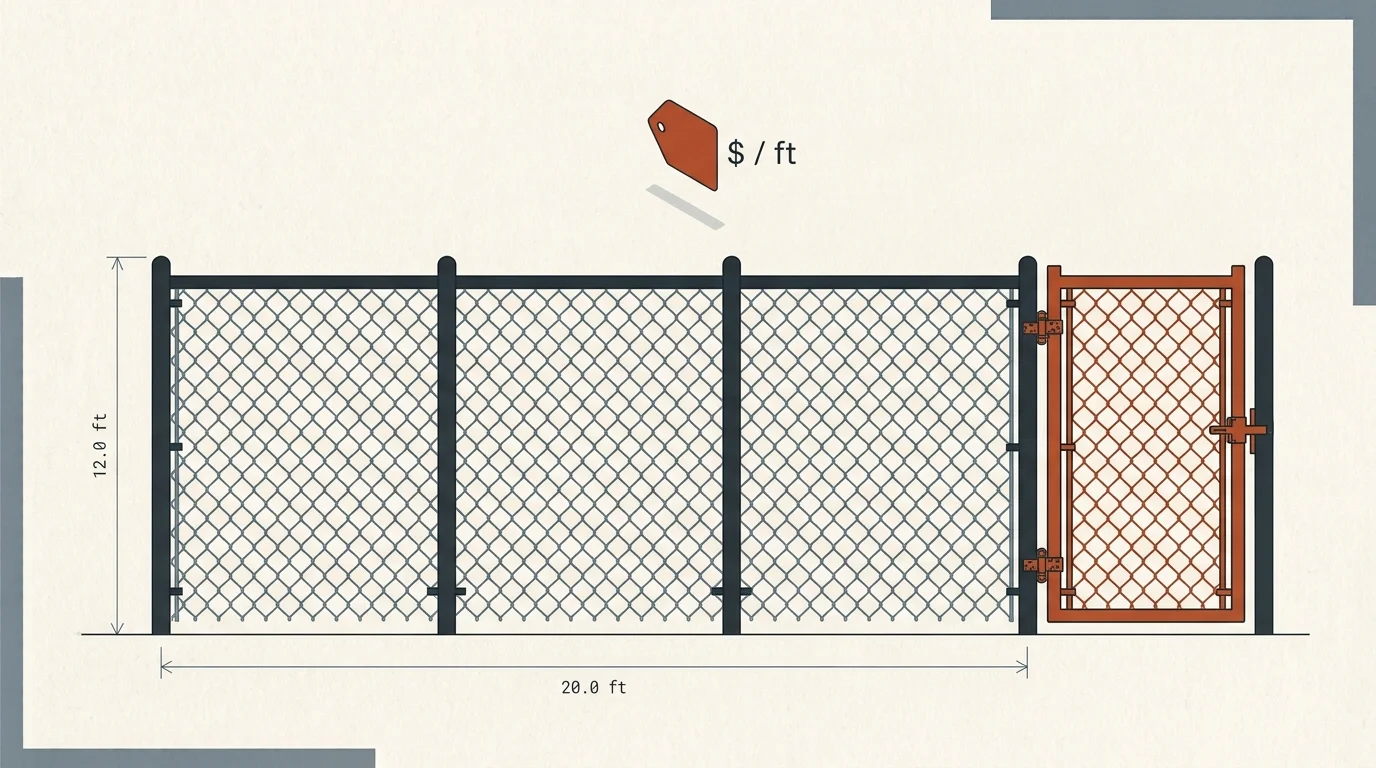
Pricing basis and calculator method
The installed height rates and add-on prices come from Angi’s 2026 chain-link fence cost guide, updated May 30, 2026. Its national installed range is $8–$40 per linear foot, including materials and labor.
| Fence height | Installed rate per linear foot |
|---|---|
| 4 ft | $8–$20 |
| 5 ft | $9–$22 |
| 6 ft | $10–$29 |
| 8 ft | $12–$34 |
| 10 ft | $17–$40 |
Formula: fence length × installed height rate, plus finish, gates, selected add-ons, and other quoted costs. The local adjustment applies to the installed fence and coating amounts. Gate and add-on allowances remain at their published ranges.
Are posts and installation labor included?
Yes. The preset height rates are installed rates that include materials and labor. Do not add posts or standard installation labor again unless your custom local quote excludes them.
Does the perimeter calculator know my actual fence line?
No. It calculates a complete rectangular perimeter. Subtract unfenced house walls, driveway openings and other gaps, or enter the measured fence length directly.
What can change the final price?
Gauge, mesh size, soil, slope, access, corner count, post depth, local labor, permits and code requirements can change bids. Pool and security fencing may require specific heights, gates and openings.
How should I compare contractor quotes?
Compare the same height, gauge, mesh opening, coating, post specifications, concrete, gates, removal, cleanup and permit scope. Confirm taxes and utility-location responsibilities.
A chain link fence cost calculator turns your boundary measurement into a real budget figure. Because installed pricing spans $8 to $40 per linear foot depending on height and finish, a single average helps almost nobody.
Below, you’ll find researched 2026 rates by height, the coating and gate costs that add up quickly, and a free tool that builds your project range instantly.
How Much Does Chain Link Fence Cost?
Height is the primary pricing driver, since taller fences need heavier posts, more mesh and deeper footings.
| Fence height | Installed per ft | 200 ft run |
|---|---|---|
| 4 feet | $8 – $20 | $1,600 – $4,000 |
| 5 feet | $9 – $22 | $1,800 – $4,400 |
| 6 feet | $10 – $29 | $2,000 – $5,800 |
| 8 feet | $12 – $34 | $2,400 – $6,800 |
| 10 feet | $17 – $40 | $3,400 – $8,000 |
These are installed rates covering both materials and labour, so no separate labour charge applies on top.
Consequently, chain link remains the most affordable fencing option available. A 4 ft residential run costs roughly a third of comparable wood privacy fencing.
Figures come from Angi’s 2026 chain-link fence cost guide, updated May 2026.
Coating Options and What They Add
Finish choice changes both appearance and price meaningfully.
| Coating | Added cost per ft | Appearance |
|---|---|---|
| Galvanized | Base price | Standard silver, utilitarian |
| Powder coated | +$6 – $8 | Black, brown or green, smooth finish |
| Colored vinyl | +$10 – $30 | Black or green, softer look |
On a 200 ft run, vinyl coating adds $2,000 to $6,000 — potentially more than the fence itself.
Black vinyl-coated chain link is popular for residential use, largely because it visually recedes into landscaping rather than dominating it. Galvanized, meanwhile, remains standard for commercial, security and utility applications.
👉 Try the free Chain Link Fence Cost Calculator
Gate Costs
Gates are priced individually rather than by the foot.
| Gate type | Cost each |
|---|---|
| Standard swing gate | $100 – $450 |
| Automated rolling gate | $500 – $1,800 |
Swing gates cover most residential needs, typically at 3–4 ft for walk-throughs and 10–12 ft for driveways.
Automated rolling gates sit in a different category entirely. Since they involve motors, tracks, safety sensors and often an electrical run, the installed price reflects considerably more than the gate itself.
Additionally, gate posts carry far more stress than line posts. Therefore, they need deeper footings and heavier gauge, which is why gates cost more than an equivalent length of fence.
Measuring Your Fence Line
Two approaches work, though one is more accurate.
Direct measurement — walk the boundary and record actual runs. This is always the better method.
Rectangular perimeter — calculated as 2 × (length + width).
Crucially, the perimeter method returns a complete rectangle. Consequently, you must subtract:
- House walls forming part of the boundary
- Driveway openings without gates
- Existing fencing being retained
- Any side deliberately left unfenced
Rather than accepting the raw perimeter figure, adjust it down for these gaps. Otherwise your estimate will overshoot noticeably.
Privacy Slats and Add-Ons
Several extras appear on real projects.
| Add-on | Cost | Notes |
|---|---|---|
| Privacy slats | $3 – $10 per fence ft | Woven vertically through mesh |
| Old fence removal | $3 – $5 per removed ft | Disposal included |
| Permit allowance | $20 – $60 | Varies by jurisdiction |
| Land survey | $1,000 – $3,200 | Where boundaries are unclear |
Privacy slats deserve honest expectations. Although they block roughly 75–90% of visibility, they don’t match solid fencing, and they add wind load that stresses posts over time.
On the survey question, it’s worth doing when boundaries are genuinely uncertain. Since building even inches over a line can force removal at your expense, the cost is cheap insurance on a disputed boundary.
Chain Link vs Other Fencing
Understanding the trade-off helps set expectations.
| Fence type | Installed per ft | Lifespan | Privacy |
|---|---|---|---|
| Chain link | $8 – $40 | 20 – 30 years | Low without slats |
| Wood privacy | $25 – $50 | 15 – 30 years | Full |
| Vinyl privacy | $25 – $60 | 25 – 30 years | Full |
| Ornamental metal | $30 – $80 | 30+ years | Low |
Chain link wins clearly on cost and durability. Where it loses is aesthetics and privacy, which is why it dominates commercial, industrial and rear-boundary residential applications rather than street frontages.
Furthermore, galvanized chain link needs almost no maintenance. Unlike wood, it doesn’t require staining, and unlike vinyl, it doesn’t become brittle in cold climates.
How to Use the Chain Link Fence Cost Calculator
Follow these steps for an accurate budget.
1 — Choose your measurement method
Enter linear feet directly, or use the perimeter calculator for a rectangular yard.
2 — Subtract unfenced sections
Deduct house walls, driveway gaps and retained fencing from the perimeter figure.
3 — Select your height
Pick from 4 to 10 feet, or switch to custom with a contractor’s quoted rates.
4 — Choose your coating
Galvanized is the base price. Powder coating and vinyl add per-foot premiums.
5 — Enter gate counts
Separate swing gates from automated rolling gates, since they price very differently.
6 — Tick your add-ons
Include slats, removal, permits and survey as needed.
7 — Apply a local adjustment if warranted
Leave at 0% unless a local quote justifies otherwise. Note this applies only to fence and coating, not to gates or allowances.
8 — Review the effective cost per foot
That combined figure is your best comparison number against contractor bids.
Before You Build
Fencing carries legal considerations other projects don’t.
Verify your boundaries. Never assume the existing fence sits on the property line. Since even a small encroachment can force removal, a survey resolves this definitively where there’s any doubt.
Call 811 before digging. Because post holes reach 2–3 feet deep, striking a buried utility is a genuine risk.
Check local requirements. Height limits, setbacks and permits all vary. Additionally, pool fencing carries specific code requirements around height, gate self-closing and latch positioning that standard fencing doesn’t.
Talk to neighbours first. Shared boundary fences sometimes involve cost-sharing obligations, and that conversation is far easier before installation.
What Changes a Real Quote
Several specifications sit outside the calculator’s scope yet affect bids:
- Wire gauge — 9-gauge is heavier and costlier than 11-gauge
- Mesh opening size — smaller apertures use more wire
- Post diameter and schedule — commercial specs cost more
- Corner and terminal post count — irregular layouts need more
- Concrete footing depth — frost lines vary by region
- Slope and grading — stepped or raked installations take longer
- Soil conditions — rock or clay slows post setting
Consequently, ask each contractor to state gauge, mesh size and post specification. Otherwise you’ll compare quotes built on different materials.
Frequently Asked Questions
How much does chain link fence cost per foot?
Installed pricing runs $8 to $40 per linear foot nationally, depending on height and coating. A standard 4 ft galvanized fence sits at the lower end.
Is the chain link fence cost calculator free?
Yes, entirely free with no sign-up. Moreover, you can download a PDF or copy the summary for comparing contractor bids.
How much is a 6 foot chain link fence?
Expect $10 to $29 per linear foot installed. On a 200 ft run, that’s $2,000 to $5,800 before coating and gates.
Does black chain link cost more?
Yes. Powder coating adds $6 to $8 per foot, whereas colored vinyl adds $10 to $30 per foot.
Are posts and labour included in these rates?
Yes. All preset height rates are installed prices, so don’t add posts or standard labour again unless a custom quote excludes them.
How long does chain link fence last?
Galvanized chain link typically lasts 20 to 30 years with minimal maintenance. Vinyl-coated versions can last longer, since the coating adds corrosion protection.
Price Your Fence Now
Rather than guessing, enter your fence length and height to see a costed breakdown immediately. Afterwards, you’ll know whether a contractor’s bid sits within a reasonable range.
2 thoughts on “Chain Link Fence Cost Calculator: Price Per Linear Foot”