
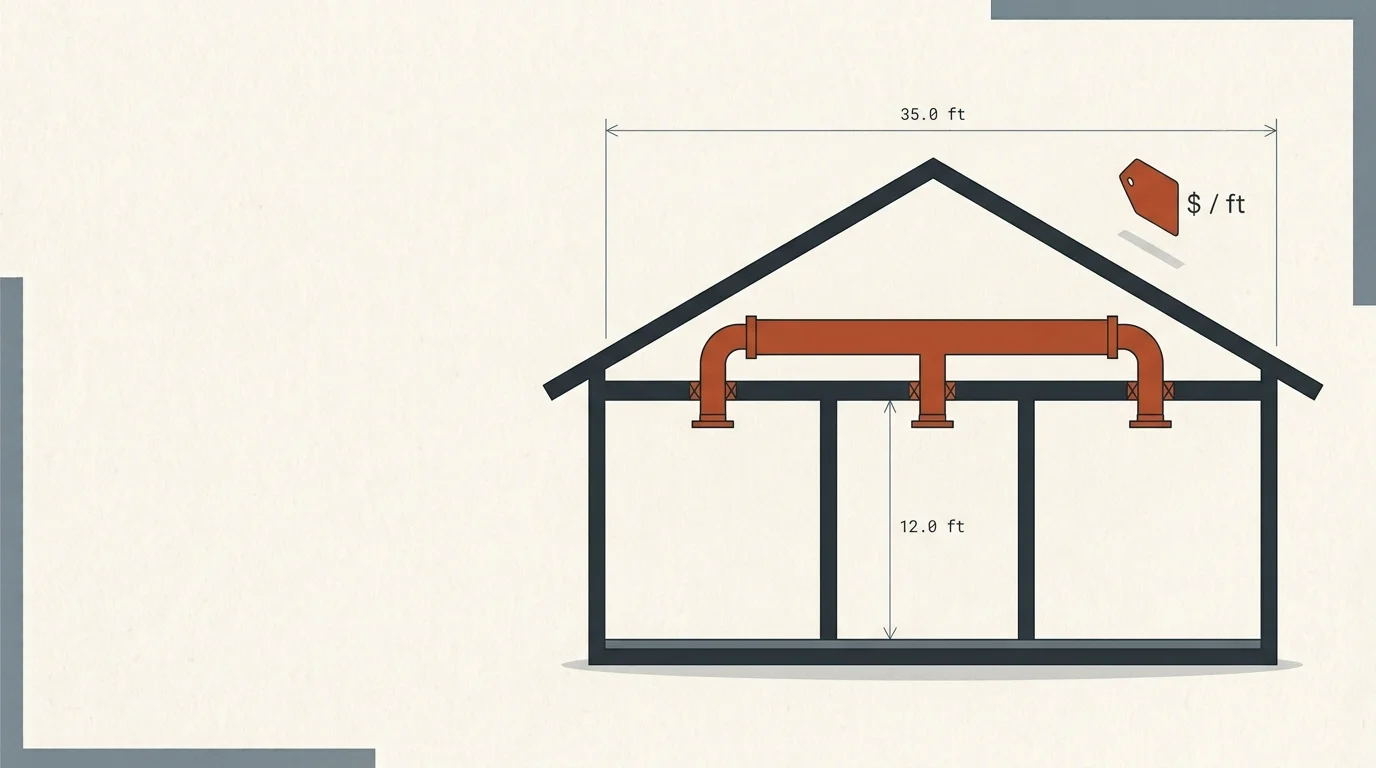
Ductwork Replacement Cost Calculator
Estimate the cost to remove and replace residential HVAC ductwork in the U.S. Calculate by home size or enter measured linear footage for a more tailored planning range.
How this calculator works
Home-size mode begins with published U.S. whole-home replacement ranges. Linear-foot mode uses a baseline of $25–$55 per linear foot, including typical removal and installation. The calculator then adjusts for material, access, location, redesign complexity, zoning, and selected extras.
Replacement should be based on a duct design and load evaluation—not simply copying undersized, leaky, or poorly routed existing ducts.
What commonly changes the quote?
- Attic, crawl-space, wall, and ceiling access
- Flex, duct board, or fabricated sheet-metal material
- Number of supply and return runs, zones, and dampers
- Local labor, permits, testing, demolition, and finish repairs
A ductwork replacement cost calculator gives you a realistic budget before HVAC contractors start quoting. Because ductwork is priced by linear foot of actual duct run — not by home square footage — estimates built on house size are wrong from the start.
Below, you’ll find the researched installed rate, how to measure your duct runs properly, and a free tool that builds your budget instantly.
How Much Does Ductwork Replacement Cost?
The national benchmark for replacement is $25 to $55 per linear foot, installed.
Crucially, that rate covers removing the existing ducts and installing replacements, including both materials and labour. It isn’t a material-only price.
| Duct length | Estimated cost |
|---|---|
| 50 linear ft | $1,250 – $2,750 |
| 100 linear ft | $2,500 – $5,500 |
| 150 linear ft | $3,750 – $8,250 |
| 200 linear ft | $5,000 – $11,000 |
| 300 linear ft | $7,500 – $16,500 |
Consequently, a typical whole-home replacement lands somewhere between $3,000 and $10,000, depending heavily on run length and access.
Figures come from HomeGuide’s ductwork replacement cost guide.
Why Home Square Footage Doesn’t Work
This is the core estimating mistake, and it’s worth being blunt about.
There’s no reliable conversion from home area to duct length. Two 2,000 sq ft homes can have wildly different duct runs depending on:
- Where the air handler sits relative to the rooms
- Whether the system is single or multi-zone
- Roof and floor structure dictating routing
- Number of supply registers and their placement
- Return air strategy — central return versus room returns
Therefore, get a measured scope. Either your contractor’s plan or an actual measurement along the duct paths gives you a usable figure.
👉 Try the free Ductwork Replacement Cost Calculator
How to Measure Duct Length
Accuracy here determines everything downstream.
Measure along the duct paths, following each run as it actually travels, not the straight-line distance between rooms.
Count shared trunks once. The main trunk line serves multiple branches, so counting it again for every branch inflates your total substantially.
Separate supply from return. These are distinct networks, and the calculator lets you enter them separately or combined.
Registers aren’t a substitute. Counting vents tells you nothing reliable about footage, since run lengths vary enormously between them.
Above all, don’t enter unsafe or inaccessible spaces to measure. Crawl spaces and attics carry real hazards, and a contractor’s measured scope serves the same purpose.
What Location Means for Your Project
Where your ducts run affects access, labour and disruption.
| Location | Access considerations |
|---|---|
| Attic | Generally accessible, though heat and insulation slow work |
| Crawl space | Tight, sometimes requires specialist access equipment |
| Basement | Easiest access, often the cheapest scenario |
| Inside finished walls/ceilings | Requires drywall opening and repair |
| Multiple locations | Combined complexity across zones |
Ducts inside finished walls carry the biggest hidden cost. Since drywall must be opened and then repaired, that work is frequently excluded from an HVAC quote and billed separately.
Consequently, ask directly who handles drywall repair. Otherwise you’ll discover a second contractor is needed halfway through.
Duct Material Options
Material choice affects both cost and performance.
| Material | Characteristics |
|---|---|
| Insulated flexible duct | Cheapest, fastest to install, easy around obstacles |
| Sheet metal | Durable, better airflow, higher labour cost |
| Mixed materials | Rigid trunks with flexible branch runs |
Flexible duct dominates residential retrofits, largely because it navigates joists and framing without custom fittings. However, it’s easier to install badly — kinks, sags and compression all restrict airflow.
Sheet metal delivers better airflow and lasts longer. Nevertheless, it requires fabrication and more skilled labour, which pushes it toward the upper end of the range.
Mixed systems are common and often sensible, using rigid trunks for main runs and flexible duct for branches.
What the Rate Includes and Excludes
The $25–$55 installed range covers ordinary removal and installation. Several items frequently sit outside it.
Commonly excluded:
- Additional insulation beyond standard
- Registers, boots and plenums
- Drywall access and repair
- Design, testing and air balancing
- Permits and taxes
- Hazardous material handling
Rather than assuming, ask each contractor which of these their quote covers. The calculator lets you enter excluded items individually, so your total reflects your actual scope.
Regarding air balancing specifically, it’s worth budgeting. Since a new duct network without balancing often produces uneven room temperatures, skipping it undermines the whole investment.
Repair or Replace?
Full replacement isn’t always the answer.
Repair or seal when:
- Leaks are localised at joints
- Ducts are otherwise structurally sound
- Insulation is intact
- The system is under 15 years old
Replace when:
- Ducts are collapsed, crushed or disconnected
- Widespread leakage across the network
- Insulation has deteriorated or fallen away
- Rodent damage or contamination exists
- The layout was never sized correctly
Importantly, this calculator doesn’t determine which applies. Have an HVAC professional inspect airflow and leakage first, since duct sealing sometimes solves the problem at a fraction of replacement cost.
How to Use the Ductwork Replacement Cost Calculator
Follow these steps for an accurate budget.
1 — Choose your length entry method
Enter total measured length, or split supply and return separately.
2 — Enter your measured footage
Use a contractor’s scope or your own measurement along the actual paths.
3 — Record location and material
These document scope for your notes. Notably, they don’t apply invented surcharges.
4 — Select your price basis
Use the published $25–$55 range, or enter custom rates from comparable quotes.
5 — Apply a local adjustment if warranted
Leave at 0% when your rate already reflects local conditions.
6 — Enter any quoted minimum
This acts as a floor on base cost, not an additional charge.
7 — Add excluded items
Enter only work your contractor has actually excluded.
8 — Set your contingency
The 10% default is a planning reserve, adjustable to your risk tolerance.
Comparing HVAC Quotes
Duct quotes are difficult to compare because scope varies so much.
Ask every contractor to specify:
- Supply and return scope separately
- Duct dimensions and materials
- Insulation R-value
- Supports, fittings and dampers
- Sealing method used at joints
- Plenums and register handling
- Access repairs and who performs them
- Debris disposal
- Permits and testing
- Whether air balancing is included
Additionally, confirm the proposed network suits your existing HVAC equipment. Because a duct system sized for different equipment will underperform, that check matters before approving anything.
Frequently Asked Questions
How much does ductwork replacement cost?
Expect $25 to $55 per linear foot installed, covering removal and replacement. A typical 100 ft run therefore costs $2,500 to $5,500.
Is the ductwork replacement cost calculator free?
Yes, entirely free with no sign-up. Moreover, you can download a PDF or copy the summary for comparing contractor bids.
Does this include HVAC equipment?
No. The estimate covers ductwork only, so furnaces, air handlers and condensers need separate quoting.
Is installing ducts in a house without them the same price?
No, generally higher. First-time installation may need new design work, chases, wall openings and restoration, so use custom rates for a retrofit.
How long does ductwork last?
Most residential ductwork lasts 20 to 25 years. Flexible duct typically reaches the shorter end, whereas sheet metal often exceeds it.
Should I clean or replace my ducts?
Cleaning addresses dust and debris, not leakage or damage. If airflow is poor or the ducts are physically damaged, cleaning won’t solve it.
Budget Your Ductwork Now
Rather than guessing from home size, enter your measured duct length and see a costed breakdown immediately. Afterwards, you’ll know whether a contractor’s bid sits within a reasonable range.
1 thought on “Ductwork Replacement Cost Calculator: 2026 Prices”