
The frustrating thing about any interior painting cost calculator search is that the published numbers appear to contradict each other. One guide says $1 to $3 per square foot, another says $2 to $6, a third quotes $4.70. All three are correct — they are just measuring different things. Some price against your home’s floor area, others against the actual wall surface being coated. Until you know which basis a number uses, comparing quotes is guesswork.
The calculator below builds a budget from your rooms and the surfaces you actually want painted, and keeps the items contractors usually quote separately — drywall repair, primer, trim, ceilings — on their own lines instead of hiding them inside a single rate. Enter your numbers, then read the sections underneath to understand what each figure represents on a real estimate.
Pricing and measurement guide
HomeGuide’s interior painting guide reports walls at $1–$2 per square foot of surface area, ceilings at $1–$2 per square foot, and trim at $1–$4 per linear foot. These are the presets. The guide is dated August 2023 and was checked September 9, 2026; use current local quotes for your project.
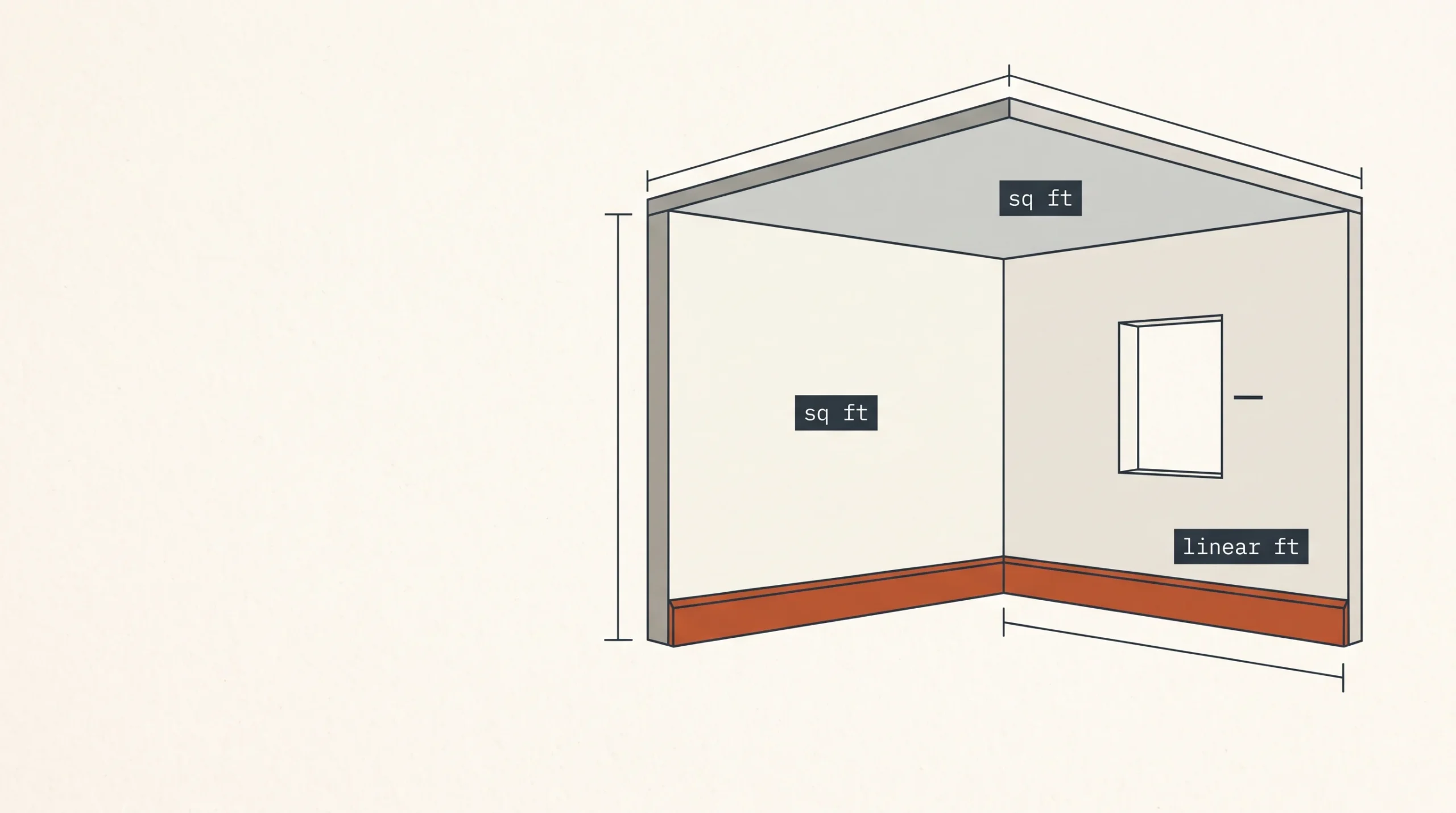
Room walls = 2 × (length + width) × height − openings. Ceiling = length × width. Painting subtotal = wall area × wall rate + selected ceiling area × ceiling rate + trim length × trim rate. Apply local adjustment and your quoted minimum, then add exclusions and contingency. Rates are for completed painting, not per coat.
Paint quantity = surface area × coats ÷ coverage × (1 + quantity allowance). The 400 sq ft/gallon default is an editable product-dependent estimate: Benjamin Moore SCUFF-X, for example, lists 350–400 sq ft/gallon. This does not establish coverage for every paint.
How do I estimate a whole house?
Use measured-surfaces mode and add the wall areas of all rooms, subtracting openings. Add the ceilings separately. Walls on both sides of a partition are separate painted surfaces. Split calculations by color or product when estimating purchases; combining areas can understate can-rounding needs.
Why doesn’t changing the coat count change the labor price?
Published painting rates describe a finished job rather than a per-coat rate. The coat input controls paint quantities only. Confirm primer, number of finish coats, product line, colors, and surface preparation in the quote; use custom rates or an excluded-work allowance where needed.
What should I compare in painter quotes?
Compare measured surfaces, preparation and repairs, primer, finish coats, paint product and sheen, trim and doors, furniture handling, protection, cleanup, taxes, and warranty. Specialty work should be identified separately.
The per-square-foot trap
This is the single most useful thing to understand before you price a repaint, and most guides skip right past it.
When Angi reports $2.75 per square foot for walls, or $4.70 per square foot including walls, trim, and ceilings, those figures are anchored to your home’s square footage — the number on the listing. When HomeGuide reports $1 to $3 per square foot, that is per square foot of surface area being painted. A 1,500 square foot home has roughly 3,500 to 4,500 square feet of paintable wall surface, so the two bases differ by a factor of two to three.
Both conventions are legitimate. Contractors use them inconsistently. When a quote says “$2.50 a square foot,” ask which square feet, because the answer changes the total by thousands of dollars.
What interior painting costs in 2026
| Source | Figure | Basis |
|---|---|---|
| Angi | $2.75 per sq ft | Home square footage, walls only |
| Angi | $4.70 per sq ft | Home square footage, walls + trim + ceilings |
| HomeAdvisor | $2,021 national average | Whole project, typical range $966 – $3,087 |
| HomeGuide | $1 – $3 per sq ft | Painted surface area |
| Improovy | $3.75 / $6.75 per sq ft | Walls only / walls + trim + ceilings |
Project totals by home size, using the $2 to $6 per square foot band on home area:
| Home size | Typical total |
|---|---|
| 800 sq ft | $1,600 – $4,800 |
| 1,000 sq ft | $2,000 – $6,000 |
| 1,200 sq ft | $2,400 – $7,200 |
| 1,500 sq ft | $3,000 – $9,000 |
| 2,000 sq ft | $4,000 – $12,000 |
| 2,500 sq ft | $5,000 – $15,000 |
| 3,000 sq ft | $6,000 – $18,000 |
A three-bedroom house commonly lands in the $4,400 to $6,600 range for a full interior repaint. Single rooms typically run $350 to $950, with a standard 12×12 bedroom at the lower end and kitchens or stairwells well above it.
Cost by surface
- Walls: $1 – $2 per square foot of surface area. The baseline everything else is measured against.
- Ceilings: $1 – $2 per square foot. Textured and popcorn ceilings cost more — they hold more paint and are slower to cut in.
- Trim and baseboards: $1 – $4 per linear foot. Slow, detailed brushwork that adds up faster than people expect.
- Accent wall: $80 – $200, or roughly 20% to 30% added to that room’s budget once the color change and extra cut-ins are accounted for.
- Kitchen cabinets: $30 – $60 per linear foot, commonly $900 to $3,800. A different job from wall painting, with its own prep and finish requirements.
- Wall texture: adds $0.80 – $2.00 per square foot, and increases the surface area that needs coating.
Adding ceilings and trim to a walls-only quote roughly doubles it. That is not a contractor padding the bill — it is close to double the labor.
How to measure your own wall area
Five minutes with a tape measure gives you a far better estimate than any square-footage shortcut:
- Measure the perimeter of the room — add the lengths of all four walls.
- Multiply the perimeter by the ceiling height. That is your gross wall area.
- Subtract about 20 square feet per standard door and 15 per standard window.
- For ceilings, multiply room length by width.
- For trim, measure the linear feet of baseboard, plus door and window casing if you want those painted.
Repeat per room and add them up. Keep the rooms listed separately rather than as one lump — it makes comparing itemized quotes far easier, and lets you drop a room if the budget gets tight.
Labor is most of the bill
Labor accounts for roughly 70% to 85% of a professional interior paint job. Paint itself runs $25 to $60 per gallon for standard latex, and a gallon covers about 350 to 400 square feet per coat.
That ratio explains two things that confuse homeowners. First, upgrading from mid-grade to premium paint barely moves the total — it is a small slice of a small slice, and better paint often covers in fewer coats, partly paying for itself. Second, anything that consumes labor hours moves the total a lot: high ceilings, extensive patching, intricate trim, dark-to-light color changes needing a third coat, and furniture that has to be moved and re-moved.
What is usually included
A standard professional quote covers light surface preparation, filling small nail holes, taping and masking, drop cloths, two coats of paint on the specified surfaces, basic cleanup, and the paint itself unless the bid says otherwise. Confirm that last point — some painters quote labor only and have you buy materials.
What is usually quoted separately
- Primer. Required over stains, new drywall patches, glossy existing paint, or a dramatic color change. Budget $150 – $500. Many bids omit this line entirely.
- Drywall and ceiling repair. Hairline cracks, water stains, popped tape, and skim-coating run $200 – $800 and are the most common mid-project surprise.
- A third coat. Going from a deep color to a light one often needs one, regardless of paint quality.
- Wallpaper removal. Priced separately and highly variable depending on how the paper was hung.
- Furniture moving and heavy masking. Some painters include light moving; few include a packed room.
- Lead paint precautions. Homes built before 1978 may require EPA RRP-certified containment work.
- Minimum job charge. Most painters have one, typically $250 – $500. For a single small room, the minimum — not the square footage — sets your price.
The minimum matters more than people expect. If you are painting one bedroom, you are probably paying the minimum either way, which means adding a second room often costs far less per room than the first did.
DIY versus hiring a painter
Interior painting is one of the more realistic DIY projects, largely because the failure modes are cosmetic and fixable rather than structural. With labor at 70% to 85% of the bill, doing it yourself genuinely saves most of the cost.
The honest accounting: materials for a whole-home repaint typically run several hundred dollars, and the real expense is time. Cutting in clean lines is a learned skill, and prep — patching, sanding, caulking, masking — takes longer than the painting. Where hiring out usually wins is ceilings, stairwells, anything above eight feet, and occupied houses where a project dragging across three weekends has a real cost of its own.
How to compare painting quotes
- Which surfaces are included — walls, ceilings, trim, doors, closets, inside of closets.
- Number of coats, stated explicitly, not “as needed.”
- Whether primer is included and on which surfaces.
- What level of patching and repair is covered, and what happens if more is found.
- Paint brand, line, and sheen per surface — paint lines vary more in price than brands do.
- Who supplies the paint.
- Furniture moving and protection.
- Whether the square-foot rate refers to floor area or wall surface area.
- Cleanup and touch-up policy after the work is signed off.
- Proof of insurance, and RRP certification if the home predates 1978.
Item 8 is where most apples-to-oranges comparisons hide. Item 2 is where the cheap bid usually turns out to be a single coat.
The same logic — separate the predictable rate from the prep work nobody can price from a photo — applies across home projects. Our epoxy flooring cost calculator handles garage and basement floor coatings the same way, and the new HVAC system cost calculator does it for heating and cooling replacements.
Frequently asked questions
How much does it cost to paint a 2,000 square foot house interior?
Roughly $4,000 to $12,000 depending on whether ceilings and trim are included, wall condition, and ceiling height. Walls only sits toward the lower half of that range; a full walls-trim-ceilings repaint with meaningful patching sits toward the top.
How much does it cost to paint one room?
Typically $350 to $950 for a standard bedroom, with most 2026 quotes landing between $450 and $950. Kitchens, bathrooms, and stairwells run higher because of cut-ins, fixtures, and ladder work.
Is it cheaper to paint the whole house at once?
Per room, almost always. Setup, masking, travel, and the minimum job charge are spread across more work, and you avoid paying mobilization costs twice.
How much paint will I need?
One gallon covers roughly 350 to 400 square feet per coat. Divide your measured wall area by 375, then double it for two coats, then add about 10% for touch-ups and waste.
Does a fresh interior paint job add resale value?
Neutral repainting is consistently cited among the better-returning pre-sale improvements, but be skeptical of any specific percentage figure unless it names its methodology. The reliable benefit is presentation and faster sale, not a guaranteed dollar return.
Bottom line
An interior painting cost calculator is most useful when it forces you to be specific about two things: which surfaces you are actually painting, and which square feet the rate applies to. Those two answers explain nearly every confusing gap between one quote and the next. Measure your rooms, decide about ceilings and trim before you call anyone, and treat primer and patching as line items rather than assumptions.
This article provides planning estimates based on published national cost guides, not a bid. Confirm surface scope, coat count, preparation, and materials with a licensed painter before committing to a project.
3 thoughts on “Interior Painting Cost Calculator: Estimate Your Repaint Budget”