
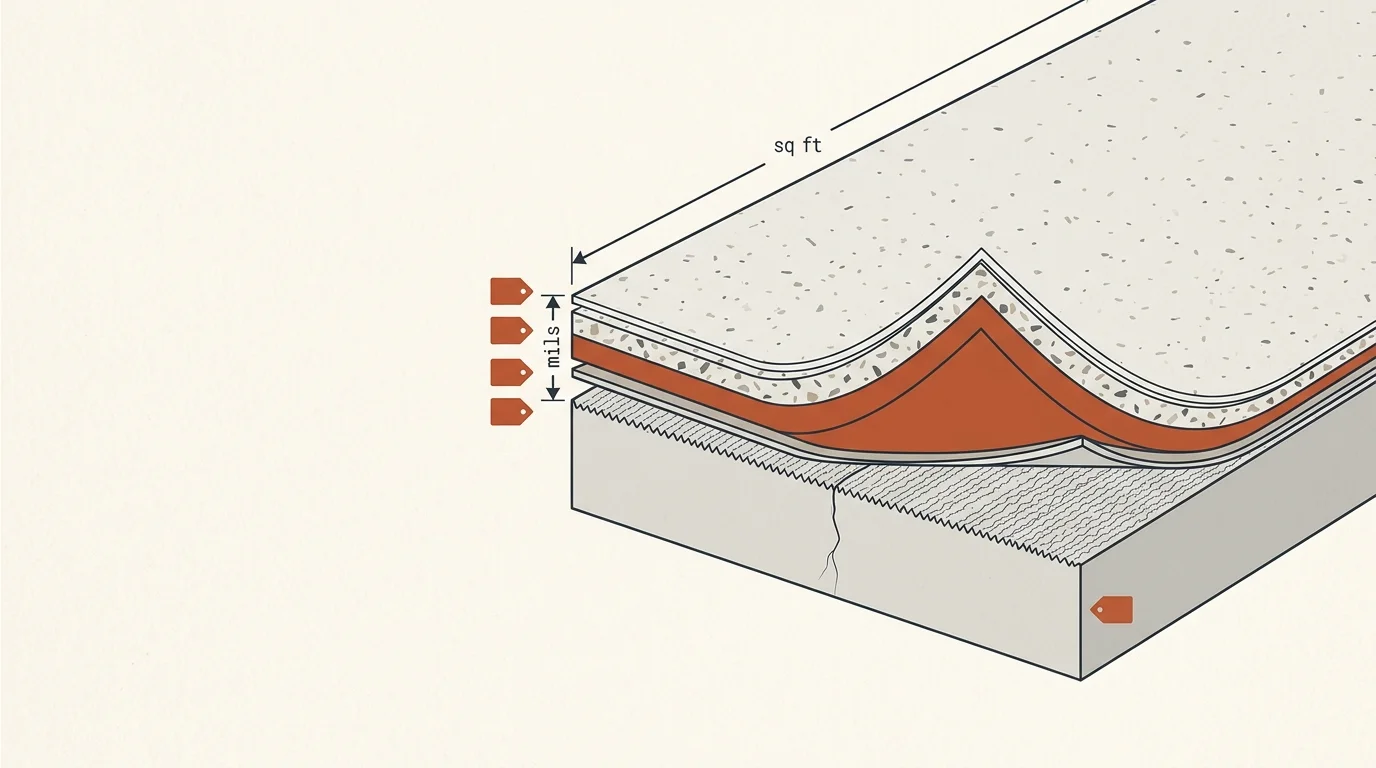
An epoxy flooring cost calculator does one job well: it turns a vague national average into a number that actually describes your floor. Most homeowners start this search because contractor quotes feel random. One bid says $3 per square foot, another says $9, and a third lands at $12. However, none of those numbers are wrong. They describe different coating systems applied with different preparation methods to slabs in different condition.
In other words, the range is a map — not noise. The calculator below helps you locate your project on that map. Enter your floor area, pick the system you are considering, and add the preparation items that typically get quoted separately. As a result, you will have a budget you can bring to a site visit with real questions instead of guesswork.
Pricing sources and methodology
HomeGuide reports epoxy flooring at $4–$10 per square foot installed. This is the default range. Angi gives a broader $2–$12 installed range. These are national guides, not live local bids.
Installation = area × installed rate × local adjustment, subject to your entered minimum job charge. Add separately quoted exclusions, then your contingency percentage. Labor is already in the installed rate; it is not added twice. The midpoint is arithmetic, not a prediction.
Does a flake or metallic finish change the cost?
It can. The selected finish records what you want but does not apply an unsupported automatic surcharge. Enter an all-in custom rate or a separately quoted upgrade, not both for the same work.
Is polyaspartic the same as epoxy?
No. Ask which products form the primer, base coat, and topcoat. A mixed system needs its own comparable quote; this preset should not be treated as pricing for every concrete coating.
What should I ask before accepting a quote?
Request written scope for substrate preparation, crack and joint treatment, moisture testing, specified coating thickness, decorative coverage, topcoats, slip resistance, warranty exclusions, and return-to-service times. Use the manufacturer’s instructions for the actual system; this tool does not set cure times.
Epoxy flooring cost per square foot in 2026
Published figures vary because each source prices a different specification. Consequently, comparing them without knowing the basis creates confusion. Here is how the major guides break down:
| Source | Installed cost | What it covers |
|---|---|---|
| Angi | $2 – $12 per sq ft | All professional systems |
| HomeGuide | $4 – $10 per sq ft | Typical professional epoxy |
| Homewyse | $7.78 – $12.71 per sq ft | Higher-spec garage floors |
| National average project | ~$2,400 | Average garage coating |
The mid-range professional install sits around $7 per square foot in 2026. Meanwhile, the full project range spans $1,200 to $8,600 once slab condition enters the picture.
Epoxy flooring cost by garage size
Running the $4 to $10 installed range against common floor sizes gives a useful starting point. Additionally, these figures assume existing concrete in reasonable condition.
| Space | Area | Installed range |
|---|---|---|
| Single-car garage | 250 sq ft | $1,000 – $2,500 |
| Two-car garage | 400 – 500 sq ft | $1,600 – $5,800 |
| Two-car with flake finish | 500 sq ft | $3,000 – $4,500 |
| Three-car garage | 700 – 850 sq ft | $3,000 – $6,750 |
| Basement floor | Varies | $1,200 – $20,000 |
These are installation figures only. They do not include concrete repair, moisture mitigation, or decorative upgrades. That is exactly why the calculator keeps those on separate lines.
Epoxy flooring cost by system type
The system you choose is the single biggest cost driver. Furthermore, each system has a different lifespan, which changes the true long-term cost dramatically.
| System | Installed cost | Lifespan |
|---|---|---|
| DIY kit (materials only) | $0.50 – $2.66 per sq ft | 3 – 5 years |
| Solid color 100% solids | $3 – $7 per sq ft | 10+ years |
| Decorative flake | $6 – $9 per sq ft | 10 – 20 years |
| Polyaspartic / polyurea | $5 – $12 per sq ft | 15 – 20 years |
| Metallic epoxy | $8 – $15 per sq ft | 10 – 20 years |
A $3 quote and a $9 quote on the same garage usually describe different jobs. One is likely a thin coat over an acid-etched slab. The other is a diamond-ground, primed, full-broadcast flake system with a polyaspartic topcoat. Both are real products. Only one is still bonded in ten years.
Where does the money go in an epoxy flooring project?
Labor accounts for 33% to 60% of a professional installation. That translates to roughly $1 to $7 per square foot, or $50 to $150 per hour for a typical two-person crew. Materials add another $1 to $5 per square foot.
Resin quality varies enormously within that range. Water-based epoxy runs $30 to $50 per gallon. Solvent-based sits around $45. Meanwhile, 100% solids epoxy costs $45 to $150 per gallon. Nobody saves money on resin, though. They save it by spending less time on the floor — and that almost always means skipping the grinding.
Surface preparation determines epoxy flooring cost and lifespan
If you take one thing from this page, take this: preparation predicts lifespan more reliably than brand does.
Professional installers grind the slab with diamond tooling. This mechanically opens the concrete’s pores and creates a profile the coating keys into. As a result, professional installations last several times longer than DIY kits.
In contrast, acid etching is chemical roughening. It works on clean, porous, bare concrete. However, it fails on anything sealed, oily, or previously coated — which describes most existing garage floors. A coating over an etched but unprofiled slab can look flawless for months. Then it peels in sheets when a hot tire grabs it.
Therefore, when comparing bids, ask one question first: grinding or etching? The answer sorts the quotes faster than the price does.
Slab condition and epoxy flooring cost
Coatings follow the contour of the concrete underneath. They do not level, fill, or fix it. Three slab problems change the scope of your project significantly.
Cracks and spalling. Hairline cracks are routine prep. However, wide or actively moving cracks are a structural question first. A coating over them will telegraph and re-crack. If cracking pairs with sticking doors or sloping floors, price the underlying issue with our foundation repair cost calculator before spending on a finish.
Moisture. Slabs without a vapor barrier push water vapor up through the concrete. This is common in older homes and below-grade basements. That pressure delaminates coatings from below. A moisture test is inexpensive. A moisture-mitigating primer system is not. Skipping the test, however, is the most expensive shortcut available — because a failed coating must be ground off entirely before anything can be reapplied.
Slabs past saving. Occasionally the concrete is too deteriorated to coat. In that case, replacement makes more sense. Our concrete slab cost calculator gives you the pour cost to weigh against a coating that would only buy time.
Epoxy flooring cost by decorative finish
The finish you choose affects both the look and the price. Here is how each option compares:
- Solid color: $3 – $7 per square foot installed. One pigmented coat plus a clear topcoat. Durable and affordable, but shows dust and imperfections more than textured finishes.
- Decorative flake: $6 – $9 per square foot. The most popular residential garage choice. Vinyl chips broadcast into the wet base coat, then sealed. Full broadcast hides slab imperfections far better than a light scatter.
- Quartz broadcast: Heavier and naturally slip-resistant. Common in commercial kitchens and locker rooms. Priced above flake.
- Metallic: $8 – $15 per square foot. Pigments manipulated before cure create a marbled three-dimensional effect. Results vary by installer more than by product.
Epoxy versus polyaspartic and polyurea coatings
Many “one-day garage floor” systems are not epoxy at all. Instead, they use a polyurea base with a polyaspartic topcoat. These cure faster and resist UV yellowing better. However, they cost $5 to $12 per square foot against epoxy’s $3 to $7.
This distinction matters when comparing quotes. A polyaspartic bid will always look expensive next to an epoxy bid. Consequently, a homeowner comparing on price alone may pick the wrong system for the wrong reason.
Therefore, ask each contractor which specific products form the primer, the base coat, and the topcoat. A quote that just says “epoxy floor” cannot be compared to anything.
DIY epoxy flooring cost versus professional installation
The material gap is large. DIY kits run $0.50 to $2.66 per square foot. Professional installation runs $5 to $15 installed. For a two-car garage, that is often $600 versus $3,000.
However, the honest accounting has three parts. First, most retail kits are thinner systems lasting three to five years. Professional systems last ten to twenty. Second, the preparation gap explains most failures. Renting a diamond grinder closes much of it. Skipping that step produces the peeling floors in every cautionary photo. Third, removing a failed coating costs more than the original application.
As a result, DIY makes sense on a clean, newer, bare slab in a dry garage where you rent the grinder. It makes much less sense on a basement, a previously coated floor, or anywhere with unresolved moisture.
What epoxy flooring quotes usually exclude
Most quotes cover the coating itself. However, several common items fall outside the per-square-foot rate:
- Old coating removal: grinding beyond the planned profiling.
- Crack and spall repair beyond a nominal allowance.
- Moisture testing and mitigation.
- Self-leveling or resurfacing for uneven slabs.
- Steps, coving, and vertical edges: hand work priced per linear foot.
- Oil and grease decontamination: old stains wick back up through fresh coating.
- Power washing: $0.35 – $0.77 per square foot where required.
- Emptying the space: budget a truck rental or storage unit if needed.
This same approach — separating the predictable rate from unpredictable prep work — applies to most home surface projects. For instance, our interior painting cost calculator handles primer, patching, and trim the same way rather than burying them in a per-square-foot rate.
How to compare epoxy flooring quotes
Ask every bidder for the same written scope. Then compare line by line:
- Preparation method — diamond grinding, shot blasting, or acid etch.
- Specific products for primer, base coat, and topcoat by name.
- Total system thickness in mils.
- Crack and joint treatment with a stated allowance.
- Whether moisture testing is performed and what happens if it fails.
- Decorative coverage — partial or full broadcast and media quantity.
- Number of clear topcoats and whether the topcoat is UV-stable.
- Slip resistance additives if desired.
- Warranty terms and exclusions.
- Return-to-service times for foot and vehicle traffic.
Items 1, 3, and 7 explain most of the price gap between two bids. Once you can see those differences, the cheaper bid either becomes obviously competitive or obviously incomplete.
Frequently asked questions about epoxy flooring cost
How much does it cost to epoxy a two-car garage?
A two-car garage typically costs $1,600 to $5,800 installed. Decorative flake on a 500 square foot floor runs $3,000 to $4,500. Solid color drops to $1,500 to $3,500. Slab condition moves that total more than square footage does.
Why is my epoxy flooring quote higher than the average?
Usually one of five things: an existing coating that must be removed, significant crack repair, moisture mitigation, a premium finish like metallic, or a polyaspartic system rather than epoxy. Any single factor can push a project up an entire tier.
Is epoxy flooring worth the cost?
For a garage you plan to keep, a professionally prepared system generally outlasts several rounds of cheaper coatings. As a result, the twenty-year cost often favors professional installation. The reliable benefits are cleanability, appearance, and durability.
How long does an epoxy floor last?
Three to five years for a thin DIY kit over an etched slab. Ten to twenty years for a ground, primed, multi-coat professional system. Preparation and thickness predict lifespan far better than brand.
Can I put epoxy on a basement floor?
Yes, but moisture testing is not optional below grade. Basement projects span $1,200 to $20,000. The range depends on size and how much mitigation the slab requires.
Bottom line on epoxy flooring cost
The $2 to $12 range is not noise — it is a map of different products. Decide which system you want. Confirm the preparation method. Test for moisture before anyone quotes a finish. Those three steps collapse the spread into a number you can plan around. Run your figures above, export the summary, and use it as a list of questions at your first site visit.
This article provides planning estimates based on published national cost guides, not a bid. Confirm coating system, preparation scope, moisture requirements, thickness, and included topcoats with a licensed installer before committing to a project.