
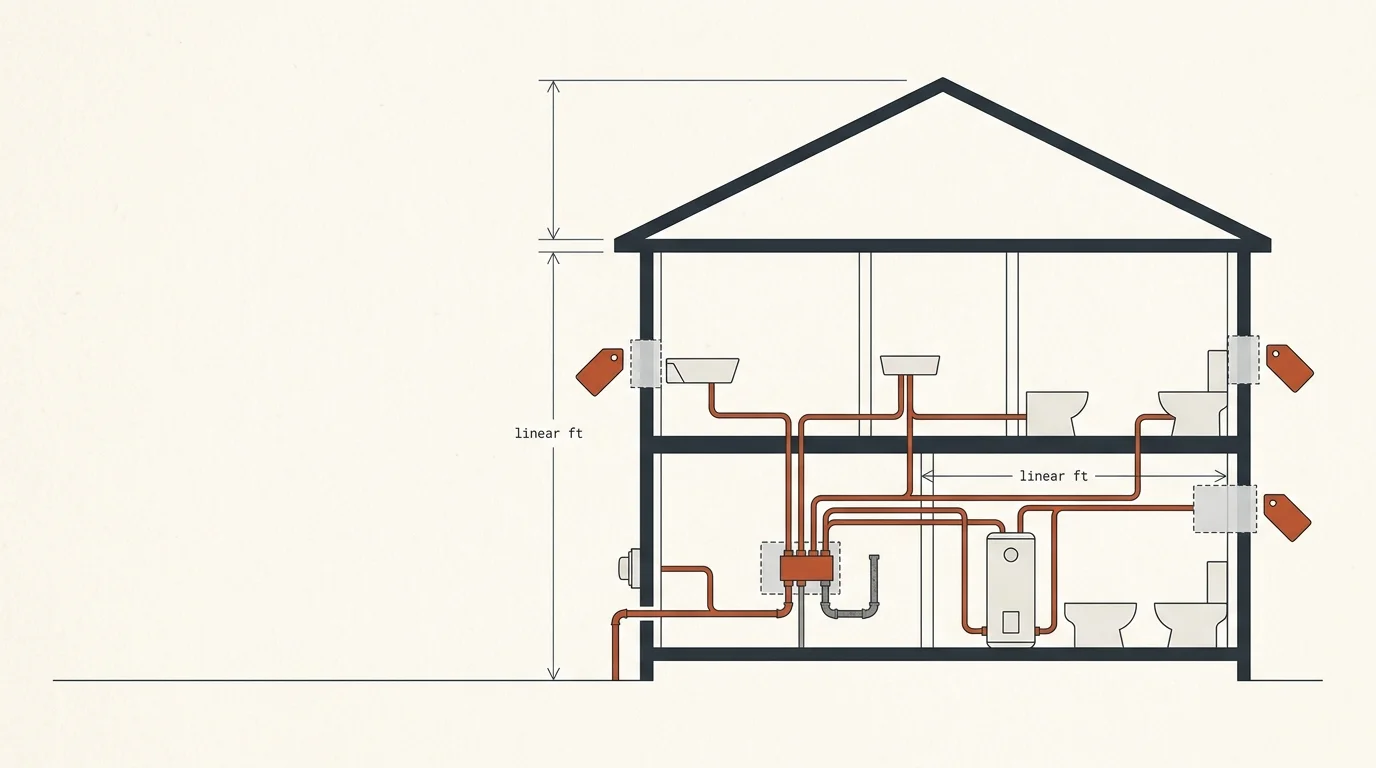
A house repiping cost calculator gives you a realistic budget for one of the most disruptive — but most necessary — plumbing upgrades a homeowner can face. Repiping replaces all or most of the water supply lines in your home, and the cost depends on home size, number of fixtures, pipe material, accessibility, and how much drywall and flooring must be opened and repaired afterward. Our house repiping cost calculator accounts for your home’s square footage, stories, fixture count, and pipe material to produce an estimate that reflects your actual project.
Enter your home details below for a personalised number. Then read the full guide for 2026 per-fixture and per-linear-foot pricing, pipe material comparisons, the signs that indicate repiping is overdue, and what to expect during the process.
Calculation method and important limitations
The calculator estimates domestic water-supply repiping from home area and material, then adjusts for bathrooms, stories, fixture layout, access and local labor costs. It separately adds existing-pipe removal, wall restoration, permits, service-line or drain work, water-heater connections, valves and optional equipment. The contingency reserve is applied after the selected scope.
Angi’s 2026 guide gives a broad professional repiping range of about $1,250–$22,000 and estimates labor at roughly 70% of total cost. HomeGuide reports about $2,000–$15,000 for new or replacement house piping and roughly $8,000–$16,000 for a copper repipe, with drywall repair often adding $300–$1,500 or more. Repipe Solutions estimates roughly $4,500–$8,500 for PEX and $9,000–$12,000 or more for copper in a typical 1,500-square-foot home. These are planning benchmarks, not bids.
“Whole-house repipe” often means water-supply piping only; sewer, drain and vent piping is a separate scope unless explicitly included. Actual pricing depends on fixture count, pipe sizing, water chemistry, foundation, access, asbestos or lead hazards, fire-stopping, local code, inspection requirements and finish restoration. Hire a licensed and insured plumber, confirm approved materials locally, and obtain itemized bids.
How a House Repiping Cost Calculator Works
Every house repiping cost calculator starts with two primary inputs: your home’s size and the number of water-using fixtures (sinks, toilets, showers, tubs, hose bibs, water heater, dishwasher, washing machine). Then, it applies a per-fixture or per-linear-foot rate based on your chosen pipe material. Finally, it adds access costs — opening and patching walls, ceilings, and floors — to produce a complete estimate.
As a result, the output covers plumbing labour, pipe material, fittings, and restoration work. However, the actual scope often expands once walls are opened and plumbers discover additional deterioration, improper connections, or code violations that must be addressed simultaneously.
Average House Repiping Cost in 2026
A whole-house repipe costs $4,000 to $15,000 for most single-family homes, with the national average sitting near $6,500 to $10,000. Specifically, here is how costs break down by home size.
- 1-bathroom home (under 1,000 sq ft): $3,500 – $6,000.
- 2-bathroom home (1,000–1,800 sq ft): $5,000 – $9,000.
- 3-bathroom home (1,800–2,500 sq ft): $7,000 – $12,000.
- 4+ bathroom home (2,500+ sq ft): $10,000 – $18,000+.
Furthermore, two-story homes cost 20% to 40% more than single-story homes of the same size because vertical pipe runs require access through upper-floor walls and ceilings. Additionally, slab-on-grade homes where pipes run under the concrete floor add significant cost if those lines must be rerouted overhead.
House Repiping Cost Calculator: Price by Pipe Material
The pipe material you choose determines both the per-foot material cost and the labour time, since different materials join differently.
PEX (Cross-Linked Polyethylene)
PEX is the dominant residential repiping material in 2026. It costs $0.40 to $1.00 per linear foot for material and $4 to $8 per linear foot installed. PEX is flexible, resists corrosion, tolerates freezing better than rigid pipe, and installs faster because it bends around obstacles without fittings. Consequently, PEX repiping typically costs 30% to 40% less than copper for the same home.
Furthermore, PEX uses a manifold distribution system that runs individual lines to each fixture from a central point. This design allows shutoff of individual fixtures without affecting the rest of the house — a significant advantage over traditional trunk-and-branch layouts.
Copper
Copper costs $2 to $5 per linear foot for material and $8 to $15 per linear foot installed. It remains the gold standard for durability (50 to 70+ year lifespan) and has a proven track record spanning decades. However, copper requires soldered joints, which takes more labour time and skill than PEX connections. As a result, copper repiping costs roughly double what PEX costs for the same project.
Specifically, copper is preferred in regions with aggressive water chemistry that may degrade PEX over time, and in high-end homes where longevity justifies the premium. However, for most residential repiping, PEX offers superior value.
CPVC (Chlorinated Polyvinyl Chloride)
CPVC costs $0.50 to $1.50 per linear foot for material and $4 to $8 per linear foot installed. It uses solvent-welded joints and has been used in residential plumbing since the 1960s. However, CPVC becomes brittle with age and exposure to certain chemicals. Consequently, most plumbers now recommend PEX over CPVC for new repiping projects due to PEX’s superior flexibility and connection reliability.
House Repiping Cost Calculator: Access and Restoration
The most underestimated cost in any repiping project is the wall and ceiling access required to reach existing pipes and install new ones. Plumbers must open walls, ceilings, and sometimes floors to remove old pipes and route new ones.
Drywall repair:
$2 to $6 per square foot for patching, taping, mudding, and sanding. A typical repipe opens 15 to 40 access points, creating 100 to 300 square feet of drywall repair. Total: $200 to $1,800.
Painting:
After drywall repair, patched areas need primer and paint to match the existing walls. Budget $300 to $1,000 for touch-up painting across multiple rooms. Our interior painting cost calculator covers full-room repainting for homeowners who take the opportunity to repaint entirely.
Flooring repair:
If pipes run under flooring that must be removed for access, flooring replacement in those areas adds $3 to $10 per square foot. Specifically, tile floors are the most expensive to restore because of demolition and re-laying costs.
Consequently, access and restoration work adds $1,000 to $4,000 on top of the plumbing itself for a typical whole-house repipe. Some plumbers include basic drywall patching in their bid; others bill it separately or recommend a drywall contractor for the finish work.
Signs Your Home Needs Repiping
Several indicators signal that repiping has moved from a future consideration to an urgent need.
First, frequent leaks. If you are repairing pinhole leaks more than once a year, the pipe material is failing systemically — not just at one weak point. Patching individual leaks on deteriorating pipes is the plumbing equivalent of putting a bandage on a spreading rash. Therefore, multiple leaks in a short period strongly favour full repiping over continued repair.
Second, discoloured water. Rusty or brown water from hot and cold taps indicates interior pipe corrosion. Additionally, metallic taste and visible sediment are related symptoms. These indicate that the pipe walls are thinning and failure is approaching.
Third, low water pressure that has worsened over time. Mineral buildup and corrosion products narrow the pipe interior, reducing flow. If pressure has dropped noticeably over the past two to five years, the buildup is likely too extensive for chemical treatment. Consequently, repiping restores full flow permanently.
Fourth, pipe material history. Homes built between 1978 and 1995 with polybutylene (poly-B) pipes should repipe proactively — polybutylene is known to fail catastrophically due to chlorine degradation. Similarly, galvanised steel pipes in pre-1960 homes are almost certainly corroded internally. Our foundation repair cost calculator covers the related structural costs that sometimes coincide with plumbing failures in aging homes.
House Repiping Cost Calculator: What to Expect During the Process
Understanding the timeline and disruption helps you plan accordingly.
Day 1: The plumbing crew opens access points in walls and ceilings, removes or disconnects old pipes, and begins routing new pipe runs. Water is shut off for most of the day. Specifically, the crew typically restores water to at least one bathroom by end of day.
Day 2: Remaining pipe runs are completed, connections to fixtures are made, and the system is pressure-tested for leaks. Water is restored to all fixtures by end of day.
Day 3 (if needed): Final connections, water heater hookup, hose bibs, and final pressure test. Permit inspection occurs after completion.
Days 4–7: Drywall patching and painting. This phase can be handled by the plumbing company, a drywall subcontractor, or the homeowner.
Consequently, a typical whole-house repipe takes two to three days for plumbing plus two to four days for restoration. Furthermore, water is usually off for only 6 to 10 hours on the first day — the crew reconnects essential fixtures at day’s end. Our home inspection cost calculator covers the pre-purchase inspection that often reveals the repiping need.
House Repiping Cost Calculator: Partial vs. Full Repipe
Not every home needs a complete repipe. Here is how to decide.
Partial repipe ($1,500–$5,000):
Replaces only the most deteriorated sections — typically the hot water lines, which corrode faster than cold lines. A partial repipe makes sense when damage is isolated and the remaining pipes are in acceptable condition.
Full repipe ($4,000–$15,000+):
Replaces all supply lines from the main shutoff to every fixture. A full repipe makes sense when the pipe material is failing systemically (polybutylene, galvanised steel) or when multiple sections show corrosion, leaks, or flow restriction.
Furthermore, a partial repipe costs less today but may lead to a second partial repipe in five to ten years as the remaining old sections deteriorate. As a result, a full repipe is almost always more cost-effective over a 20-year horizon than two partial jobs.
How to Get the Best Price on Repiping
Several strategies reduce costs and ensure quality.
First, get three itemised bids. Each bid should specify pipe material, linear footage, fixture count, access plan, and whether drywall repair is included. Comparing vague “repipe” bids is meaningless — line-item comparison reveals where contractors differ.
Second, choose PEX unless you have a specific reason for copper. PEX delivers equivalent reliability at 30% to 40% lower installed cost. Consequently, PEX is the value choice for the vast majority of residential repiping projects.
Third, handle drywall repair and painting yourself. Plumbers charge a premium for finish work because it is outside their core trade. Patching drywall and painting are DIY-accessible tasks that save $500 to $2,000. However, ensure the plumber leaves access points clearly marked and structurally supported.
Fourth, coordinate with other renovations. If you are already remodelling a bathroom or kitchen, repiping during that project eliminates redundant wall opening and closing. Our home addition cost calculator covers how plumbing costs integrate into larger renovation budgets.
Frequently Asked Questions
How much does it cost to repipe a 2-bathroom house?
Repiping a 2-bathroom house costs $5,000 to $9,000 in PEX and $8,000 to $14,000 in copper, including plumbing labour, materials, and basic drywall patching. Specifically, two-story homes fall at the higher end due to the vertical pipe access required.
How long does a whole-house repipe take?
The plumbing work takes two to three days. Drywall patching and painting add two to four days. Consequently, the total project from start to move-in-ready condition takes one to two weeks. Water is typically restored to essential fixtures by the end of the first day.
Does repiping increase home value?
Yes. New plumbing eliminates a major inspection concern and buyer objection. Furthermore, homes with polybutylene or galvanised pipes often struggle to sell or require price reductions. Repiping before listing removes that obstacle and can increase the sale price by more than the repiping cost.
Can I stay in my home during repiping?
Yes. Water is off during working hours on the first day but typically restored to at least one bathroom each evening. However, expect noise, dust from wall openings, and limited access to plumbing fixtures during the project. Consequently, some homeowners with young children or health concerns prefer to stay elsewhere for the two to three plumbing days.
The Bottom Line on House Repiping Costs
Repiping is a high-disruption, high-value investment that resolves leaks, restores water pressure, eliminates contamination risks, and adds decades of reliable service. Use our house repiping cost calculator at the top of this page to estimate your specific project, then bring that number to plumber conversations knowing exactly what drives the price.
All figures in this guide are 2026 planning estimates. Your actual cost will vary with home size, pipe material, access difficulty, and regional labour rates. Always obtain at least three itemised quotes before committing.