
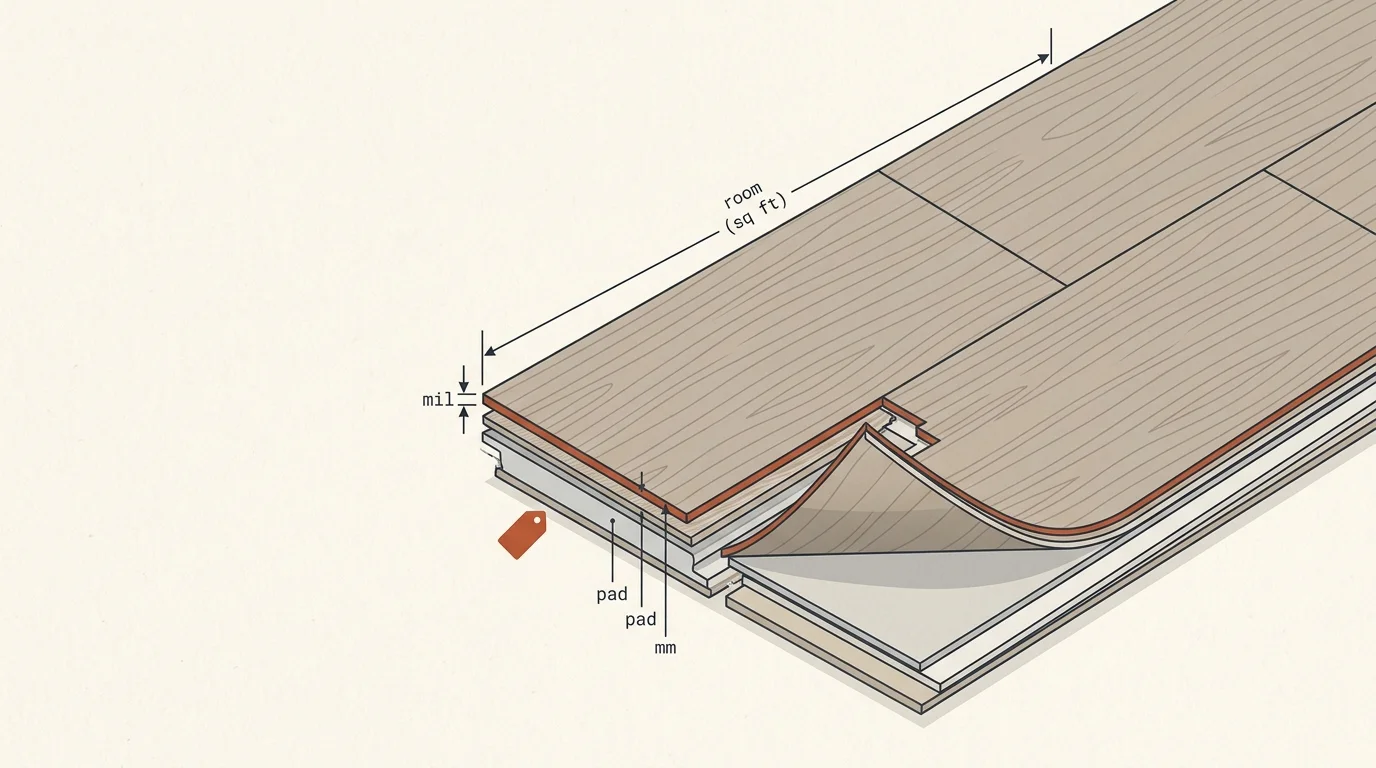
A luxury vinyl plank flooring cost calculator helps you budget one of the most popular flooring choices in residential remodelling today. LVP has become a popular alternative to hardwood, laminate, and tile for kitchens, bathrooms, basements, and living areas because it is waterproof, durable, and available in realistic wood-look designs. To provide a more accurate estimate, our luxury vinyl plank flooring cost calculator considers your room dimensions, plank quality, underlayment requirements, and installation method.
Enter your floor area below for a personalised number. Then read the full guide for 2026 per-square-foot pricing by quality grade, installation options, subfloor preparation costs, and the comparison data that helps you decide whether LVP is the right choice for your space.
Calculation method, sources and limitations
The calculator multiplies the measured floor area by the selected waste allowance to determine material quantity. Product, labor, subfloor work, removal, underlayment, furniture moving, trim, stairs, delivery and contingency are calculated separately. Labor is adjusted for room complexity and local market conditions. The planning range is approximately 15% below to 20% above the modeled total.
The Home Depot reports typical vinyl installation totals around $5–$9 per square foot, including common material and labor allowances. Forbes Home describes a broader professional installed range of about $2.50–$13 per square foot. MSI notes professional installation labor can commonly run about $1–$5 per square foot. These are U.S. planning benchmarks, not contractor bids.
Actual quotes depend on field measurements, product availability, plank and wear-layer specifications, substrate flatness and moisture, floor height transitions, adhesives, stairs, occupied-room logistics, minimum job charges, local disposal fees and concealed damage. Verify whether a quote includes materials, sales tax, delivery, acclimation, transitions, baseboards, appliance/toilet handling and a written installation warranty.
How a Luxury Vinyl Plank Flooring Cost Calculator Works
Every luxury vinyl plank flooring cost calculator starts with your total floor area in square feet. Then, it adds 10% for waste and cuts. Next, it applies the per-square-foot rate for your chosen plank quality tier. Finally, it adds underlayment, subfloor preparation, transition strips, and installation labour to produce a complete installed estimate.
As a result, the output covers materials, prep, and labour — not just the box price. However, subfloor condition is the wild card in every flooring project. A level, clean subfloor adds nothing; a subfloor that needs grinding, levelling compound, or moisture mitigation can add $1 to $4 per square foot to the total.
Average Luxury Vinyl Plank Flooring Cost in 2026
LVP flooring costs $3 to $10 per square foot installed, with most residential projects landing between $5 and $8 per square foot. For a typical 500-square-foot living room, total installed cost ranges from $1,500 to $5,000. Specifically, here is how costs break down by quality tier.
- Entry-level LVP ($2–$4 per sq ft material): $3 – $6 per sq ft installed. Thin wear layer (6–12 mil), basic designs, suitable for low-traffic areas and rentals.
- Mid-range LVP ($4–$6 per sq ft material): $5 – $8 per sq ft installed. Thicker wear layer (20 mil), realistic embossed textures, attached underlayment. The sweet spot for most residential projects.
- Premium LVP ($6–$10+ per sq ft material): $7 – $12 per sq ft installed. 28+ mil wear layer, rigid SPC core, deep embossed textures, wide planks, and premium warranties.
Furthermore, material prices have stabilised in 2026 after the supply chain disruptions of prior years. Consequently, LVP delivers the best value-per-dollar in the residential flooring market — comparable appearance to hardwood at 30% to 50% of the installed cost.
Luxury Vinyl Plank Flooring Cost Calculator: Material Breakdown
Understanding LVP construction helps you use the cost calculator effectively and choose the right product for your application.
Wear Layer Thickness
The wear layer is the transparent top coating that protects against scratches, scuffs, and stains. It is the single most important specification for durability.
- 6–12 mil: Light residential use. Bedrooms, guest rooms, closets. Expected lifespan: 5–10 years.
- 20 mil: Standard residential use. Living rooms, kitchens, hallways. Expected lifespan: 15–20 years.
- 28+ mil: Heavy residential and light commercial use. Entryways, kitchens with heavy traffic, pet households. Expected lifespan: 20–25+ years.
Consequently, skipping from 12 mil to 20 mil wear layer — typically a $1 to $2 per square foot upgrade — doubles the expected lifespan. This is the single best value upgrade in LVP purchasing.
Core Type
Modern LVP comes in two core types that affect both performance and cost.
WPC (Wood Plastic Composite) core: A foamed core that provides softer feel underfoot and better sound absorption. WPC planks are typically thicker (5 to 8 mm) and more comfortable to stand on. However, the softer core is slightly more susceptible to denting from heavy furniture. WPC runs $0.50 to $1.00 more per square foot than SPC at comparable quality levels.
SPC (Stone Plastic Composite) core: A dense, rigid core that resists denting and temperature expansion. SPC planks handle temperature swings better, making them ideal for sunrooms, enclosed porches, and rooms with large windows. Furthermore, SPC’s rigidity allows installation over minor subfloor imperfections that would telegraph through WPC. SPC has become the dominant core type in 2026 for its all-around versatility.
Luxury Vinyl Plank Flooring Cost Calculator: Installation Options
Installation method affects both cost and long-term flexibility.
Floating Installation (Click-Lock)
Floating installation uses interlocking click-lock planks that snap together without adhesive or fasteners. The floor “floats” on an underlayment layer over the subfloor. Installation costs $1.50 to $3.50 per square foot for labour and is the fastest, most common, and most DIY-friendly method. Furthermore, floating floors can be removed and reinstalled if needed — a significant advantage for renters and homeowners who may change flooring later.
Glue-Down Installation
Glue-down installation adheres each plank directly to the subfloor with pressure-sensitive adhesive. It costs $2.50 to $4.50 per square foot for labour and produces a more solid, stable feel underfoot. Glue-down is preferred for large open areas, commercial applications, and areas with heavy rolling traffic (wheelchairs, office chairs). However, removal is destructive — the planks cannot be reused.
Loose-Lay Installation
Loose-lay planks use friction grip and their own weight to stay in place without click-locks or adhesive. Installation costs $1.00 to $2.50 per square foot for labour. This method works for temporary installations and areas where future access to the subfloor is needed. However, loose-lay products are less common and tend to cost more per square foot for material.
Subfloor Preparation Costs
Subfloor condition directly affects both installation quality and long-term performance. The luxury vinyl plank flooring cost calculator assumes a standard subfloor; here is what to add for common prep scenarios.
Levelling compound: $1 to $3 per square foot. Applied to smooth high and low spots in concrete or plywood subfloors. Most LVP manufacturers require subfloor flatness within 3/16 inch over 10 feet.
Moisture barrier: $0.25 to $0.75 per square foot. Required over concrete subfloors to prevent moisture migration. Many LVP products with attached underlayment include a moisture barrier, but separate installation is needed for products without it.
Old flooring removal: $1 to $3 per square foot. Removing existing carpet, tile, or hardwood before LVP installation. Specifically, LVP can install directly over existing hard flooring (vinyl, tile, hardwood) if the surface is flat and in good condition — saving the removal cost entirely.
Plywood overlay: $2 to $4 per square foot. If the existing subfloor is badly damaged, warped, or uneven beyond what levelling compound can address, a new layer of ¼-inch plywood provides a fresh substrate. Our interior painting cost calculator covers the wall-finishing work that pairs with flooring upgrades for complete room renovations.
LVP vs. Other Flooring: Cost Comparison
Understanding how LVP compares to alternatives helps you evaluate whether it delivers the best value for your project.
- Sheet vinyl: $2 – $5 per sq ft installed. Cheapest waterproof option but less realistic appearance and harder to repair.
- Laminate: $3 – $8 per sq ft installed. Similar look to LVP but NOT waterproof. Swells and fails when exposed to moisture.
- Luxury vinyl plank: $3 – $10 per sq ft installed. Waterproof, durable, realistic designs, easy installation.
- Engineered hardwood: $6 – $14 per sq ft installed. Real wood veneer, not waterproof, requires more maintenance.
- Solid hardwood: $8 – $18 per sq ft installed. Premium appearance, not waterproof, can be refinished multiple times.
- Porcelain tile: $6 – $15 per sq ft installed. Fully waterproof but cold, hard, and expensive to install.
Consequently, LVP delivers the best combination of water resistance, durability, appearance, and affordability in the market. For basements and bathrooms where moisture is a concern, LVP is the clear winner over laminate and hardwood. Our home addition cost calculator covers flooring as a component of addition and renovation budgets.
How to Get the Best Price on LVP Flooring
Several strategies reduce costs without sacrificing quality.
First, buy material in bulk. Flooring retailers offer 5% to 15% discounts on orders over 500 square feet. Furthermore, buying all rooms at once ensures consistent colour and lot matching.
Second, install it yourself. Click-lock LVP is the most DIY-friendly flooring available. A homeowner with basic tools can install 200 to 300 square feet per day, saving $1.50 to $3.50 per square foot in labour. Consequently, a 1,000-square-foot DIY installation saves $1,500 to $3,500.
Third, skip unnecessary underlayment. Many mid-range and premium LVP products include an attached underlayment pad. Adding a separate underlayment is unnecessary and can void the warranty. Therefore, check the product specifications before purchasing separate underlayment.
Fourth, shop sales and closeouts. Flooring retailers regularly discontinue colours and rotate inventory. Closeout pricing runs 20% to 40% below retail on first-quality product. However, buy enough for the entire project plus waste — discontinued colours cannot be reordered. Our home inspection cost calculator covers the property evaluation that identifies flooring replacement needs during home purchases.
Frequently Asked Questions
How much does luxury vinyl plank flooring cost per square foot?
LVP costs $3 to $10 per square foot installed in 2026. Specifically, entry-level products run $3 to $6, mid-range $5 to $8, and premium $7 to $12 per square foot including material and labour.
How long does luxury vinyl plank flooring last?
LVP lasts 10 to 25 years depending on wear layer thickness and traffic. Entry-level (6–12 mil) lasts 5 to 10 years. Mid-range (20 mil) lasts 15 to 20 years. Premium (28+ mil) lasts 20 to 25+ years. Water resistance is permanent regardless of wear layer.
Can LVP be installed in bathrooms and kitchens?
Yes. LVP is 100% waterproof and is one of the best flooring choices for bathrooms, kitchens, laundry rooms, and basements. The click-lock seams resist water penetration from surface spills. However, standing water should still be wiped up promptly as it can migrate through seams in extreme cases.
Is LVP better than laminate?
For moisture-prone areas, yes. LVP is waterproof while laminate is not — laminate swells and fails when exposed to standing water. Furthermore, LVP is quieter underfoot, more dent-resistant, and available in wider format planks. Laminate’s only advantage is slightly better scratch resistance in some products.
The Bottom Line on LVP Flooring Costs
Luxury vinyl plank delivers waterproof durability and realistic wood aesthetics at a fraction of hardwood pricing. Use our luxury vinyl plank flooring cost calculator at the top of this page to estimate your specific project, then bring that number to showroom conversations knowing what a fair price looks like.
All figures in this guide are 2026 planning estimates. Your actual cost will vary with product quality, subfloor condition, and regional labour rates. Always order 10% extra for waste and keep a few planks for future repairs.