
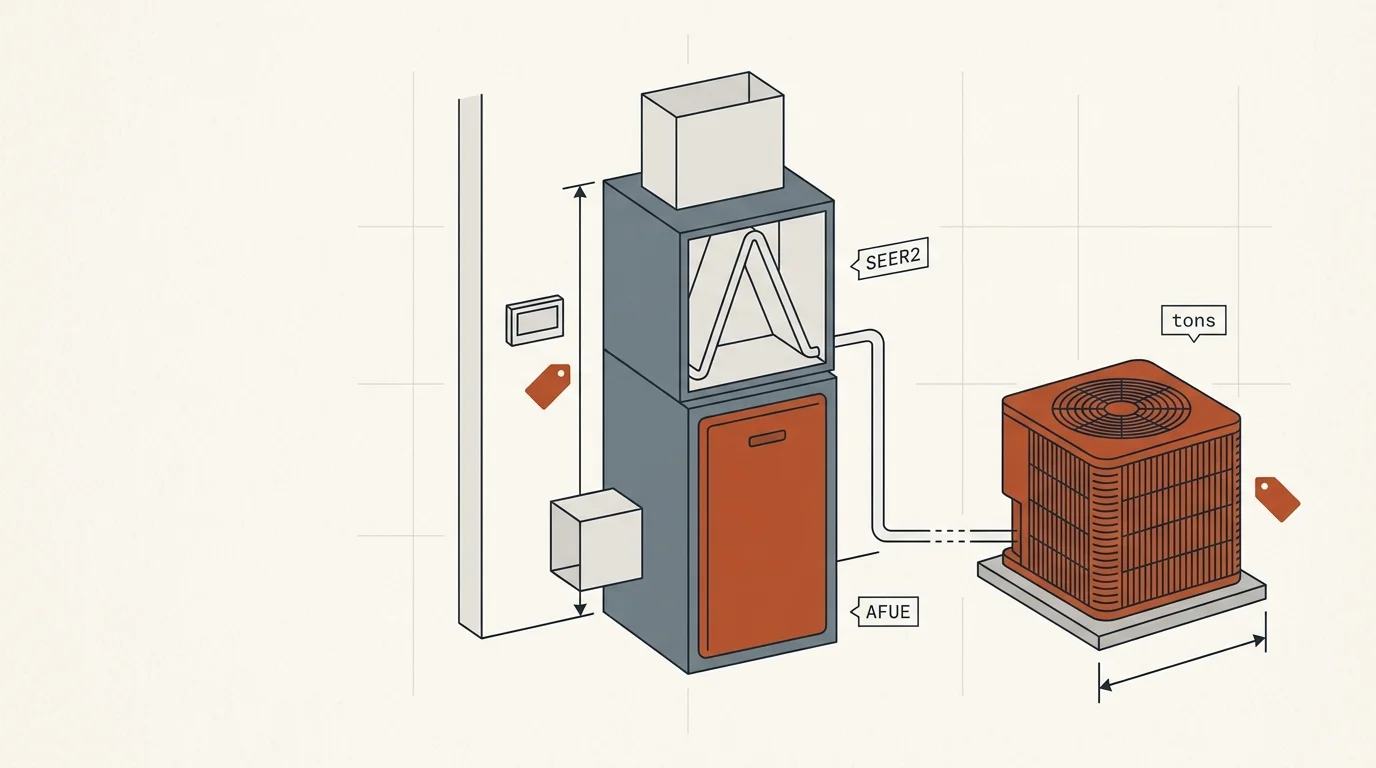
An HVAC replacement cost estimator helps you budget the single most expensive mechanical upgrade in your home — swapping an aging heating and cooling system for modern, efficient equipment.Whether your furnace is dying, your AC compressor has failed, or you are proactively upgrading to cut energy bills, the total cost swings from $5,000 to $20,000+ based on system type, efficiency tier, and installation complexity. Our HVAC replacement cost estimator accounts for your home size, equipment preferences, ductwork condition, and regional labour rates, giving you a number that reflects your real-world project.
Enter your details below for a personalised estimate. Next, read the full guide for 2026 pricing by system type, tonnage, efficiency ratings, and the hidden line items that can push HVAC projects past the initial quote.
Calculation method and important limitations
The estimator anchors each HVAC configuration to a national planning cost, then adjusts for nominal capacity, cooling and heating efficiency, staging, brand/warranty tier, local labor, and access. It separately adds ductwork, zoning, electrical work, fuel conversion, indoor-air accessories, controls, removal, permits, startup, and commissioning. The equipment and labor split is a planning allocation rather than a contractor markup disclosure.
Bryant’s 2026 guide gives a broad national complete-system replacement range of about $5,000–$28,000. Trane’s 2026 guide lists approximate replacement ranges of $6,568–$13,669 for central AC, $5,093–$8,390 for furnaces, and $7,369–$15,608 for heat pumps. Fuse Service reports typical installed ranges around $8,500–$14,000 for AC plus gas furnace, $9,500–$17,000 for ducted heat pumps, and $12,000–$19,000 for dual fuel. These are planning benchmarks, not bids.
Actual cost depends on load, climate, equipment match, refrigerant, duct design, electrical capacity, fuel conversion, local codes, incentives, access, warranty and contractor scope. Require an ACCA Manual J load calculation and appropriate Manual S equipment selection; verify matched equipment and rated performance with an AHRI certificate. Do not select larger equipment solely from square footage or the old unit’s nameplate.
How an HVAC Replacement Cost Estimator Works
Every HVAC replacement cost estimator starts with your home’s heating and cooling load — driven by square footage, insulation, climate zone, and window areaIt applies the installed cost for your chosen system type and efficiency tier. It adds ductwork modifications, electrical upgrades, thermostat, and permits to produce a complete project total.
The output covers everything from the equipment pad to the final inspection. Understanding each cost component makes the estimator easier to use.
Average HVAC Replacement Cost in 2026
A full HVAC replacement, including both heating and cooling equipment, typically costs $7,000 to $18,000 for most residential projects.. Replacing only the AC or only the furnace costs $3,500 to $8,000 per unit. These figures vary by system configuration, as shown in the ranges below.
- Gas furnace + central AC (mid-efficiency): $6,500 – $12,000.
- Gas furnace + central AC (high-efficiency): $10,000 – $18,000.
- Air-source heat pump (standard): $5,500 – $11,000.
- Air-source heat pump (cold-climate inverter): $10,000 – $20,000.
- Dual-fuel hybrid (heat pump + gas furnace): $10,500 – $19,000.
- Ductless mini-split (whole-house multi-zone): $8,000 – $22,000.
Additionally, these ranges include standard installation on existing infrastructure. By comparison, first-time installations requiring new ductwork, gas lines, or electrical upgrades add $3,000 to $10,000 on top of these figures.
HVAC Replacement Cost Estimator: Price by Equipment Type
Understanding each system type helps you use the HVAC replacement cost estimator more effectively and evaluate contractor recommendations.
Gas Furnace and Central AC
This remains the most common residential HVAC configuration. A mid-efficiency furnace (80% AFUE) paired with a 15–16 SEER2 AC is the budget option at $6,500 to $12,000 installed. Stepping up to a condensing furnace (96%+ AFUE) with a variable-speed 18+ SEER2 AC pushes the range to $10,000 to $18,000. Consequently, the premium buys lower utility bills, quieter operation, and better humidity control that justify the investment in cold climates.
Air-Source Heat Pump
Heat pumps handle both heating and cooling in one outdoor unit, eliminating the separate furnace. Standard single-stage models cost $5,500 to $11,000 installed. By comparison, cold-climate inverter models rated below 0°F run $10,000 to $20,000. Additionally, federal tax credits offset up to $2,000 per year on qualifying installations, substantially reducing the effective cost. Our blown-in insulation calculator helps homeowners reduce their heating and cooling load before sizing heat pump equipment.
Dual-Fuel Hybrid System
A dual-fuel system pairs an electric heat pump with a gas furnace, switching automatically based on outdoor temperature.The system captures the heat pump’s efficiency in moderate weather and falls back to gas during extreme cold. Installed cost runs $10,500 to $19,000 — the highest upfront but often the lowest operating cost in climates with cold winters and moderate electricity rates.
HVAC Replacement Cost Estimator: Sizing by Tonnage
Correct sizing determines both upfront cost and long-term performance. Here are typical installed costs by tonnage for a mid-efficiency gas furnace and central AC combination.
- 2 ton (24,000 BTU): $5,500 – $8,500. Homes under 1,300 sq ft.
- 2.5 ton (30,000 BTU): $6,000 – $9,500. 1,300–1,700 sq ft.
- 3 ton (36,000 BTU): $7,000 – $11,500. 1,700–2,100 sq ft. The most common size.
- 4 ton (48,000 BTU): $8,500 – $14,000. 2,100–2,700 sq ft.
- 5 ton (60,000 BTU): $10,000 – $17,000. 2,700–3,500 sq ft.
Notably, a proper Manual J load calculation — not a rule-of-thumb estimate — is the only reliable way to determine the correct size. Oversized equipment short-cycles, wastes energy, and fails to dehumidify. The HVAC replacement cost estimator uses your inputs to approximate the right tonnage range.
Efficiency Ratings and Their Cost Impact
Higher efficiency equipment costs more upfront but delivers lower monthly utility bills. Here is how to evaluate the trade-off.
Cooling: SEER2
Federal minimum is 14.3 SEER2 (North) and 15 SEER2 (South). Premium units reach 22 to 26 SEER2. Moving from 14.3 to 18 SEER2 reduces cooling costs by 20% to 25%. However, going from 18 to 24 SEER2 saves only another 15% to 20% while adding $2,000 to $4,000 in equipment cost. Therefore, the 16 to 19 SEER2 range delivers the best return for most homeowners.
Heating: AFUE
An 80% AFUE furnace sends 80 cents of every fuel dollar into the house as heat. A 96% AFUE condensing furnace sends 96 cents. Specifically, the upgrade costs $1,500 to $3,000 more but saves $200 to $500 annually in cold climates. Consequently, payback runs three to six years in regions with heavy heating seasons.
HVAC Replacement Cost Estimator: Hidden Expenses
Several line items appear on virtually every HVAC replacement project beyond the core equipment.
First, ductwork repairs or modifications. Existing ducts may be undersized, leaky, or damaged. Partial repair runs $1,500 to $5,000. Full replacement costs $5,000 to $12,000. Furthermore, leaky ducts waste 25% to 40% of conditioned air, undermining even the most efficient new equipment. Our ductwork replacement cost calculator covers this component in detail.
Second, electrical panel upgrades. Switching to a heat pump or adding a high-draw air handler may require upgrading from 100-amp to 200-amp service. Budget $1,800 to $4,000 for a panel upgrade.
Third, thermostat replacement. Modern communicating systems often require a compatible smart thermostat ($150 to $400). Additionally, many utility companies offer $50 to $100 rebates on smart thermostats.
Fourth, permits and inspections. Most jurisdictions require a mechanical permit ($100 to $500) for HVAC replacement. The inspection verifies code compliance for refrigerant lines, gas connections, electrical work, and venting.
Fifth, disposal of old equipment. Removing the old furnace and condenser costs $200 to $500. Specifically, refrigerant must be recovered by an EPA-certified technician before the old condenser is removed. Our home inspection cost calculator covers the assessment that often identifies HVAC replacement needs during a home purchase.
HVAC Replacement Cost Estimator: Replace vs. Repair
Not every breakdown justifies full replacement. However, several clear indicators favour replacement over continued repairs.
First, equipment age. AC units and heat pumps last 15 to 20 years. Furnaces last 20 to 30 years. Beyond these ranges, parts become scarce and failures become frequent. Therefore, a major repair on equipment past 75% of its expected lifespan rarely makes financial sense.
Second, the 50% rule. If a single repair exceeds 50% of new equipment cost, replacement is almost always the better investment. Similarly, cumulative repairs exceeding 30% of replacement cost over the past three years indicate a clear trend.
Third, efficiency gains. Upgrading from a 10 SEER system to 16 SEER2 cuts cooling costs by 40%. Over a decade, that savings often exceeds the entire cost difference between repairing and replacing. Additionally, new equipment carries a full warranty, eliminating repair costs for five to ten years.
How to Get the Best Price on HVAC Replacement
Several strategies consistently deliver savings.
First, get three written, itemised quotes. Compare equipment model numbers, efficiency ratings, warranty terms, and line-item labour costs across all three. Specifically, a lump-sum bid hides details — an itemised bid lets you negotiate.
Second, schedule in the off-season. Late fall and early spring offer lower contractor rates and better availability. Consequently, planning your replacement rather than waiting for an emergency failure saves 5% to 15%.
Third, stack incentives. Federal tax credits, state rebates, utility incentives, and manufacturer promotions can combine for $2,000 to $8,000 in savings on qualifying equipment. However, verify each incentive’s requirements before purchasing.
Fourth, invest in the building envelope first. Upgrading insulation and windows before sizing your HVAC system allows a smaller, cheaper unit with lower operating costs permanently. Our window replacement cost estimator covers this companion improvement.
Frequently Asked Questions
How much does a full HVAC replacement cost?
A full HVAC replacement (both heating and cooling) costs $7,000 to $18,000 in 2026. Specifically, mid-efficiency systems fall at $7,000 to $12,000 and high-efficiency systems at $10,000 to $18,000+. System type, home size, and regional labour rates drive the variation.
How long does HVAC replacement take?
A standard like-for-like replacement takes one day. System conversions (furnace to heat pump) or projects requiring ductwork modifications take two to three days. Additionally, electrical panel upgrades add a half-day to one day.
Should I replace the furnace and AC at the same time?
Yes, in most cases. Matched systems achieve their rated efficiency, and combined replacement saves $1,000 to $3,000 versus two separate projects. Furthermore, mismatched equipment often underperforms and may void manufacturer warranties.
Does HVAC replacement increase home value?
Yes. A modern, efficient HVAC system returns 50% to 75% of its cost at resale. Additionally, buyers view a new system as a major expense eliminated, which can accelerate the sale in competitive markets.
The Bottom Line on HVAC Replacement Costs
HVAC replacement is a significant investment that pays daily dividends in comfort and efficiency for 15 to 25 years. Use our HVAC replacement cost estimator at the top of this page to build a realistic budget, then bring that number to contractor conversations knowing what a fair price looks like for your home.
All figures in this guide are 2026 planning estimates. Your actual cost will vary with system type, home size, and regional labour rates. Always obtain at least three itemised quotes before committing.