
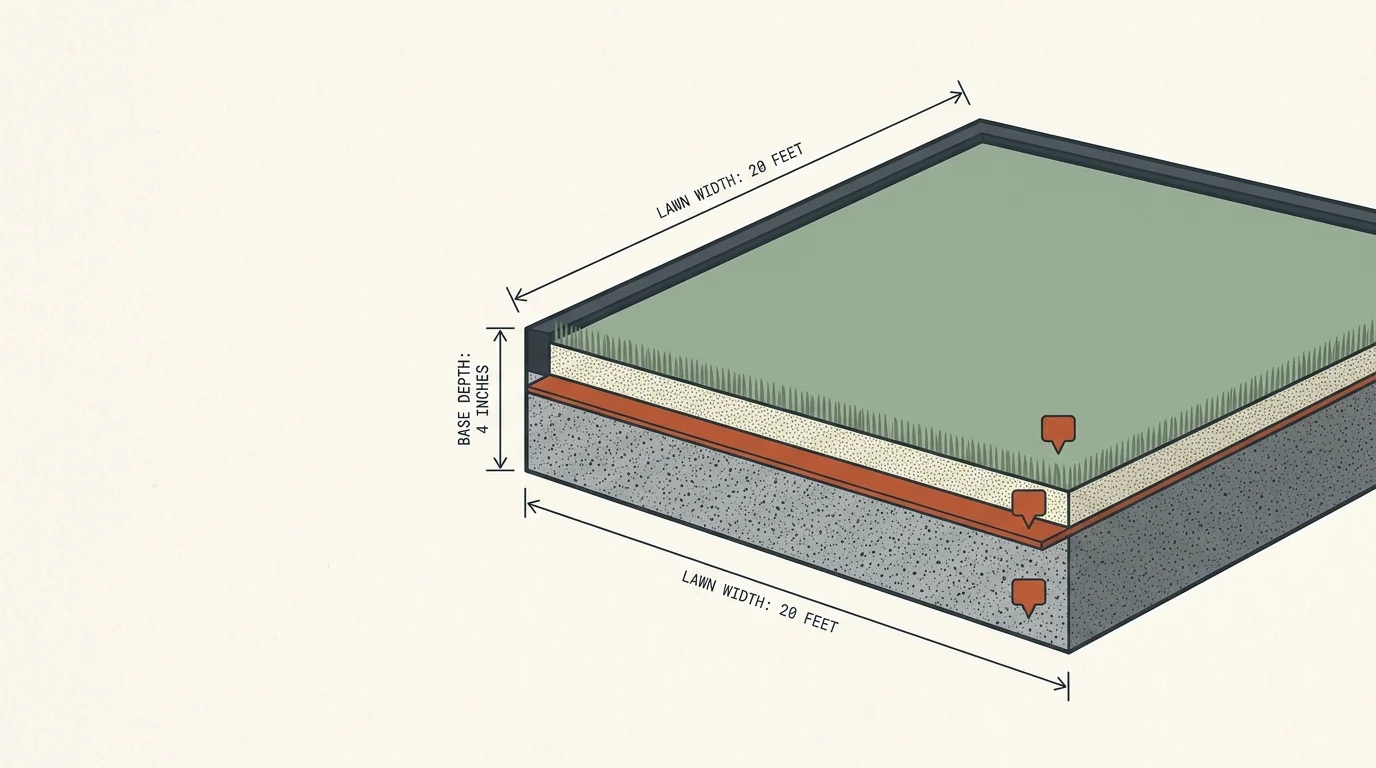
An artificial turf cost calculator gives you the full picture — material, base preparation, installation labour, and infill — before committing to a project that eliminates mowing, watering, and fertilising permanently. Artificial grass costs more upfront than natural sod, but the payback in saved maintenance is real and measurable. Our artificial turf cost calculator factors in your yard size, turf quality, base requirements, and local labour rates so the estimate reflects your specific project rather than a generic average.
Enter your lawn dimensions below for a personalised estimate. Then read the full guide for 2026 pricing by turf grade, base construction costs, infill options, and the honest long-term cost comparison against natural grass.
Calculation method and important limitations
The tool multiplies the measured area by the selected cutting allowance, then estimates turf, aggregate base, infill, geotextile, site preparation, removal, drainage, edging, labor, delivery, irrigation work, and optional padding or putting-green accessories. Aggregate volume includes 10% for compaction and uses a planning density of 1.4 tons per cubic yard. Professional labor starts at $5.50 per project square foot; DIY mode substitutes an equipment and installation-supplies allowance. Regional cost, access, slope, shape, and intended-use adjustments are applied where appropriate.
Current U.S. benchmarks vary significantly. LawnStarter’s 2026 guide reports an average of about $15–$19 per square foot installed and lawn removal around $0.88–$1.84 per square foot. Homewyse estimates roughly $16.08–$19.74 per square foot for a basic installation, while Thumbtack gives a broader $7–$15 per-square-foot range for projects under 1,500 square feet. Planning estimate only: local labor, turf brand, freight, excavation, soil, drainage, permits, heat mitigation, seams, curves, warranty, access, and contractor minimums can materially change the quote.
How an Artificial Turf Cost Calculator Works
The artificial turf cost calculator multiplies your area in square feet by the per-square-foot installed cost for your chosen turf grade. Then, it adds base preparation (excavation, aggregate, and compaction), infill material, seaming, and edging. Finally, it applies regional labour adjustments to produce a total installed estimate.
As a result, the output covers every cost component from excavation to final brushing. However, accuracy depends on measuring your area carefully and noting any slopes, drainage issues, or complex shapes that increase installation difficulty.
Average Artificial Turf Cost in 2026
Artificial turf costs $5 to $20 per square foot fully installed, with most residential projects landing between $8 and $14 per square foot. For a typical 500-square-foot front yard, total installed cost ranges from $2,500 to $10,000. Specifically, a 1,000-square-foot backyard conversion runs $5,000 to $20,000.
Furthermore, pet-turf installations with enhanced drainage and antimicrobial infill fall at the higher end of these ranges. Commercial installations for sports fields and playgrounds use different turf systems and typically cost $8 to $15 per square foot before line marking and accessories.
Artificial Turf Cost Calculator: Price by Turf Grade
Turf quality is the largest variable in material cost. Higher grades look more realistic, feel softer, and last longer. Here are the three main tiers.
Economy Grade ($2–$4 per sq ft material)
Economy turf uses shorter pile height (25 to 35 mm), lower face weight, and simpler blade shapes. It looks acceptable from a distance but lacks the realism of premium products up close. Consequently, economy turf works well for side yards, utility areas, rooftop decks, and commercial applications where appearance is secondary to function. Typical lifespan is 8 to 12 years.
Mid-Range Grade ($4–$7 per sq ft material)
Mid-range turf features 35 to 50 mm pile height, multi-colour blade blends (mixing greens with brown and tan thatching), and improved UV stabilisation. As a result, it closely mimics natural grass from normal viewing distance. Additionally, mid-range products offer better drainage rates and softer hand feel. This tier dominates residential front-yard and backyard installations. Lifespan is 12 to 18 years.
Premium Grade ($7–$12+ per sq ft material)
Premium turf uses advanced blade shapes (W-cut, diamond, S-blade), dense thatching layers, and the highest face weights for maximum realism and resilience. It is virtually indistinguishable from a well-maintained natural lawn. However, the material cost alone approaches the total installed cost of mid-range turf. Therefore, premium grade is typically reserved for front yards where curb appeal justifies the investment and putting greens where performance matters.
Artificial Turf Cost Calculator: Base Preparation
Base preparation is the critical foundation that determines drainage, levelness, and turf longevity. Skipping or shortcutting the base is the most common cause of artificial turf failure.
Excavation
Removing existing grass, soil, and organic material to a depth of 3 to 4 inches costs $1.00 to $2.50 per square foot. All organic material must come out — decomposing roots and grass beneath turf create uneven settling and drainage problems. Furthermore, the excavated material needs hauling and disposal, which adds $100 to $400 for a typical residential project.
Aggregate Base
A 3- to 4-inch layer of crushed aggregate (typically Class II road base or decomposed granite) provides structural support and drainage. Material and installation cost $1.50 to $3.00 per square foot. Specifically, the aggregate must be compacted to 90% to 95% density using a plate compactor. Without proper compaction, the surface develops depressions and unevenness within the first year.
Weed Barrier
A commercial-grade weed barrier fabric between the aggregate base and the turf prevents weed growth from below. Cost is $0.15 to $0.35 per square foot. Consequently, this inexpensive layer eliminates the most common maintenance complaint about artificial turf — weeds pushing through the seams. Our lawn mowing cost calculator provides a useful comparison of the annual costs you eliminate by switching from natural grass to turf.
Infill Materials and Costs
Infill is the granular material brushed into the turf blades after installation. It weighs the turf down, supports blade uprightness, provides cushioning, and aids drainage.
- Silica sand: $0.25 – $0.50 per sq ft. The most common and affordable infill. Provides weight and drainage but no cushioning.
- Crumb rubber: $0.50 – $1.00 per sq ft. Recycled tire rubber that provides excellent cushioning. However, environmental and health concerns have reduced its popularity for residential use.
- Zeolite: $0.75 – $1.50 per sq ft. A natural mineral that absorbs pet odours and drains well. Consequently, zeolite is the top choice for pet-turf installations.
- Acrylic-coated sand: $0.50 – $1.00 per sq ft. Temperature-reducing infill that stays cooler in direct sun. Ideal for yards with heavy sun exposure in hot climates.
Notably, infill type significantly affects surface temperature. Standard artificial turf can reach 150°F or more in direct summer sun. Acrylic-coated and organic infills reduce surface temperatures by 15 to 30 degrees. Therefore, infill selection is a comfort and safety decision, not just a cost one.
Artificial Turf Cost Calculator: Installation Labour
Installation labour costs $2 to $5 per square foot and covers turf rolling, cutting, seaming, securing edges, applying infill, and final brushing.
Professional installation of a 500-square-foot area takes a two- to three-person crew one day. Larger projects of 1,000+ square feet take two to three days. Additionally, complex shapes with curves, tree cutouts, and multiple seams increase labour time by 20% to 40%.
DIY installation is possible for small, simple areas and saves $2 to $5 per square foot. However, seaming is the most skill-dependent step — poorly joined seams are visible and separate over time. Consequently, DIY works best for enclosed backyards where minor imperfections are less noticeable, while professional installation is recommended for front yards and any area visible from the street.
Artificial Turf vs. Natural Grass: 10-Year Cost Comparison
The upfront cost of artificial turf is significantly higher than natural sod. However, the ongoing maintenance savings change the equation over time.
Natural grass (500 sq ft, 10-year total):
- Sod installation: $750 – $1,250
- Annual mowing (40 visits × $30): $1,200 per year × 10 = $12,000
- Annual watering: $200 – $500 per year × 10 = $2,000 – $5,000
- Fertiliser, weed control, overseeding: $200 – $400 per year × 10 = $2,000 – $4,000
- 10-year total: $16,950 – $22,250
Artificial turf (500 sq ft, 10-year total):
- Installed cost: $4,000 – $7,000
- Annual maintenance (brushing, infill top-up): $100 – $200 per year × 10 = $1,000 – $2,000
- 10-year total: $5,000 – $9,000
Consequently, artificial turf breaks even with natural grass in three to five years for most residential installations. After the breakeven point, every additional year represents pure savings. Furthermore, the comparison improves in drought-prone regions where water costs are high. Our tree trimming cost calculator covers another recurring landscape maintenance cost that turf eliminates around tree bases.
How to Get the Best Price on Artificial Turf
Several strategies reduce costs without compromising quality.
First, buy turf rolls in standard widths. Artificial turf comes in 12-foot and 15-foot rolls. Designing your layout to minimise seams reduces waste and labour. Specifically, a 12-foot-wide yard section covered by a single roll width eliminates seaming entirely for that area.
Second, handle excavation yourself. Removing the top 3 to 4 inches of soil is the most physically demanding but least skill-dependent step. Renting a skid steer for a day ($200 to $400) and doing the digging yourself saves $500 to $1,500 on a typical project.
Third, shop remnants for small areas. Turf suppliers sell leftover roll ends at 20% to 50% off retail. A dog run, side yard, or balcony project can often be covered by a single remnant. Additionally, remnants from premium turf cost less than new mid-range product.
Fourth, install during the off-season. Winter and early spring are the slow months for landscape installers. As a result, scheduling during this window often yields 10% to 15% lower labour rates. Our wood fence cost calculator covers companion fencing projects that pair well with yard transformations.
Frequently Asked Questions
How much does artificial turf cost per square foot?
Artificial turf costs $5 to $20 per square foot fully installed in 2026. Specifically, material runs $2 to $12 per square foot, base preparation adds $2.50 to $5.50, and installation labour adds $2 to $5.
How long does artificial turf last?
Quality artificial turf lasts 12 to 20 years depending on grade, UV exposure, and traffic. Economy turf averages 8 to 12 years. Mid-range lasts 12 to 18 years. Premium products with advanced UV stabilisation reach 15 to 20 years before needing replacement.
Is artificial turf safe for pets?
Yes. Pet-specific turf systems with enhanced drainage and antimicrobial zeolite infill handle pet waste effectively. Rinse solid waste areas with water and apply an enzyme cleaner monthly. Consequently, pet-turf installations are one of the fastest-growing segments of the residential artificial turf market.
Does artificial turf get too hot in summer?
Standard turf can reach 150°F in direct sun. However, light-coloured turf, acrylic-coated infill, and shade from trees reduce surface temperatures by 15 to 40 degrees. Additionally, a quick spray with a garden hose cools the surface instantly. Therefore, heat management is a solvable problem, not a dealbreaker.
The Bottom Line on Artificial Turf Costs
Artificial turf is a higher upfront investment that eliminates virtually all ongoing lawn maintenance costs. Use our artificial turf cost calculator at the top of this page to build a realistic budget, compare it to your current lawn maintenance spending, and determine your breakeven timeline.
All figures in this guide are 2026 planning estimates. Your actual cost will vary with turf grade, base conditions, and regional labour rates. Always obtain at least three itemised quotes before committing to an installer.