
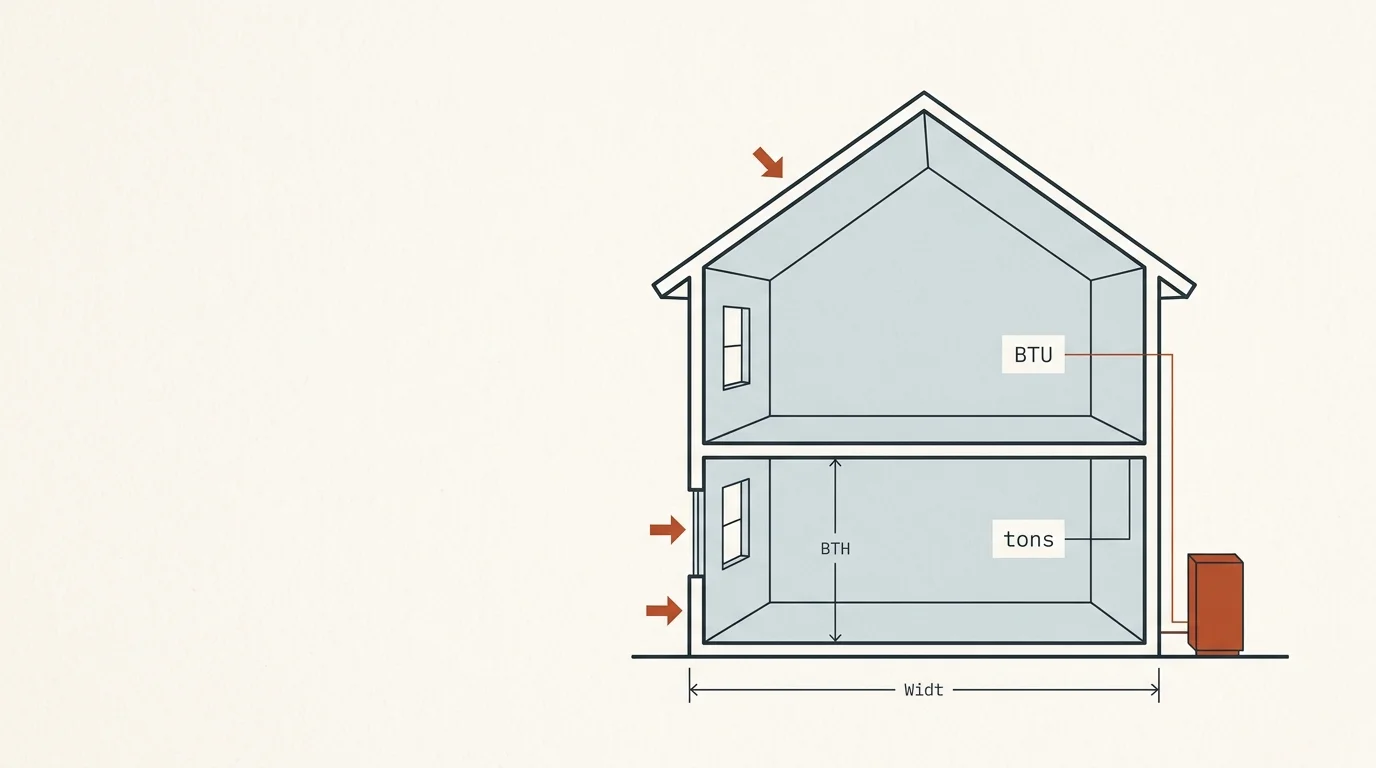
An air conditioner size calculator determines the exact BTU capacity and tonnage your home needs to cool efficiently without wasting energy or leaving rooms uncomfortable. An oversized AC short-cycles, fails to dehumidify, and costs more upfront. An undersized unit runs nonstop without reaching setpoint. Our air conditioner size calculator factors in your home’s square footage, insulation level, ceiling height, window area, climate zone, and sun exposure to recommend the right cooling capacity for your specific situation.
Enter your home details below for a personalised sizing recommendation. Then read the full guide for the BTU-per-square-foot formulas, AC tonnage charts by home size, efficiency ratings that affect operating cost, and the sizing mistakes that waste the most money.
Calculation method and important limitations
The calculator starts with a climate-sensitive BTU-per-square-foot planning value, then adjusts for ceiling height, insulation, windows, solar exposure, air leakage, duct location, indoor target, equipment, occupants, kitchen use and roof exposure. One ton equals 12,000 BTU per hour. The suggested nominal capacity is the closest common equipment size, not an automatic instruction to round up.
ENERGY STAR explains that an oversized air conditioner may cool before adequately removing humidity and provides room-size capacity guidance based on 8-foot ceilings. Carrier describes 20 BTU per square foot as a general starting rule and notes that actual capacity depends on efficiency and climate. ACCA Manual J is the residential load-calculation standard used to determine heating and cooling loads. Square-foot rules cannot replace it.
Final sizing depends on local outdoor design temperature and humidity, indoor design conditions, wall/roof/floor assemblies, orientation, exact window area and ratings, infiltration or ventilation, latent load, duct gain/leakage and room-by-room airflow. Equipment must then be selected with manufacturer performance data at actual design conditions using ACCA Manual S. Large homes may need multiple systems or zones rather than one unit over five tons.
How an Air Conditioner Size Calculator Works
Every air conditioner size calculator starts with your conditioned square footage and applies a base cooling factor — typically 20 BTU per square foot for standard conditions. Then, it adjusts for variables that increase or decrease the cooling load: insulation quality, window area and orientation, ceiling height, number of occupants, heat-generating appliances, and climate zone. Finally, it converts the total BTU requirement to tons (one ton = 12,000 BTU) and recommends the appropriate equipment size.
However, this calculator-based approach is a screening tool that narrows the range. A professional Manual J load calculation — which accounts for wall construction, infiltration rates, duct losses, and design-day temperatures — is the gold standard for final sizing. Nevertheless, the air conditioner size calculator prevents the most costly mistake: gross oversizing by contractors who use rule-of-thumb estimates.
Air Conditioner Size Calculator: AC Tonnage Chart
Here is a quick-reference chart for homes with 8-foot ceilings, average insulation, and moderate climate conditions. Use the air conditioner size calculator above for a more precise result.
- 600–1,000 sq ft: 1.5 ton (18,000 BTU). Apartments, small homes, additions.
- 1,000–1,300 sq ft: 2 ton (24,000 BTU). Starter homes and condos.
- 1,300–1,700 sq ft: 2.5 ton (30,000 BTU). Average single-family homes.
- 1,700–2,100 sq ft: 3 ton (36,000 BTU). The most common residential AC size.
- 2,100–2,700 sq ft: 3.5–4 ton (42,000–48,000 BTU). Larger homes.
- 2,700–3,500 sq ft: 4–5 ton (48,000–60,000 BTU). Large or poorly insulated homes.
Notably, these ranges shift significantly with insulation quality and climate. A well-insulated 2,000-square-foot home in a moderate climate may need only 2.5 tons, while a poorly insulated home of the same size in the deep South may require 4 tons. The air conditioner size calculator accounts for these differences automatically.
Factors That Affect AC Sizing
The air conditioner size calculator adjusts for several variables that shift the BTU requirement away from the baseline chart.
Insulation and Air Sealing
Insulation is the most impactful variable after square footage. A well-insulated home (code-compliant walls, R-38+ attic, sealed envelope) may need only 15 to 18 BTU per square foot. In contrast, a poorly insulated home with uninsulated walls and a leaky envelope may require 25 to 35 BTU per square foot. Consequently, the difference between a well-sealed and a leaky 2,000-square-foot home can be a full ton of AC capacity. Our blown-in insulation calculator estimates the cost of improving attic insulation before sizing your AC.
Window Area and Sun Exposure
Large south- and west-facing windows increase solar heat gain by 10% to 25%. Additionally, single-pane or failed double-pane windows conduct outdoor heat directly into the living space. Therefore, window area, orientation, and condition all factor into the air conditioner size calculator’s recommendation. Our window replacement cost estimator covers the cost of upgrading windows for both comfort and energy savings.
Ceiling Height
Every foot of ceiling height above 8 feet adds approximately 10% to the cooling requirement because the AC must condition a larger air volume. Furthermore, vaulted ceilings create hot air pockets at the peak that are difficult to reach with standard ducted systems. Consequently, homes with 10- to 12-foot ceilings routinely need one size tier larger than the baseline chart suggests.
Climate Zone
Hot, humid climates (the Gulf Coast, Florida, the Desert Southwest) require more cooling capacity than moderate climates (the Mid-Atlantic, Pacific Northwest). Specifically, design-day temperatures — the outdoor temperature the AC must overcome on the hottest days — range from 85°F in cool climates to 110°F+ in the Desert Southwest. The air conditioner size calculator uses your location to apply the correct design-day factor.
Number of Occupants and Appliances
Each person in the home generates approximately 400 BTU of heat per hour. Furthermore, cooking appliances, clothes dryers, and electronic equipment add to the internal heat load. A home with five occupants and a commercial-style kitchen generates significantly more internal heat than a two-person household with a standard kitchen.
Air Conditioner Size Calculator: Cost by Tonnage in 2026
Here are typical installed costs for central air conditioning systems by capacity, including equipment, labour, and standard materials.
- 1.5 ton (18,000 BTU): $3,000 – $5,500 installed.
- 2 ton (24,000 BTU): $3,500 – $6,500 installed.
- 2.5 ton (30,000 BTU): $4,000 – $7,500 installed.
- 3 ton (36,000 BTU): $4,500 – $8,500 installed.
- 3.5 ton (42,000 BTU): $5,500 – $10,000 installed.
- 4 ton (48,000 BTU): $6,000 – $11,500 installed.
- 5 ton (60,000 BTU): $7,500 – $14,000 installed.
Specifically, every half-ton of unnecessary capacity adds $500 to $1,500 to the equipment price. Consequently, right-sizing saves money on purchase day and every month afterward through lower energy bills. Our ductwork replacement cost calculator covers the duct system costs that complement AC installation.
Why Oversizing Your AC Is the Costliest Mistake
Oversizing is the most common AC sizing error, and it creates three specific, measurable problems.
First, an oversized AC short-cycles. It cools the thermostat’s location quickly, shuts off, then restarts minutes later when the temperature drifts back up. This rapid on-off cycling wastes energy on startup surges and creates noticeable temperature swings between rooms.
Second, oversized units fail to dehumidify. Air conditioners remove humidity by running long enough for moisture to condense on the evaporator coil. A short-cycling unit never runs long enough to pull adequate moisture from the air. As a result, the home reaches target temperature but feels clammy and uncomfortable — a problem that no thermostat setting can fix.
Third, oversized equipment wears out faster. Each startup cycle stresses the compressor, contactor, and capacitor. A properly sized unit running 15-minute cycles experiences fewer startups per day than an oversized unit cycling every 5 to 8 minutes. Therefore, right-sizing extends equipment lifespan alongside reducing energy consumption.
SEER2 Ratings and Operating Cost
SEER2 (Seasonal Energy Efficiency Ratio) measures how much cooling the AC delivers per watt of electricity consumed. Higher SEER2 means lower electricity bills.
Federal minimums in 2026 are 14.3 SEER2 in the North and 15 SEER2 in the South. Premium units reach 22 to 26 SEER2. However, each SEER2 tier increase adds $500 to $2,000 to equipment cost. Therefore, here is how to evaluate the trade-off.
Upgrading from 14.3 to 18 SEER2 reduces cooling costs by approximately 20% to 25%. In a home spending $800 per summer on cooling, that saves $160 to $200 annually, producing payback in three to five years in hot climates. Going further to 22+ SEER2 saves an additional 10% to 15% but at a higher equipment premium — payback extends to six to ten years. Consequently, the 16 to 19 SEER2 range delivers the best return for most homeowners.
How to Get the Best Price on an Air Conditioner
Several strategies consistently reduce costs.
First, get three itemised quotes specifying equipment model numbers, SEER2 ratings, and warranty terms. Comparing specific models reveals real pricing differences. Furthermore, ask whether the quote includes thermostat, refrigerant line set, and electrical work or bills them as extras.
Second, install during the off-season. Late fall and early spring offer lower contractor rates and better scheduling availability. As a result, off-season installations save 5% to 15% on labour.
Third, stack incentives. Federal tax credits, utility rebates, and manufacturer promotions can combine to reduce the effective cost by $1,000 to $4,000 on qualifying high-efficiency equipment.
Fourth, improve insulation before sizing. Upgrading insulation and air sealing before buying the AC allows a smaller, cheaper unit that costs less to operate permanently. Consequently, the insulation investment often pays for itself through equipment savings alone. Our spray foam insulation cost calculator covers one of the most effective envelope upgrades available.
Frequently Asked Questions
What size air conditioner do I need for 2,000 square feet?
A 2,000-square-foot home with average insulation and standard ceilings typically needs a 3-ton (36,000 BTU) air conditioner. However, poor insulation, high ceilings, or a hot climate may push the requirement to 3.5 or 4 tons. Use the air conditioner size calculator above for a precise recommendation.
How many BTU per square foot for air conditioning?
The baseline is 20 BTU per square foot for standard conditions. Well-insulated homes in moderate climates need 15 to 18 BTU. Poorly insulated homes in hot climates may need 25 to 35. Specifically, the correct number depends on insulation, windows, climate, ceiling height, and occupancy — not square footage alone.
Can an air conditioner be too big for a house?
Yes. An oversized AC short-cycles, wastes energy, fails to dehumidify, and wears out faster than a correctly sized unit. Consequently, right-sizing — not oversizing — delivers better comfort, lower bills, and longer equipment life. A Manual J load calculation is the most reliable sizing method.
What is SEER2 and does it matter?
SEER2 measures cooling efficiency — higher numbers mean lower electricity consumption per BTU of cooling. The federal minimum is 14.3 to 15 SEER2 depending on region. Upgrading to 16 to 19 SEER2 reduces cooling costs by 15% to 25% and typically pays back in three to six years in warm climates.
The Bottom Line on AC Sizing
Correct sizing is the foundation of air conditioning comfort, efficiency, and equipment longevity. Use our air conditioner size calculator at the top of this page to determine the right capacity, then match that number to available equipment. The homeowners who get the best results are the ones who size right before they shop.
All figures in this guide are 2026 estimates. Your actual sizing requirement will vary with insulation, climate, and home layout. Always confirm sizing with a Manual J load calculation before purchasing equipment.