
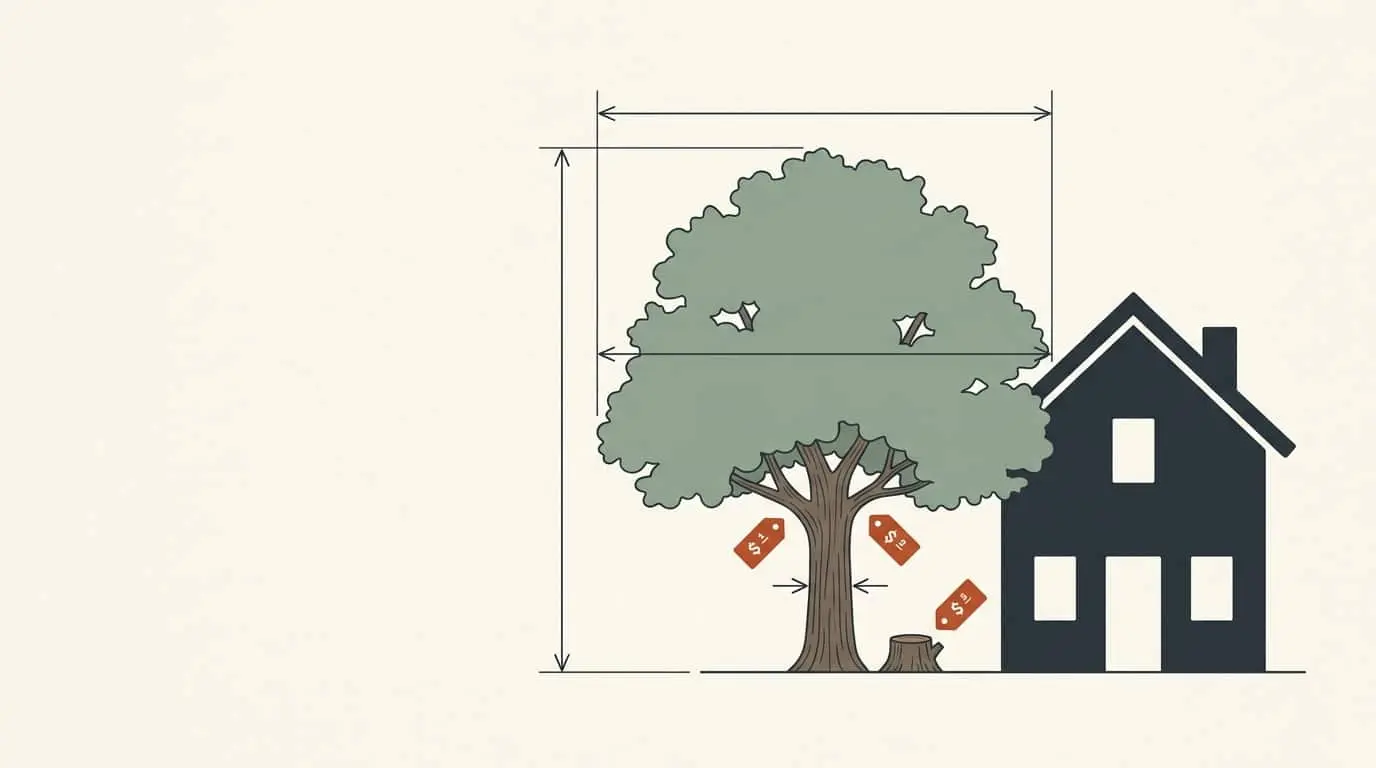
Tree Removal Cost Calculator
Answer a few quick questions about your tree to get an instant, ballpark cost estimate for removal.
What Affects Tree Removal Cost
Tree Size
- Small trees (under 30 ft)
- Medium trees (30–60 ft)
- Large & extra-large trees (60+ ft)
Location & Access
- Proximity to structures or fences
- Distance from power lines
- Crane or bucket-truck access
Condition & Extras
- Tree health and lean direction
- Stump grinding and debris hauling
- Emergency or same-day service
A tree removal cost calculator gives you a realistic price range before you ever call a company. Since quotes for the same tree can swing by thousands of dollars, walking in blind usually costs you money.
Below, you’ll find the real pricing tiers, the factors that push a quote up, and a free tool that does the maths instantly.
How Much Does It Cost to Cut Down a Tree?
Nationally, most homeowners pay between $400 and $1,200 for a standard removal. However, that range is almost useless on its own.
Because height drives roughly 60% of the price, a small backyard tree and a mature oak sit in completely different worlds.
| Tree height | Typical cost range | Example |
|---|---|---|
| Under 30 ft | $150 – $500 | Young ornamental, small fruit tree |
| 30 – 60 ft | $500 – $1,200 | Mature maple, mid-size pine |
| 60 – 80 ft | $1,200 – $2,200 | Full-grown oak, tall conifer |
| 80 ft+ | $2,200 – $3,800 | Old-growth hardwood, heritage tree |
Consequently, the first question any estimator asks is height — not species, not location.
Why Tree Removal Prices Vary So Much
Two identical trees can produce wildly different quotes. Essentially, crews price risk and access, not just wood.
Here’s what actually moves the number:
- Height and canopy spread — taller trees need rigging, not just felling
- Trunk diameter — thicker trunks mean slower cuts and heavier sections
- Species density — hardwood takes far longer than softwood
- Proximity to buildings — no room to drop means sectional removal
- Power lines nearby — often requires utility coordination
- Equipment access — crane or bucket-truck reach changes everything
Therefore, a 50 ft tree in an open field might cost $600, while the same tree over a roof easily hits $1,100.
👉 Try the free Tree Removal Cost Calculator
How Trunk Diameter Affects Tree Felling Costs
Height sets the tier, but diameter fine-tunes it. Generally, anything under 24 inches falls within standard pricing.
Once you pass that threshold, expect a surcharge:
- Roughly $12–$20 extra per inch beyond 24 inches
- A 36-inch trunk therefore adds around $145–$240
- Meanwhile, a 48-inch trunk can add $290–$480
Why? Thicker trunks require larger bars, more fuel, more cuts and significantly more time on the ground.
Tree Type: Species Changes the Price
Wood density directly affects labour hours. As a result, species acts as a multiplier on your base cost.
| Tree type | Cost multiplier | Why |
|---|---|---|
| Palm | ×0.85 | Lightweight trunk, no heavy limbs |
| Pine | ×0.90 | Softwood with light branching |
| Maple | ×1.05 | Dense canopy, strong wood |
| Willow | ×1.10 | Brittle limbs need careful sectioning |
| Oak | ×1.20 | Very dense hardwood, most labour-intensive |
To put that in context, an oak costs about 35% more than a palm of identical height. Nevertheless, most homeowners overlook species entirely when budgeting.
Location Surcharges You Should Expect
Where the tree stands matters enormously. Since crews price by risk, tight or hazardous positions carry real premiums.
| Location | Surcharge | Notes |
|---|---|---|
| Open yard | No extra cost | Tree can be felled whole |
| Tight space | +15% | Near fences or structures |
| Near power lines | +20% and $150 flat | May need utility shutdown |
| Over roofline | +35% and $200 flat | Full rigging and sectional lowering |
Above all, never downplay proximity when requesting a quote. If the crew arrives and finds a roof-hazard job priced as an open-yard removal, they’ll re-quote on the spot.
Large Tree Removal Cost Calculator: The 80 ft+ Problem
Extra-large trees behave differently from everything below them. Once a tree passes 80 feet, crane work often becomes mandatory rather than optional.
Budget accordingly:
- Base range of $2,200 – $3,800 before any modifiers
- Crane hire frequently adding $500 – $1,500 on top
- Oak or willow species pushing the total past $5,000
- Permits required in many municipalities for heritage specimens
Furthermore, large removals usually take a full day with a crew of three or four. Because of that, scheduling can stretch weeks out during storm season.
Add-On Costs Most Quotes Don’t Include
Here’s where surprise charges appear. Although the felling price sounds complete, cleanup rarely is.
| Add-on | Typical cost | What you get |
|---|---|---|
| Stump grinding | +$125 – $350 per stump | Ground below grade, area levelled |
| Debris hauling | +$100 – $300 | Full cleanup and removal |
| Emergency service | +20% – 35% | Same-day or 24/7 response |
Notably, “tree removal” in most contracts means the tree comes down — not that your yard is left clean. Always confirm in writing whether the stump and debris are included.
How to Use the Tree Removal Cost Estimator
Follow these steps for an accurate ballpark figure.
Steps:
1 — Estimate the height
Compare the tree against a known reference, such as a two-storey house at roughly 25 feet.
2 — Select the species
If you’re unsure, leave it on “Not sure” and the estimator applies an average multiplier.
3 — Measure trunk diameter
Wrap a tape around the trunk at chest height, then divide the circumference by 3.14.
4 — Set the number of trees
Multiple removals in one visit usually cost less per tree, since mobilisation is shared.
5 — Choose the location type
Be honest here, because access is the single biggest source of quote revisions.
6 — Tick your add-ons
Include stump grinding and hauling if you want a genuinely finished yard.
7 — Read the breakdown
Review the base, site and add-on figures separately so you know what to negotiate.
How to Reduce Tree Removal Prices
Costs are negotiable more often than people assume. Try these tactics:
- Book in winter — demand drops sharply between December and February
- Skip the hauling — keep the wood if you have a fireplace or chipper
- Bundle multiple trees — one mobilisation covers several removals
- Avoid emergency calls — unless the tree is genuinely unstable
- Clear the access route — moving vehicles and furniture saves crew time
- Get three quotes — pricing varies enormously between local firms
Additionally, ask whether the company holds liability insurance and worker’s compensation. Otherwise, you’re financially exposed if something goes wrong on your property.
When Removal Isn’t the Answer
Sometimes pruning solves the problem for a fraction of the price. Consider alternatives when:
- Only a few limbs threaten your roof or gutters
- The tree is structurally sound but overgrown
- Local ordinances protect the species
- Root damage can be managed with a barrier
Consult a certified arborist first. Although an inspection costs $100–$300, it occasionally saves you thousands.
Frequently Asked Questions
How much will it cost to cut down a tree in my area?
Regional labour rates shift pricing by 20–40%. Typically, urban and coastal areas sit at the top of every range shown above.
What is the average cost of tree removal?
Nationally, the average lands near $750. However, your specific figure depends far more on height and access than on any national average.
Is stump removal included in the price?
Rarely. Most quotes cover felling only, so budget an extra $125–$350 per stump.
Does insurance cover tree removal?
Sometimes. If a tree falls and damages an insured structure, coverage often applies — whereas preventative removal usually doesn’t.
How long does tree removal take?
Small trees take 2–4 hours, while large removals frequently need a full day.
Get Your Estimate Now
Instead of guessing, enter your tree details and see a costed breakdown in seconds. Afterwards, you’ll know immediately whether a quote is fair or inflated.
6 thoughts on “Tree Removal Cost Calculator: What You’ll Really Pay in 2026”