
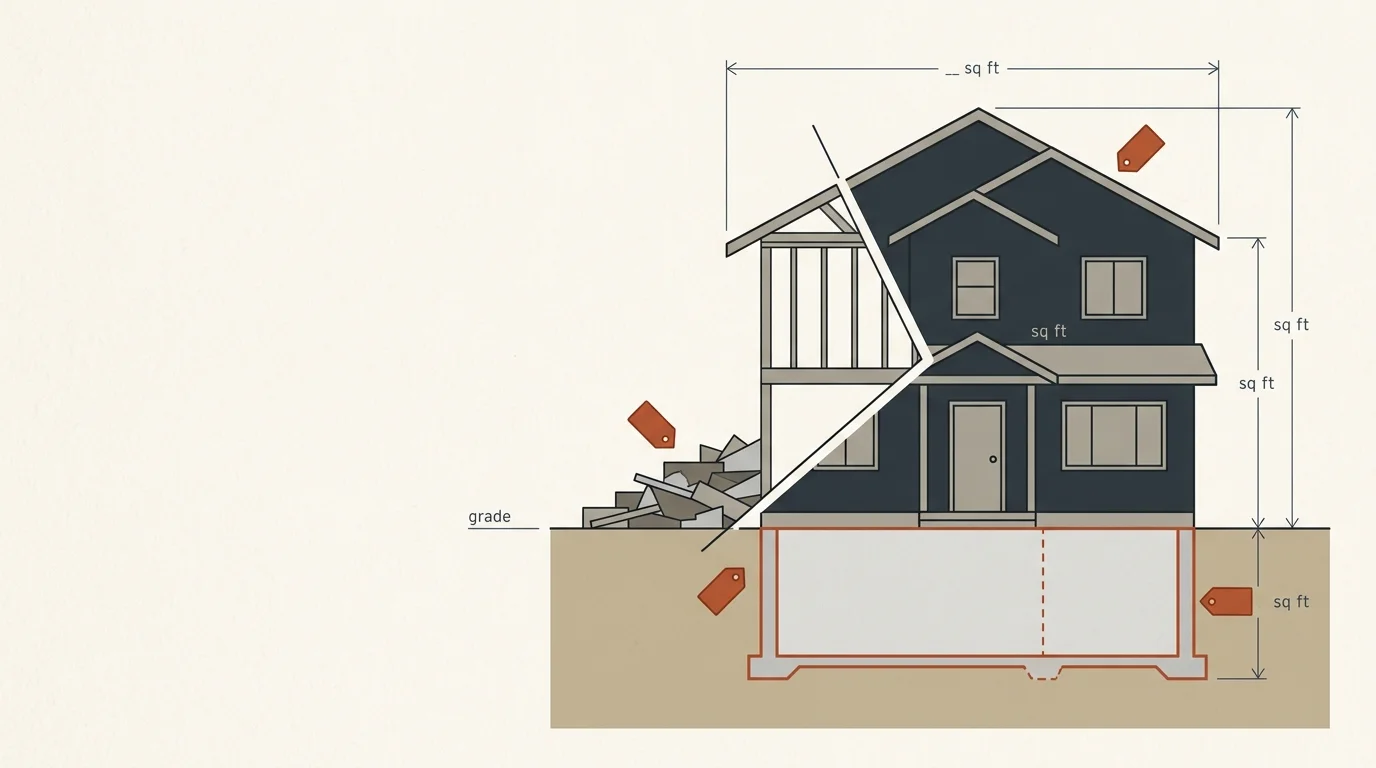
A house demolition cost calculator gives property owners a realistic budget for tearing down a structure — whether to build new, clear a lot for sale, or remove a condemned building. Demolition costs swing widely based on house size, construction type, hazardous materials, disposal fees, and permit requirements. Our house demolition cost calculator factors in your home’s square footage, stories, foundation type, and local disposal rates to produce an estimate that matches your actual project.
Enter your property details below for a personalised number. Then read the full guide for 2026 per-square-foot pricing, mechanical versus full demolition costs, asbestos and lead considerations, and the permit process that governs every residential teardown.
Calculation method and important limitations
The calculator applies a square-foot demolition rate to the selected scope, construction type, height, access, disposal market and region. Foundation removal is priced separately per square foot. It then adds hazardous-material work, grading, accessory concrete, utilities, permits, professional planning and contingency.
HomeGuide’s 2026 guide reports roughly $4–$10 per square foot for house demolition and up to about $25 per square foot when asbestos or lead is involved. Angi’s 2026 guide lists foundation removal around $1,000–$5,000 and demolition permits commonly around $100–$500 each. The Home Depot guide gives a broad national range of about $3,000–$25,000 or $2–$17 per square foot. These are planning benchmarks, not bids.
Local rules may require an asbestos survey, utility releases, rodent control, erosion measures, tree protection, engineering, demolition permit and waste reporting before work begins. Abatement must be performed and disposed of under applicable federal, state and local requirements. Verify whether quotes include contents removal, foundations, septic systems, wells, underground tanks, pools, driveways, trees, hauling, tipping fees, clean fill, compaction and final grading.
How a House Demolition Cost Calculator Works
Every house demolition cost calculator starts with your home’s total square footage and number of stories. Then, it applies a per-square-foot rate based on your region and the demolition method. Finally, it adds permit fees, hazardous material abatement, utility disconnects, and disposal costs to produce a total project estimate.
As a result, the output covers every phase from pre-demolition permits to final lot grading. However, demolition costs are highly site-specific — access constraints, neighbouring structures, and local landfill rates create variations that a calculator can only approximate. Always get on-site quotes before committing.
Average House Demolition Cost in 2026
Complete house demolition costs $5 to $15 per square foot, with most residential projects falling between $8 and $12 per square foot. For a standard 1,500-square-foot home, the total ranges from $7,500 to $22,500. Specifically, here is how costs vary by home size.
- Under 1,000 sq ft: $5,000 – $12,000. Small homes, cottages, and mobile homes.
- 1,000–1,500 sq ft: $7,500 – $18,000. Standard ranch homes and bungalows.
- 1,500–2,500 sq ft: $12,000 – $30,000. Mid-size two-story homes.
- 2,500–4,000 sq ft: $20,000 – $45,000. Large homes with complex construction.
- 4,000+ sq ft: $30,000 – $75,000+. Estate homes and multi-unit structures.
Furthermore, these ranges assume standard wood-frame construction. Brick, stone, and concrete structures cost 20% to 50% more to demolish because of the heavier equipment and increased disposal weight.
House Demolition Cost Calculator: Demolition Methods
The demolition method significantly affects both cost and timeline.
Mechanical Demolition
Mechanical demolition uses excavators with hydraulic attachments to tear down the structure rapidly. It costs $5 to $12 per square foot and is the most common method for residential teardowns. A standard home takes one to three days to demolish mechanically. Consequently, mechanical demolition is the fastest and most cost-effective approach when the entire structure is being removed.
Deconstruction (Selective Demolition)
Deconstruction involves carefully dismantling the structure to salvage reusable materials — lumber, fixtures, doors, windows, cabinets, and architectural elements. It costs $10 to $25 per square foot, roughly double mechanical demolition. However, salvaged materials can be donated for tax deductions or sold, offsetting 20% to 40% of the higher cost. Furthermore, deconstruction diverts 70% to 90% of materials from landfills versus 30% to 50% for mechanical demolition.
Deconstruction makes financial sense when the home contains high-value salvageable materials (old-growth lumber, antique fixtures, premium hardwood flooring) and when the homeowner benefits from the charitable donation tax deduction. Our home replacement cost calculator covers the rebuild costs that follow demolition for homeowners planning new construction.
Interior-Only Demolition
Interior demolition strips the house to the studs while preserving the structure. It costs $2 to $7 per square foot and is the scope for gut-renovation projects. Specifically, interior demolition removes drywall, flooring, cabinets, fixtures, and insulation but leaves framing, roofing, and exterior walls intact.
House Demolition Cost Calculator: Pre-Demolition Costs
Several mandatory steps precede any demolition work and carry their own costs.
Permits
Demolition permits cost $200 to $2,500 depending on your municipality. Most jurisdictions require a demolition permit that involves a plan review, neighbour notification, and post-demolition inspection. Specifically, permit timelines range from two weeks to three months, so early application is essential for project scheduling.
Utility Disconnects
All utilities — electric, gas, water, sewer, cable, and telephone — must be professionally disconnected before demolition begins. Disconnect fees total $500 to $2,500 across all services. Furthermore, the gas company and electric utility each require advance scheduling (typically two to four weeks). Failing to disconnect utilities before demolition creates life-threatening hazards and legal liability.
Hazardous Material Survey and Abatement
Homes built before 1980 likely contain asbestos (in insulation, floor tiles, siding, and roofing) and lead paint. A hazardous material survey costs $300 to $800. If asbestos is found, abatement costs $1,500 to $20,000 depending on material type, quantity, and location. Lead paint abatement adds $1,000 to $5,000.
Notably, federal and state regulations require asbestos identification and removal before demolition in most jurisdictions. Demolishing a structure containing asbestos without abatement is a serious environmental violation with significant fines. Consequently, the hazardous material survey is not optional — it is a legal requirement for pre-1980 homes.
House Demolition Cost Calculator: Disposal Costs
Debris hauling and landfill disposal are often the largest single line item after labour and equipment.
A typical 1,500-square-foot wood-frame home generates 100 to 200 tons of debris. Disposal costs run $30 to $60 per ton at most landfills, totalling $3,000 to $12,000 in disposal fees alone. Furthermore, some municipalities charge premium rates for construction and demolition debris versus general waste.
Recycling reduces disposal costs by 20% to 40%. Concrete, metal, and clean wood can often be diverted to recycling facilities at lower rates than landfill disposal. Additionally, scrap metal (copper, steel, aluminium) has salvage value — a demolition contractor typically credits this against the disposal total.
House Demolition Cost Calculator: Foundation Removal
Foundation removal is a separate decision and cost from the above-ground demolition.
Foundation removal (concrete slab or basement): $2,000 to $10,000. This involves breaking up and hauling the concrete foundation, which adds significant weight to disposal totals. Specifically, a 1,500-square-foot basement with 8-inch concrete walls and a 4-inch floor slab generates 40 to 80 additional tons of concrete debris.
Foundation backfill: $1,000 to $5,000. After removal, the hole must be filled with clean fill dirt and compacted. Alternatively, if new construction will use the same footprint, the existing foundation may be left in place and built upon — saving both removal and backfill costs.
Consequently, deciding whether to remove or preserve the foundation is one of the most consequential cost decisions in a demolition project. Our foundation repair cost calculator helps evaluate whether an existing foundation can be reused for new construction. Our cost to build a house calculator covers the full rebuild budget that follows demolition.
House Demolition Cost Calculator: Site Restoration
After demolition, the lot needs final grading and often additional work before it is considered complete.
Rough grading: $500 to $2,500. Levelling the lot and establishing drainage patterns. Specifically, the goal is a smooth, sloped surface that drains away from neighbouring properties and any remaining infrastructure.
Topsoil and seeding: $500 to $2,000. Spreading 2 to 4 inches of topsoil and seeding or hydroseeding to prevent erosion. Many municipalities require erosion control measures as a condition of the demolition permit.
Tree protection: $200 to $1,000. If trees on or near the lot must be preserved, root-zone protection fencing and pruning of damaged limbs are required. Our tree removal cost calculator covers the cost of removing trees that cannot be preserved during demolition.
How to Get the Best Price on House Demolition
Several strategies reduce costs.
First, get three on-site bids. Demolition pricing varies 30% to 50% between contractors because of differences in equipment, disposal contracts, and overhead. An on-site visit is essential — contractors cannot price demolition accurately from photos alone.
Second, consider deconstruction for the tax benefit. If the home contains salvageable materials, a charitable donation of those materials can generate a tax deduction worth 15% to 30% of the higher deconstruction cost. Consequently, deconstruction sometimes costs less on an after-tax basis than mechanical demolition.
Third, schedule during the dry season. Wet conditions slow demolition, complicate hauling, and increase site restoration costs. Furthermore, muddy lots require additional grading work after the ground dries.
Fourth, handle utility disconnects early. Scheduling disconnects four to six weeks ahead prevents delays on demolition day. Specifically, a missed gas or electric disconnect can halt the entire project and waste a full day of equipment rental and crew time.
Frequently Asked Questions
How much does it cost to demolish a 1,500-square-foot house?
Demolishing a 1,500-square-foot house costs $7,500 to $22,500 in 2026. Specifically, a standard wood-frame home with no hazardous materials falls in the $10,000 to $18,000 range including permits, disposal, and basic grading. Asbestos abatement and foundation removal push costs toward the upper end.
How long does house demolition take?
Mechanical demolition of a standard residential home takes one to three days. Pre-demolition steps (permits, utility disconnects, abatement) add two to eight weeks. Site restoration adds one to three days. Consequently, the total project timeline from permit application to finished lot runs one to three months.
Do I need a permit to demolish my house?
Yes, in virtually all jurisdictions. The permit process ensures utility disconnects are completed, hazardous materials are addressed, and the demolition plan protects neighbouring properties. Demolishing without a permit carries significant fines and may complicate future building permits on the lot.
Can I demolish my own house?
Homeowner-performed demolition is legal in some jurisdictions with proper permits. However, asbestos abatement must be performed by licensed professionals, utility disconnects must be handled by the utility companies, and equipment rental (excavator, dumpsters) costs approach professional pricing. Therefore, the savings from DIY demolition are smaller than expected, and the safety risks are substantial.
The Bottom Line on House Demolition Costs
House demolition is a significant project that clears the way for new construction, lot sale, or property improvement. Use our house demolition cost calculator at the top of this page to estimate your specific project, then bring that number to contractor conversations knowing what drives the price.
All figures in this guide are 2026 planning estimates. Your actual cost will vary with home size, construction type, hazardous materials, and regional disposal rates. Always obtain at least three on-site quotes before committing.