
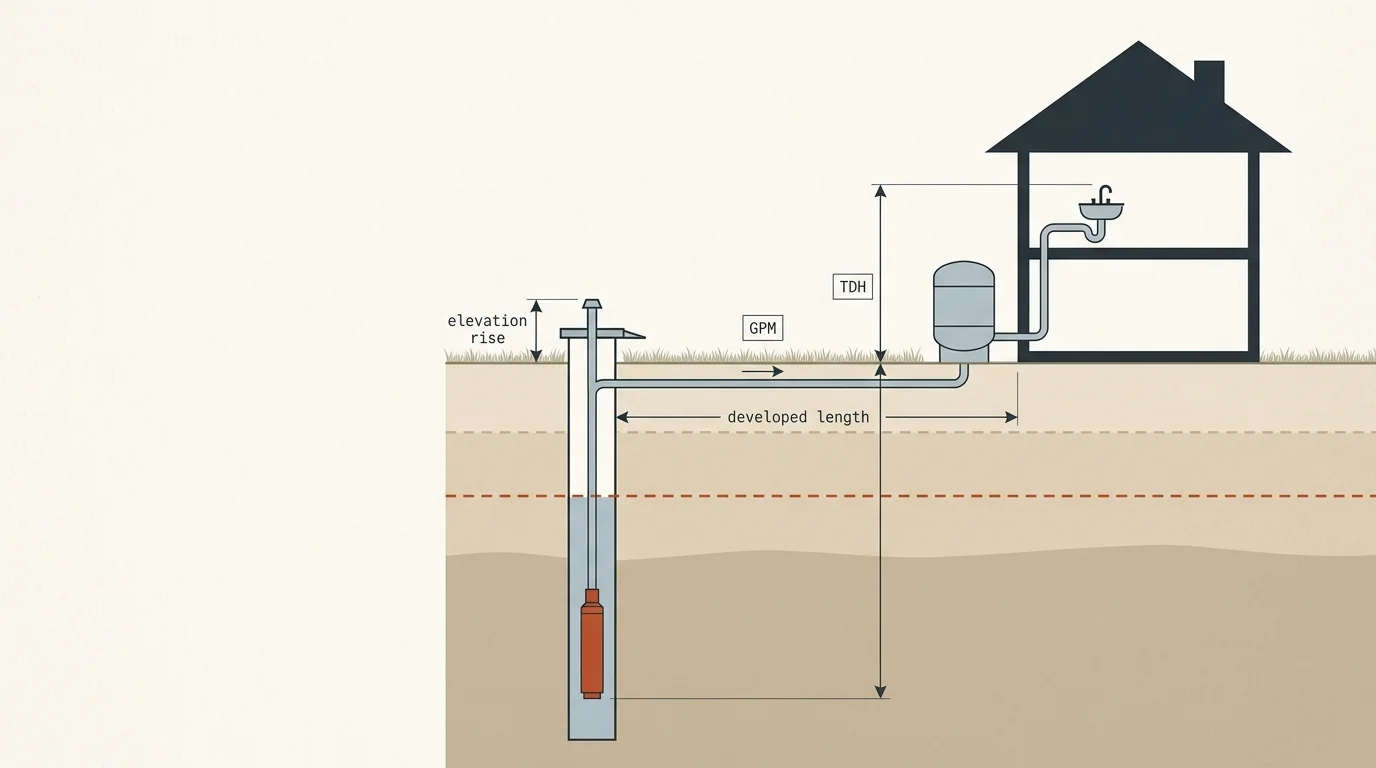
A well pump size calculator determines the exact horsepower, flow rate, and pressure capacity your pump needs to deliver reliable water to every fixture in your home. An undersized pump starves upper-floor fixtures of pressure and runs continuously, burning out in a fraction of its expected lifespan. An oversized pump wastes electricity and short-cycles, damaging the motor and pressure switch. Our well pump size calculator factors in your well depth, water table level, distance to the house, elevation change, fixture count, and peak demand to recommend the right pump specification.
Enter your well and household details below for a personalised recommendation. Then read the full guide for GPM requirements, pump types, pressure tank sizing, and the formulas behind the numbers.
Calculation method and important limitations
Design flow is estimated from household occupancy and fixture count, plus user-entered simultaneous irrigation or special demand. Total dynamic head equals pumping water level, elevation rise, pressure head (2.31 feet per PSI), Hazen–Williams pipe friction, fitting/treatment allowances and the selected margin. Estimated motor horsepower is design GPM × TDH ÷ (3,960 × assumed efficiency), rounded up to a common motor size.
Engineering ToolBox describes water-pump power as a function of flow, head and efficiency. Its Hazen–Williams reference provides the friction-loss relationship used for the pipe estimate. WellOwner.org, supported by the National Ground Water Association, provides private-well guidance and a contractor directory. The calculation is a planning estimate, not a pump schedule.
Final selection requires a current pumping test, dynamic water level at design flow, recovery rate, well diameter, casing and screen data, pump setting depth, drop-pipe rating, voltage and wire sizing, pressure-tank/control strategy and the manufacturer’s pump curve. Never size from total drilled depth or horsepower alone. A pump must not exceed the sustainable well yield without properly designed storage and low-water protection. Use a licensed well contractor or pump installer and comply with local codes.
How a Well Pump Size Calculator Works
Every well pump size calculator solves for two values: flow rate (gallons per minute) and total dynamic head (TDH). Flow rate is how much water the pump must deliver during peak demand. Total dynamic head is the total pressure the pump must overcome — including vertical lift from the water table to the highest fixture, friction losses in the pipe, and the pressure needed at the tap.
Specifically, TDH is calculated as: Vertical Lift + Friction Loss + Pressure Required. The pump must exceed this number to deliver adequate flow. Consequently, the well pump size calculator combines your site-specific inputs to determine both the required GPM and the TDH, then recommends the pump horsepower and type that match.
Well Pump Size Calculator: Flow Rate Requirements
Peak flow rate determines how many fixtures can run simultaneously without pressure drop. Here is how to calculate it.
Fixture-Count Method
Each water-using fixture has a standard flow rate. Add the fixtures that could reasonably run at the same time to determine peak demand.
- Shower: 2.0 – 2.5 GPM
- Kitchen faucet: 1.5 – 2.0 GPM
- Bathroom faucet: 1.0 – 1.5 GPM
- Toilet (fill cycle): 3.0 GPM (brief)
- Dishwasher: 1.5 – 2.0 GPM
- Washing machine: 2.0 – 4.0 GPM
- Garden hose: 3.0 – 5.0 GPM
A typical 3-bedroom home with two bathrooms has a peak demand of 8 to 12 GPM — two showers, a washing machine, and a kitchen faucet running simultaneously. However, the pressure tank absorbs brief demand spikes, so the pump’s continuous output can be slightly lower than the absolute peak. Consequently, most residential well pumps are sized for 7 to 15 GPM continuous output.
General Rule of Thumb
For quick estimation: 1 GPM per fixture provides a conservative starting point. A home with 10 fixtures needs approximately 10 GPM of pump capacity. Furthermore, homes with irrigation systems should add the sprinkler demand (typically 5 to 15 GPM per zone) to the household demand. Our lawn mowing cost calculator covers landscape maintenance costs for properties with well-fed irrigation.
Well Pump Size Calculator: Total Dynamic Head
Total dynamic head determines the pressure the pump must generate to deliver water from the well to every fixture at adequate pressure. Here is how each component is calculated.
Vertical Lift
Measure from the standing water level in the well (not the well depth) to the highest fixture in the house. For example, if the standing water level is 80 feet below ground and the highest shower is 20 feet above ground, vertical lift is 100 feet. Specifically, each foot of vertical lift equals 0.433 PSI of pressure the pump must overcome.
Friction Loss
Water flowing through pipe loses pressure to friction. The loss depends on pipe diameter, pipe material, flow rate, and total pipe length. For standard 1-inch polyethylene pipe at 10 GPM, friction loss is approximately 4 feet of head per 100 feet of pipe. Larger pipe (1.25-inch) reduces friction loss by 40% to 50%. Consequently, pipe size is a critical design decision — undersized pipe forces a larger pump to overcome excessive friction.
Pressure Required at Fixtures
Most homes operate at 40 to 60 PSI. The pressure switch turns the pump on at 40 PSI (cut-in) and off at 60 PSI (cut-out) in a standard 40/60 setup. Convert PSI to feet of head by multiplying by 2.31: 60 PSI × 2.31 = 138.6 feet. This is the pressure the pump must maintain at the pressure tank.
Putting It Together
TDH = Vertical Lift + Friction Loss + Pressure (in feet of head). For a home with 100 feet of vertical lift, 20 feet of friction loss, and 60 PSI (138.6 feet) required: TDH = 100 + 20 + 138.6 = 258.6 feet. The pump must deliver the required GPM at this TDH to operate correctly.
Well Pump Size Calculator: Pump Horsepower Guide
Here is a general sizing guide for submersible well pumps by TDH and flow rate.
- ½ HP: 7–10 GPM at 150–250 feet TDH. Wells under 150 feet with small to mid-size homes.
- ¾ HP: 10–13 GPM at 200–300 feet TDH. The most common residential size.
- 1 HP: 10–15 GPM at 250–400 feet TDH. Deeper wells and larger homes.
- 1.5 HP: 15–20 GPM at 300–500 feet TDH. Large homes with irrigation or high-demand fixtures.
- 2 HP: 20–25 GPM at 400–600 feet TDH. Large properties with significant irrigation or multiple buildings.
Specifically, always select a pump whose performance curve shows adequate GPM at your calculated TDH — not at zero head. Pump manufacturers publish performance curves showing GPM at various head pressures. The well pump size calculator matches your inputs to the right curve automatically.
Well Pump Size Calculator: Pressure Tank Sizing
The pressure tank works with the pump to maintain consistent water pressure and reduce pump cycling. A properly sized tank stores enough water to handle short demand spikes without triggering the pump.
- 20-gallon tank: Suitable for 1–2 fixture homes or supplemental storage. Drawdown: approximately 5 gallons.
- 32-gallon tank: Standard for 2-bathroom homes. Drawdown: approximately 8–10 gallons.
- 50-gallon tank: Standard for 3–4 bathroom homes. Drawdown: approximately 14–16 gallons.
- 85-gallon tank: Large homes, multiple buildings, or irrigation systems. Drawdown: approximately 25–28 gallons.
Furthermore, a larger pressure tank reduces pump cycles per hour, which extends pump lifespan. The general rule is that the pump should cycle no more than six to eight times per hour. Consequently, upgrading from a 32-gallon to a 50-gallon tank ($200 to $400 additional) is one of the best investments for pump longevity. Our home inspection cost calculator covers well system evaluation as part of property purchase assessments.
Well Pump Types and Costs
The well pump size calculator recommends the pump type based on your well depth and configuration.
Submersible Pump
Submersible pumps sit below the water level inside the well casing. They cost $500 to $2,500 for the pump and $1,500 to $4,000 installed including drop pipe, wiring, pitless adapter, and pressure tank. Submersible pumps are the standard for wells deeper than 25 feet and handle virtually all residential applications. Additionally, they are quieter, more efficient, and longer-lasting than above-ground alternatives.
Jet Pump (Above-Ground)
Jet pumps sit in the house or pump house and use suction to draw water. Shallow-well jet pumps handle depths to 25 feet ($400 to $1,000 installed). Deep-well jet pumps with dual pipe reach 60 to 90 feet ($800 to $2,000). However, jet pumps lose efficiency with depth and are noisier than submersible models. Consequently, submersible pumps have largely replaced jet pumps for new installations.
Constant Pressure (Variable-Speed) Pump
Variable-speed pumps adjust motor speed to match demand, maintaining constant pressure without the cycling of conventional fixed-speed pumps. They cost $2,000 to $4,500 for the controller and pump and $3,000 to $6,000 installed. As a result, they deliver the smoothest water pressure and the lowest energy consumption. However, the controller electronics represent an additional failure point and repair cost. Our foundation repair cost calculator covers structural work that sometimes coincides with well system upgrades on rural properties.
How to Get the Best Price on a Well Pump
Several strategies reduce costs and ensure the right result.
First, get your well report. The driller’s completion report lists well depth, static water level, recovery rate, and casing diameter — all critical inputs for the well pump size calculator. If you do not have this report, your state’s water resources agency may have a copy in the public well-log database.
Second, get three bids specifying pump model, HP, and warranty. Comparing brand-name pump models across bids reveals real cost differences. Furthermore, confirm whether the bid includes the pressure tank, electrical work, and pump test.
Third, size the pipe correctly. Upgrading from ¾-inch to 1-inch drop pipe and supply line costs only $100 to $300 more but reduces friction loss significantly, allowing a smaller pump or better performance from the same pump. Consequently, pipe sizing deserves as much attention as pump sizing.
Fourth, install a cycle-stop valve or variable-speed controller for low-yield wells. If your well’s recovery rate is lower than the pump’s output, the pump can outpace the well and draw air. A cycle-stop valve throttles the pump to match the well’s yield, preventing damage. Our land survey cost calculator covers the property evaluation costs that include well site assessment on rural parcels.
Frequently Asked Questions
What size well pump do I need for a 3-bedroom house?
A 3-bedroom, 2-bathroom home typically needs a ¾ HP submersible pump delivering 10 to 12 GPM. Specifically, the exact size depends on well depth, water table level, and distance from the well to the house. Use the well pump size calculator above for a precise recommendation.
How do I know if my well pump is too small?
Signs of an undersized pump include pressure drops when multiple fixtures run, the pump running continuously without building pressure, and the pressure gauge failing to reach the cut-out setting (typically 60 PSI). Consequently, any of these symptoms warrants a pump evaluation by a well service professional.
How long does a well pump last?
Submersible well pumps last 8 to 15 years on average. Pumps that are correctly sized and cycle fewer than eight times per hour tend toward the longer end. Oversized pumps that short-cycle and undersized pumps that run continuously wear out faster.
Can I install a well pump myself?
Shallow jet pump installation is DIY-accessible. Submersible pump installation requires specialised equipment (pulling tools, torque arrestors, heavy-gauge safety cable) and working over a deep open hole. Therefore, professional installation is strongly recommended for submersible pumps due to safety and warranty considerations.
The Bottom Line on Well Pump Sizing
The right pump size delivers consistent pressure, efficient operation, and a long service life. The wrong size creates constant problems that cost more to live with than the correct pump costs to install. Use our well pump size calculator at the top of this page to determine your exact specifications, then bring those numbers to your well service provider with confidence.
All figures in this guide are 2026 planning estimates. Your actual pump requirement will vary with well characteristics, home layout, and demand profile. Always confirm sizing with your well service professional before purchasing equipment.