
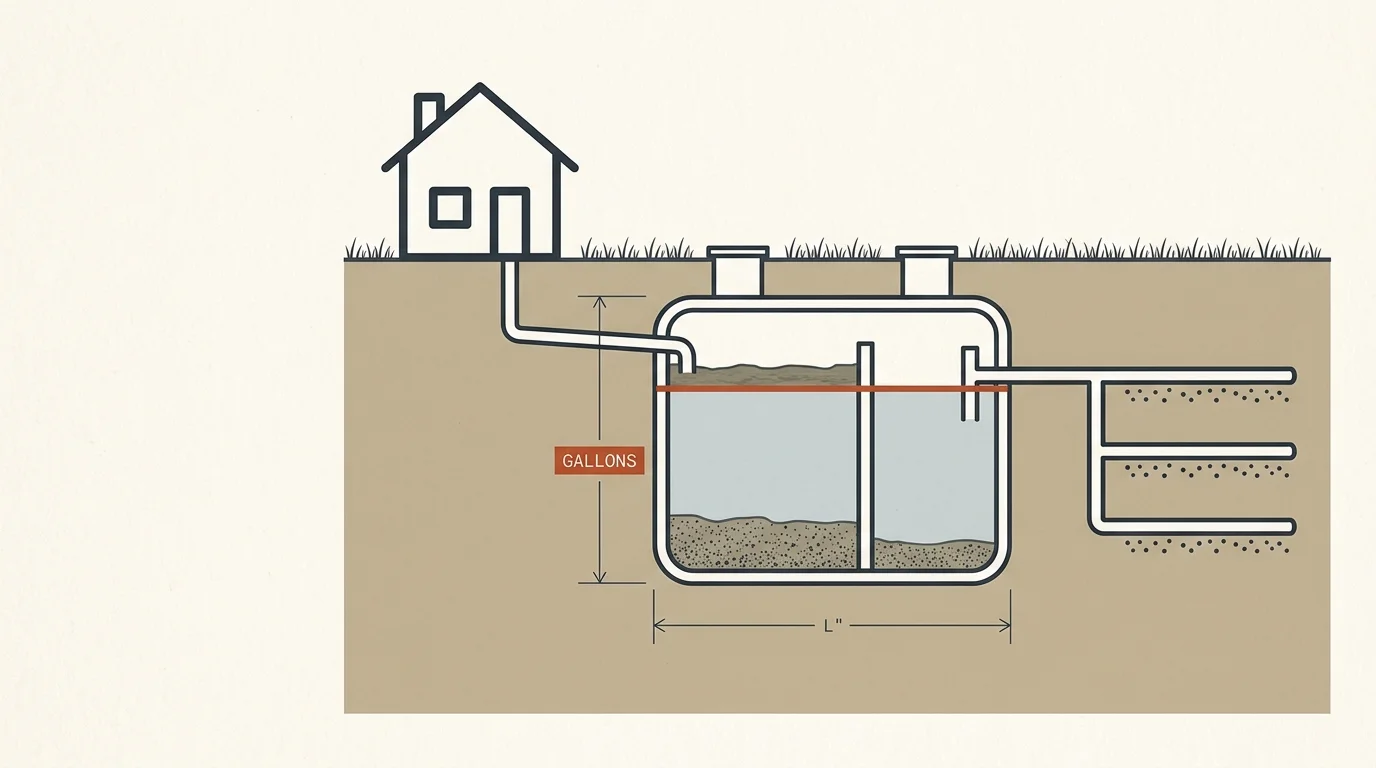
A septic tank size calculator ensures your system handles your household’s wastewater volume without backing up, overloading the drain field, or requiring premature pumping. Septic tank sizing is governed by both local health department regulations and practical engineering — get it wrong and the consequences range from foul odours to groundwater contamination and a failed drain field that costs $10,000 to $30,000 to replace. Our septic tank size calculator factors in your bedroom count, daily water usage, local code requirements, and soil conditions to recommend the right tank capacity.
Enter your property details below for a personalised recommendation. Then read the full guide for sizing formulas, tank types and costs, drain field requirements, and the maintenance schedule that keeps the system running for decades.
Calculation method and important limitations
The calculator uses the greater of bedroom-based design flow and occupant-based design flow. Selected high-use conditions add a planning allowance. Required liquid capacity is design flow multiplied by detention time and any treatment/configuration factor, then compared with a bedroom-rule minimum and the entered local minimum. The result rounds up to the next common U.S. tank size. A pump-chamber allowance is displayed separately.
Maryland’s residential rule uses at least 1,000 gallons for three or fewer bedrooms, 1,250 gallons for four bedrooms, and another 250 gallons per added bedroom; it also uses 150 gallons per day per bedroom. Virginia’s septic-tank rule requires at least 48 hours of detention based on design flow and provides a bedroom table, though its absolute minimum may be 750 gallons. University of Nebraska–Lincoln Extension notes a 1,000-gallon minimum for three or fewer bedrooms in Nebraska, plus 250 gallons for each additional bedroom. Requirements vary significantly by jurisdiction.
This estimates septic tank liquid capacity only. It does not size the absorption field, mound, pressure distribution, advanced treatment unit, grease interceptor or pump controls. Soil and site evaluation, percolation or hydraulic loading, setbacks, seasonal groundwater, reserve area, bedroom classification and local code govern final design. Use a licensed septic designer or engineer and obtain health-department approval.
How a Septic Tank Size Calculator Works
Every septic tank size calculator starts with the number of bedrooms in the home — not the number of residents. Health departments use bedroom count because it represents the maximum occupancy a home could sustain, regardless of who lives there currently. Then, the calculator applies the minimum tank size required by code for that bedroom count and adjusts upward for high-water-use fixtures (multiple bathrooms, whirlpool tubs, garbage disposals, water softeners).
As a result, the output is the minimum tank capacity in gallons that meets both code and practical performance requirements. However, going one size larger than the minimum is almost always worthwhile — the marginal cost is small, and the larger tank provides a buffer against peak usage and allows longer intervals between pumpings.
Septic Tank Size Calculator: Sizing Chart
Here is the standard sizing chart used by most health departments and septic engineers. These are minimum tank sizes — the septic tank size calculator above may recommend a larger size based on your specific inputs.
- 1–2 bedrooms: 750 – 1,000 gallons.
- 3 bedrooms: 1,000 – 1,250 gallons. The most common residential tank size.
- 4 bedrooms: 1,250 – 1,500 gallons.
- 5 bedrooms: 1,500 – 1,750 gallons.
- 6 bedrooms: 1,750 – 2,000 gallons.
Specifically, many jurisdictions mandate a minimum of 1,000 gallons regardless of bedroom count. Furthermore, adding 250 gallons per bedroom beyond three is the standard increment used in most state codes. Homes with garbage disposals typically require a tank 25% larger than the baseline because ground food waste adds significant solid volume.
Average Septic Tank Cost by Size in 2026
Tank and installation costs vary by material and capacity. Here are 2026 installed prices for the most common configurations.
- 1,000-gallon concrete tank: $2,500 – $5,000 installed. The most common residential choice.
- 1,000-gallon plastic (polyethylene) tank: $1,500 – $4,000 installed. Lighter and easier to transport to remote sites.
- 1,000-gallon fiberglass tank: $2,000 – $5,000 installed. Corrosion-resistant with the longest lifespan.
- 1,500-gallon concrete tank: $3,500 – $7,000 installed.
- 2,000-gallon concrete tank: $5,000 – $10,000 installed.
Furthermore, these prices include excavation, tank delivery, placement, inlet and outlet connections, and backfill. The drain field (leach field) is priced separately and typically costs $3,000 to $15,000 depending on soil type and field size.
Septic Tank Size Calculator: Tank Material Comparison
The three main tank materials each offer distinct advantages and trade-offs.
Concrete
Concrete tanks are the industry standard. They cost $800 to $2,000 for the tank (before installation) and last 40 to 50+ years when properly maintained. Additionally, their weight makes them resistant to floating in high water table conditions. However, concrete can crack over time due to ground movement, tree root pressure, or corrosion from hydrogen sulfide gas. Consequently, periodic inspection of the tank’s structural integrity is important.
Plastic (Polyethylene)
Plastic tanks cost $500 to $1,500 for the tank and last 30 to 40 years. They are lightweight, corrosion-resistant, and easier to transport to sites with limited access. However, their light weight makes them susceptible to floating out of the ground in areas with high water tables unless anchored. Furthermore, plastic tanks may deform under heavy soil loads if not properly backfilled with gravel.
Fiberglass
Fiberglass tanks cost $1,200 to $3,000 for the tank and last 40 to 50 years. They combine the corrosion resistance of plastic with better structural rigidity. Additionally, fiberglass resists the hydrogen sulfide corrosion that degrades concrete over time. However, they share the flotation risk of plastic tanks in high water table areas. Our land survey cost calculator covers the site evaluation costs that determine water table depth and soil conditions before septic design.
Septic Tank Size Calculator: Drain Field Sizing
The drain field (leach field) receives clarified effluent from the septic tank and disperses it into the soil for final treatment. Drain field size depends on two factors: daily wastewater volume and soil percolation rate.
Percolation test: $200 to $600. A perc test measures how fast water drains through your soil. Sandy soils drain quickly (under 10 minutes per inch), while clay soils drain slowly (60+ minutes per inch). The perc rate determines how many linear feet of drain field trench are required per bedroom.
Drain field sizing: Typical residential systems use 150 to 300 linear feet of trench per bedroom. Sandy soil requires less field area; clay soil requires more. Furthermore, a reserve drain field area (typically 100% of the primary field) must be designated on the property for future replacement.
Drain field cost: $3,000 to $15,000 depending on soil type, system design, and field size. Conventional gravity-fed systems are the least expensive. Pressure-distribution systems ($8,000 to $15,000) distribute effluent more evenly and are required in challenging soil conditions. Mound systems ($10,000 to $20,000) raise the field above the natural grade for sites with high water tables or bedrock. Our home inspection cost calculator covers septic system inspection as part of property purchase assessments.
Factors That Increase Septic Tank Size Requirements
Several household features push the required tank size above the baseline bedroom-count recommendation.
First, garbage disposals increase solid waste volume by 30% to 50%. Most codes require a 25% upsize when a garbage disposal is present. Consequently, a 3-bedroom home with a disposal needs a 1,250-gallon tank instead of 1,000.
Second, water softeners discharge backwash brine into the septic system, adding significant hydraulic load. Some engineers recommend routing softener discharge to a separate dry well rather than the septic tank to reduce this impact.
Third, whirlpool tubs and high-flow fixtures add peak-flow capacity demands. A standard bathtub holds 40 gallons; a whirlpool holds 60 to 100 gallons. Draining a whirlpool dumps a large surge into the tank that can push solids into the drain field.
Fourth, home-based businesses that generate wastewater (laundry services, beauty salons, food preparation) increase daily flow beyond residential norms. These uses typically require commercial-grade system design and permitting. Our home addition cost calculator covers the septic implications of adding bedrooms or bathrooms to an existing home.
Septic Tank Maintenance and Pumping Costs
Regular maintenance is the single most important factor in septic system longevity.
Tank pumping: $300 to $600 every 3 to 5 years. Pumping removes accumulated solids (sludge and scum) before they overflow into the drain field. A properly sized and maintained tank needs pumping every three to five years for a typical family of four. Skipping or delaying pumping is the most common cause of drain field failure.
Inspection: $100 to $300 per visit. Annual inspections check sludge levels, look for signs of backup, and verify that the baffle and outlet filter (if installed) are functioning. Many states require inspections at specific intervals — every one to three years.
Outlet filter: $100 to $300 installed. An effluent filter on the tank outlet prevents solids from reaching the drain field. Cleaning it annually ($50 to $100 for a service call) is far cheaper than replacing a clogged drain field.
How to Get the Best Price on a Septic System
Several strategies reduce costs and ensure proper design.
First, get the perc test done early. The perc test determines what system type is feasible on your site. Failing to test before buying property can result in discovering that conventional septic is impossible, requiring an engineered system costing two to three times more.
Second, get three bids from licensed septic installers. Each bid should specify tank size and material, drain field design, and whether the price includes excavation, backfill, and final grading. Furthermore, verify that the installer holds a current state license and carries liability insurance.
Third, upsize the tank by one step. The cost difference between a 1,000-gallon and a 1,250-gallon tank is typically $300 to $600 — a modest premium that provides a significant performance buffer and extends pumping intervals.
Fourth, coordinate installation with other site work. If you are already excavating for a foundation, driveway, or grading, having the septic excavation done simultaneously saves equipment mobilisation costs. Our concrete slab cost calculator covers the companion site work that often coincides with septic installation on new construction projects.
Frequently Asked Questions
What size septic tank do I need for a 3-bedroom house?
A 3-bedroom house requires a minimum 1,000-gallon septic tank in most jurisdictions. Specifically, homes with garbage disposals, water softeners, or high-flow fixtures should upsize to 1,250 gallons. The septic tank size calculator above provides a precise recommendation based on your specific features.
How much does a complete septic system cost?
A complete septic system (tank + drain field) costs $5,000 to $20,000 for a conventional gravity-fed system and $15,000 to $35,000 for engineered systems (mound, pressure distribution, or aerobic). Specifically, soil conditions and system type drive the majority of the cost variation.
How long does a septic tank last?
Concrete tanks last 40 to 50+ years. Plastic and fiberglass tanks last 30 to 40 years. The drain field lasts 20 to 30 years with proper maintenance. Consequently, the drain field — not the tank — is usually the first component that needs replacement.
Can I add a bedroom without upsizing my septic tank?
Potentially, but it depends on your current tank size and local code. Adding a bedroom increases the home’s rated occupancy, which may require a larger tank and drain field. Therefore, contact your local health department before adding bedrooms — an undersized system can result in code violations and system failure.
The Bottom Line on Septic Tank Sizing
Correct septic tank sizing protects your home, your property, and the local groundwater for decades. Use our septic tank size calculator at the top of this page to determine the right capacity, then work with a licensed installer to design a system that meets code and performs reliably.
All figures in this guide are 2026 planning estimates. Your actual system cost will vary with soil conditions, system type, and regional labour and disposal rates. Always obtain a perc test and at least three installer quotes before committing.