
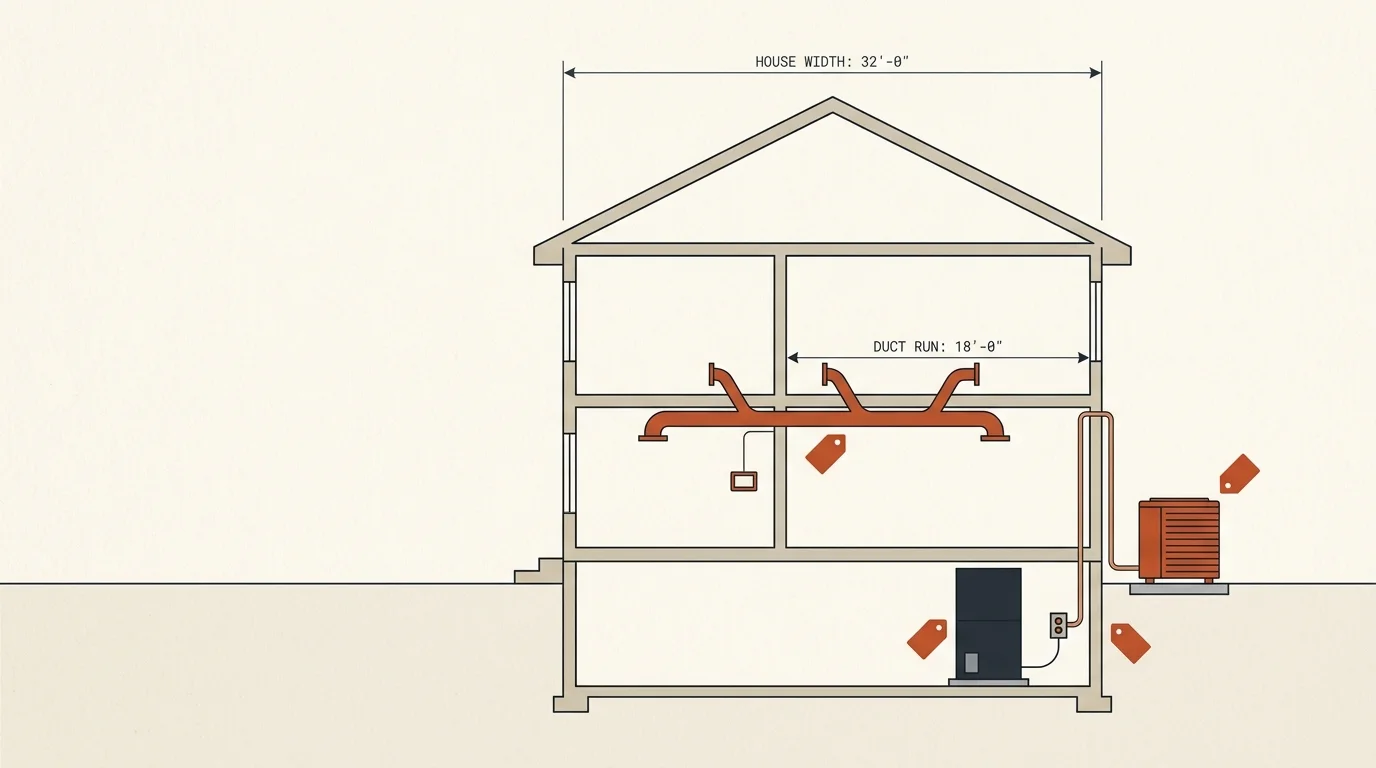
A central air installation cost calculator gives you a realistic budget for adding air conditioning to a home that currently has none — or replacing an aging system that is costing more to repair than it is worth. First-time central air installations are significantly more complex and expensive than simple replacements because they involve ductwork, electrical upgrades, and equipment placement decisions that affect comfort for decades. Our central air installation cost calculator factors in your home’s square footage, ductwork status, equipment tier, and local labour rates so the estimate matches your actual project.
Enter your home details below for a personalised estimate. Then read the full guide for 2026 installed pricing by system type, ductwork costs, efficiency trade-offs, and the hidden expenses that catch homeowners off guard.
Calculation method and important limitations
The estimate starts with an equipment allowance based on nominal tonnage, SEER2 tier, compressor type, indoor equipment and brand/warranty tier. It adds installation labor, refrigerant line work, electrical work, condensate drainage, permits, old-equipment removal, thermostat, duct repairs or replacement, project type, access difficulty and regional costs. The displayed range is a planning range around the modeled midpoint.
Current U.S. installed pricing varies widely. Carrier’s 2026 guidance places installed air-conditioning systems broadly around $3,000–$15,000 or more, depending on size, efficiency and installation. NerdWallet gives a typical central-air installation range of roughly $6,000–$11,500, while HVAC Project Cost estimates about $3,500–$9,000 with existing ducts and $8,000–$15,000+ when new ductwork is required. Planning estimate only: equipment brand, refrigerant generation, local codes, incentives, climate, load, duct design, electrical service, access, crane use, IAQ accessories and warranty terms may materially change the quote.
Do not select tonnage from floor area alone. Oversizing can cause short cycling, poor humidity control and uneven comfort. Request an ACCA Manual J load calculation, use Manual S equipment selection, and verify matched outdoor/indoor equipment through an AHRI certificate.
How a Central Air Installation Cost Calculator Works
Every central air installation cost calculator starts with your home’s cooling load — determined by square footage, insulation quality, window area, and climate zone. Then, it applies the installed cost per ton for your chosen system type. Finally, it adds ductwork (if needed), electrical upgrades, thermostat, permits, and any structural modifications required to accommodate the equipment.
As a result, the output covers every cost component from the condenser pad to the thermostat wire. However, the biggest variable is whether your home already has ductwork — that single factor can double the total project cost.
Average Central Air Installation Cost in 2026
Central air conditioning installation costs $3,500 to $7,500 for a home with existing ductwork and $7,000 to $15,000+ for a first-time installation that includes new ductwork. Specifically, here is how the major components break down.
- Central AC unit (condenser + evaporator coil): $2,000 – $5,500 depending on brand, efficiency, and tonnage.
- Installation labour: $1,500 – $3,500 for a standard replacement; $3,000 – $6,000 for a new installation with ductwork.
- Ductwork (if needed): $3,000 – $7,500 for a complete new duct system.
- Electrical upgrades: $500 – $2,500 for disconnect, whip, and potential panel upgrade.
- Thermostat: $150 – $400 for a programmable or smart thermostat.
- Permits and inspections: $100 – $500.
Furthermore, adding central air to a home that previously used window units or no cooling at all consistently falls at the higher end because of the ductwork and electrical work involved.
Central Air Installation Cost Calculator: Price by System Type
The system you choose determines both the upfront cost and the long-term operating expense.
Split-System Central AC
A conventional split system uses an outdoor condenser and an indoor evaporator coil mounted on the furnace or air handler. This is the most common and typically most affordable option. Installed cost runs $3,500 to $7,500 with existing ductwork. Consequently, split systems are the default choice for homes that already have a forced-air furnace with ductwork in place.
Heat Pump (Heating and Cooling)
A heat pump provides both cooling and heating from a single outdoor unit. Installed cost runs $5,000 to $10,000 with existing ductwork. Additionally, federal tax credits offset up to $2,000 per year on qualifying heat pump installations, significantly reducing the effective cost. Therefore, heat pumps are increasingly popular for new installations where they replace both the AC and the furnace. Our blown-in insulation calculator helps homeowners reduce their cooling load before sizing equipment.
Packaged System
A packaged system combines the condenser and air handler in a single outdoor cabinet. They cost $4,000 to $8,000 installed and are common in homes without basement or attic space for an indoor unit — particularly slab-on-grade homes in warmer climates. However, packaged systems are generally less efficient than split systems because all components sit outdoors.
Central Air Installation Cost Calculator: Sizing by Tonnage
Air conditioning capacity is measured in tons (one ton = 12,000 BTU per hour). Correct sizing is critical — oversized units short-cycle and fail to dehumidify, while undersized units run constantly without reaching setpoint.
- 1.5 ton (18,000 BTU): $3,000 – $5,500 installed. Homes under 1,000 sq ft.
- 2 ton (24,000 BTU): $3,500 – $6,500 installed. 1,000–1,300 sq ft.
- 2.5 ton (30,000 BTU): $4,000 – $7,500 installed. 1,300–1,700 sq ft.
- 3 ton (36,000 BTU): $4,500 – $8,500 installed. 1,700–2,100 sq ft.
- 4 ton (48,000 BTU): $5,500 – $10,500 installed. 2,100–2,700 sq ft.
- 5 ton (60,000 BTU): $6,500 – $12,000 installed. 2,700–3,500 sq ft.
Specifically, these ranges assume average insulation and standard 8-foot ceilings. Poorly insulated homes, homes with high ceilings, or homes in extreme climates may need a size tier higher. The central air installation cost calculator adjusts for these variables automatically.
Ductwork Costs for First-Time Central Air Installation
Ductwork is the biggest expense differentiator between a replacement and a first-time installation. A complete new duct system for a 2,000-square-foot home costs $3,000 to $7,500 depending on layout complexity, material choice (sheet metal vs. flex duct), and accessibility.
Homes with existing ductwork from a furnace or heating system save this entire cost — the central air system uses the same ducts. However, existing ducts may be undersized for the cooling load, poorly sealed, or deteriorated. Consequently, duct testing and potential modifications should be part of every central air installation quote. Our ductwork replacement cost calculator covers duct-specific costs in detail.
For homes where ductwork installation is impractical — historic homes, slab-on-grade construction, or homes with finished ceilings that would require extensive demolition — ductless mini-split systems offer an alternative. A multi-zone ductless system costs $5,000 to $15,000 installed and avoids ductwork entirely.
Central Air Installation Cost Calculator: Efficiency and SEER2
SEER2 (Seasonal Energy Efficiency Ratio) measures cooling efficiency. Higher SEER2 means lower electricity consumption per BTU of cooling delivered.
Federal minimums in 2026 are 14.3 SEER2 in the North and 15 SEER2 in the South. Premium units reach 22 to 26 SEER2. However, each SEER2 tier increase adds $500 to $1,500 to equipment cost. Therefore, the sweet spot for most homeowners is 16 to 19 SEER2 — enough to meaningfully reduce bills without paying for diminishing efficiency returns.
Specifically, upgrading from 14.3 to 18 SEER2 reduces cooling costs by 20% to 25%. In a home spending $800 per summer on cooling, that saves $160 to $200 annually. As a result, the efficiency upgrade pays back in three to five years in hot climates and five to eight years in moderate climates.
Central Air Installation Cost Calculator: Hidden Expenses
Several costs appear on virtually every central air project beyond the core equipment and labour.
First, electrical panel upgrade. Central AC requires a dedicated 220/240V circuit. If your panel lacks capacity — common in older homes with 100-amp service — a panel upgrade costs $1,500 to $4,000. Furthermore, the electrical disconnect box, wiring, and conduit from panel to condenser add $300 to $800.
Second, concrete equipment pad. The outdoor condenser sits on a concrete or composite pad. A pre-cast pad costs $50 to $150. A poured concrete pad costs $150 to $400. Specifically, the pad must be level, at least 3 inches above grade, and clear of vegetation on all sides for airflow.
Third, refrigerant line set. Copper refrigerant lines connecting the outdoor unit to the indoor coil cost $3 to $8 per linear foot installed. A typical 20- to 50-foot run adds $60 to $400. Additionally, the line set must be insulated and properly supported along its entire length.
Fourth, structural modifications. First-time installations may require cutting an opening for the evaporator coil in the furnace plenum, routing ductwork through walls or ceilings, or creating equipment access in the attic or crawlspace. These modifications add $500 to $2,500 depending on scope. Our home addition cost calculator covers HVAC costs as part of larger expansion projects.
How to Get the Best Price on Central Air Installation
Several strategies consistently reduce costs.
First, install in the off-season. Spring and fall are the slow periods for HVAC contractors. Scheduling during these windows typically yields 5% to 15% lower bids. Consequently, planning ahead rather than emergency-installing during a heat wave saves real money.
Second, get three itemised quotes. Each bid should specify equipment model numbers, SEER2 ratings, ductwork scope, electrical work, warranty terms, and permit costs. Comparing lump-sum bids is meaningless — comparing line items across three contractors reveals pricing differences.
Third, stack incentives. Federal tax credits, utility rebates, and manufacturer promotions can combine to reduce the effective cost by $1,000 to $5,000 on qualifying equipment. However, confirm eligibility before purchasing — some credits require specific efficiency tiers.
Fourth, address insulation and air sealing first. Improving your building envelope before installing central air allows a smaller, cheaper system and lower operating costs permanently. Our window replacement cost estimator covers window upgrades that reduce cooling load alongside insulation improvements.
Frequently Asked Questions
How much does it cost to install central air in a 2,000-square-foot home?
Installing central air in a 2,000-square-foot home costs $4,500 to $8,500 with existing ductwork and $8,000 to $15,000 without ductwork. Specifically, the total depends on system tonnage, efficiency tier, ductwork scope, and regional labour rates.
Can I add central air to a house with no ductwork?
Yes. The two options are installing new ductwork (adding $3,000 to $7,500) or choosing a ductless mini-split system that requires no ducts at all. Consequently, the right choice depends on your home’s layout, ceiling accessibility, and whether you also need heating upgrades.
How long does central air installation take?
A replacement on existing ductwork takes one day. A first-time installation with new ductwork takes three to five days. Specifically, ductwork fabrication and installation account for the additional time. Electrical upgrades, if needed, add a half-day to one day.
Does central air add home value?
Yes. Homes with central air sell for 5% to 10% more than comparable homes without it. Furthermore, central air is expected by buyers in most markets — its absence is a significant deterrent. As a result, central air installation is one of the highest-ROI HVAC upgrades available.
The Bottom Line on Central Air Installation Costs
Central air transforms home comfort and adds measurable value to your property. Use our central air installation cost calculator at the top of this page to estimate your specific project, then bring that number to contractor conversations knowing exactly what a fair price looks like for your home.
All figures in this guide are 2026 planning estimates. Your actual cost will vary with system type, ductwork requirements, and regional labour rates. Always obtain at least three itemised quotes before committing to a contractor.