
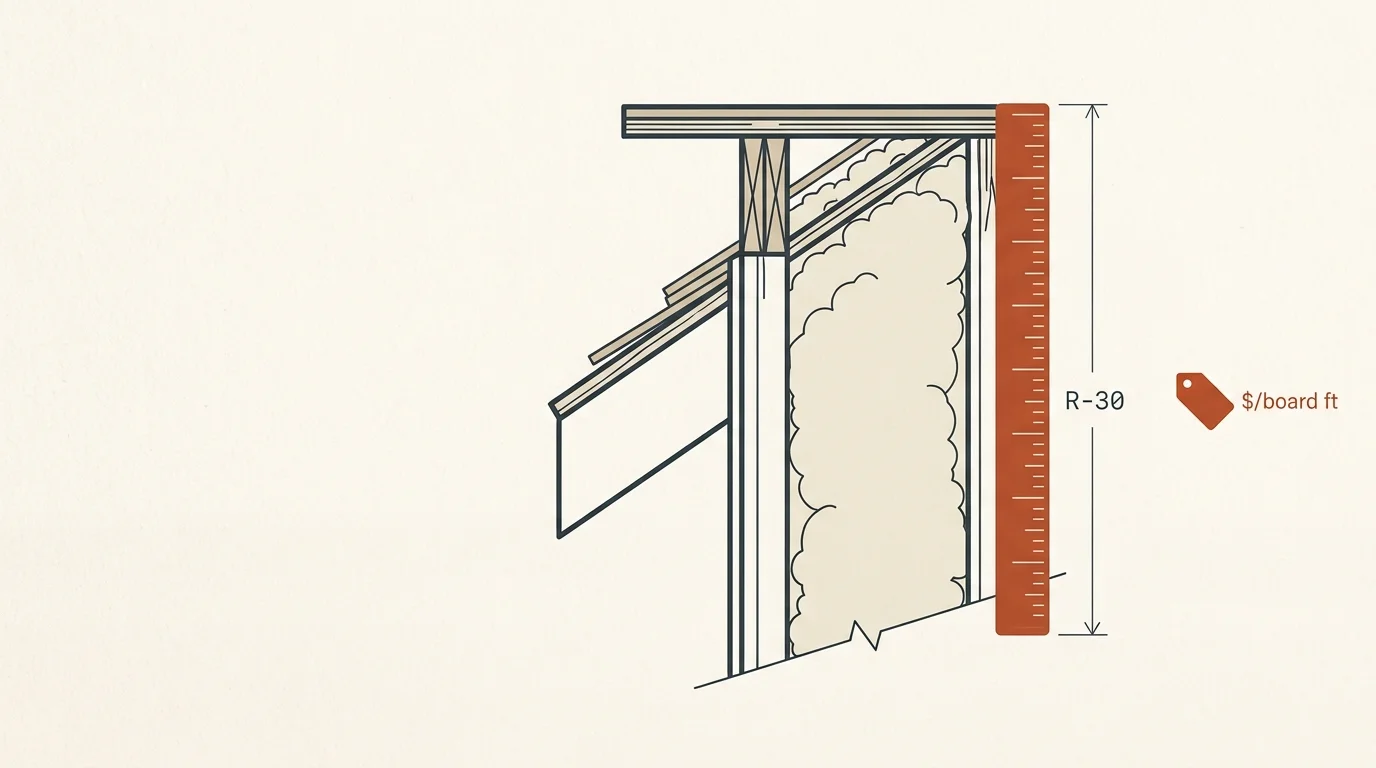
U.S. pricing basis and calculation
The calculator uses installed board-foot rates from Angi’s 2026 spray foam cost guide: $0.60–$1.60 per board foot for open-cell foam and $1.30–$3.10 for closed-cell foam. One board foot equals one square foot at one inch thick. HomeGuide reports overall professionally installed costs of $1.50–$3.50 per square foot for open-cell and $3–$5 for closed-cell, while noting that most contractors have minimum job fees of $1,000–$2,000 or more. The board-foot method is used here because it explicitly accounts for thickness.
| Calculation | Formula |
|---|---|
| Treated surface | Entered area or length × width |
| Foam thickness from R-value | (Target R − existing R) ÷ selected R per inch |
| Board feet | Surface area × thickness in inches |
| Installed foam | Board feet × published or custom rate |
| Existing insulation removal | Optional surface area × $1–$2/sq ft |
| Contingency | User percentage applied to the included subtotal |
What is a board foot?
For spray foam pricing, one board foot is a 12-inch by 12-inch area sprayed one inch thick. A 1,000-square-foot surface at three inches requires about 3,000 board feet. Contractor estimates may include yield loss, lifts, setup, and cleanup differently, so compare the same finished thickness and product.
How should I choose an R-value?
Required R-values vary by climate zone, building assembly, location in the home, and local energy code. Use the value specified by your designer, energy auditor, contractor, or code official. Product-specific R-value per inch also varies, so replace the planning default with the manufacturer’s tested value when available.
Does spray foam need a fire barrier?
Requirements depend on the assembly and how the space is used. Foam may require an approved thermal or ignition barrier such as gypsum board or a tested coating. Confirm the exact assembly with the contractor and local code official, then enter any excluded barrier quote separately.
Why is existing insulation removal separate?
Removal depends on material, contamination, access, and disposal. The optional $1–$2 per square foot preset reflects Angi’s 2026 range for dry, non-asbestos insulation. Suspected asbestos, mold, animal waste, or wet materials require specialist assessment and should use a written quote.
What should I compare in contractor bids?
Compare foam manufacturer and product, open- or closed-cell type, installed thickness, tested R-value, board feet, substrate preparation, lift limits, ventilation, re-entry time, removal, masking and cleanup, fire-barrier scope, code inspection, warranty, exclusions, and how off-ratio foam is corrected.
A spray foam insulation cost calculator gives you a real budget once you account for thickness — the variable that per-square-foot estimates ignore entirely. Because foam is priced by board foot rather than by surface area, a 1-inch and a 4-inch application on the same wall cost four times differently.
Below, you’ll find the researched installed rates, how board feet actually work, and a free tool that produces your range instantly.
How Much Does Spray Foam Insulation Cost?
Two pricing conventions exist, and they give different answers.
Per board foot (thickness-aware):
| Foam type | Installed per board ft |
|---|---|
| Open-cell | $0.60 – $1.60 |
| Closed-cell | $1.30 – $3.10 |
Per square foot (typical project range):
| Foam type | Installed per sq ft |
|---|---|
| Open-cell | $1.50 – $3.50 |
| Closed-cell | $3.00 – $5.00 |
The board-foot method is more accurate, since it explicitly accounts for how thick the application is. A per-square-foot figure only works when you already know the assumed thickness behind it.
Board-foot rates come from Angi’s 2026 spray foam guide, with per-square-foot ranges cross-referenced from HomeGuide.
What Is a Board Foot?
This is the concept that makes foam pricing make sense.
One board foot = 1 sq ft sprayed 1 inch thick
The formula is simple:
Board feet = Surface area (sq ft) × Thickness (inches)
For example, a 1,000 sq ft attic roof deck at 3 inches:
- 1,000 × 3 = 3,000 board feet
- At open-cell rates: $1,800 to $4,800
- At closed-cell rates: $3,900 to $9,300
Consequently, doubling your thickness doubles your cost. That’s exactly the relationship a flat per-square-foot quote hides.
👉 Try the free Spray Foam Insulation Cost Calculator
Open Cell vs Closed Cell Spray Foam
The choice affects cost, performance and where the foam can be used.
| Open-cell | Closed-cell | |
|---|---|---|
| R-value per inch | R-3.5 to R-3.7 | R-5 to R-7 |
| Installed cost | $0.60 – $1.60 / bd ft | $1.30 – $3.10 / bd ft |
| Density | Low, soft and spongy | High, rigid |
| Moisture behaviour | Permeable to vapour | Acts as a vapour retarder |
| Structural contribution | None | Adds racking strength |
| Sound dampening | Better | Less effective |
| Expansion | High, fills cavities well | Lower, more controlled |
Cost comparison at equal R-value:
To reach R-20 on 1,000 sq ft:
- Open-cell — 5.6 inches, 5,600 board feet, roughly $3,360 to $8,960
- Closed-cell — 3.1 inches, 3,100 board feet, roughly $4,030 to $9,610
So closed-cell isn’t dramatically more expensive per unit of R-value. However, it reaches that performance in far less depth, which matters enormously in shallow rafter bays or wall cavities.
Where closed-cell is usually required:
- Crawl spaces and rim joists
- Basements and below-grade walls
- Any moisture-prone assembly
- Where cavity depth is limited
Calculating Thickness From R-Value
Rather than guessing at inches, work backward from your target.
Thickness = (Target R − Existing R) ÷ R-value per inch
Planning defaults:
- Open-cell — 3.6 per inch
- Closed-cell — 6.5 per inch
For instance, a target of R-30 with nothing existing:
- Open-cell: 30 ÷ 3.6 = 8.3 inches
- Closed-cell: 30 ÷ 6.5 = 4.6 inches
Importantly, use the manufacturer’s tested value for your specific product when you have it. R-value per inch varies between formulations, so the planning defaults are a starting point rather than a specification.
Additionally, required R-values depend on your climate zone, assembly type and local energy code. Consult your designer, energy auditor or code official rather than assuming a number.
The Minimum Job Fee
This catches out anyone pricing a small project.
Typical minimum: $1,000 – $2,000
Because spray foam requires a rig, mobilisation, mixing equipment and cleanup regardless of job size, contractors apply a floor price.
Consequently, a 200 sq ft rim joist at 2 inches — only 400 board feet, or roughly $520 in calculated foam — will still be billed at the minimum.
This makes small spray foam jobs poor value per square foot. Therefore, bundle multiple areas into one visit wherever possible, since you’re paying the mobilisation either way.
Existing Insulation Removal
If old material must come out first, budget separately.
Removal: $1 – $2 per square foot for dry, non-asbestos material.
On 1,000 sq ft, that’s $1,000 to $2,000.
Requires specialist assessment instead:
- Suspected asbestos or vermiculite
- Mould growth
- Rodent contamination or animal waste
- Wet or water-damaged material
Never proceed with standard removal pricing where any of these exist. Instead, get a written quote from a qualified remediation contractor.
Fire Barriers and Code Requirements
Spray foam frequently requires a covering, and this is regularly excluded from quotes.
Depending on the assembly and how the space is used, foam may need an approved thermal or ignition barrier — typically gypsum board or a tested intumescent coating.
Where it usually applies:
- Attics and crawl spaces used for storage
- Garages
- Any occupied or accessible space
- Basements with living areas
Requirements vary by assembly and jurisdiction. Therefore, confirm the exact requirement with your contractor and local code official, then enter any excluded barrier cost separately.
Ventilation and Re-Entry Safety
This matters more than most homeowners realise.
The US EPA advises that occupants and unprotected workers vacate during installation. Re-entry should wait until the product has cured and the building has been adequately ventilated and cleaned.
Before booking, confirm:
- How long the house must be vacated
- The ventilation plan during and after application
- When re-entry is safe for your specific product
- Whether pets and plants need removing
- HVAC shutdown and filter replacement
Re-entry time varies by product and conditions, so follow the manufacturer and installer instructions exactly rather than a general rule of thumb.
How to Use the Spray Foam Insulation Cost Calculator
Follow these steps for an accurate budget.
1 — Enter your surface area
Measure the actual surface being sprayed, not your home’s floor area.
2 — Select the installation location
This documents scope for your contractor conversations.
3 — Choose your foam type
Open-cell or closed-cell, based on the assembly and moisture exposure.
4 — Set your thickness
Enter inches directly, or calculate from a target R-value.
5 — Choose your pricing basis
Use published board-foot rates, or enter a contractor’s quoted figures.
6 — Keep the minimum fee ticked
Most contractors apply one, so leaving it on gives a realistic floor.
7 — Add removal and quoted extras
Include barrier, drywall repair and any remediation quotes.
8 — Review board feet and achieved R-value
Both figures help you compare bids on equal terms.
Comparing Contractor Bids
Foam quotes are hard to compare because thickness is often unstated.
Ask every contractor to specify:
- Manufacturer and product name
- Open-cell or closed-cell
- Installed thickness in inches
- Tested R-value per inch
- Total board feet
- Substrate preparation
- Lift limits per pass
- Ventilation plan and re-entry time
- Removal and disposal scope
- Masking and cleanup
- Fire-barrier scope and who provides it
- Code inspection responsibility
- Warranty and exclusions
- How off-ratio foam is corrected
That last point matters. Because improperly mixed foam can fail to cure and produce persistent odours, knowing the remedy beforehand protects you.
Frequently Asked Questions
How much does spray foam insulation cost?
Open-cell runs $0.60 to $1.60 per board foot installed, while closed-cell runs $1.30 to $3.10. Most contractors also apply a $1,000 to $2,000 minimum job fee.
Is the spray foam insulation cost calculator free?
Yes, entirely free with no sign-up. Moreover, you can download a PDF or copy the summary for comparing bids.
What’s the difference between open and closed cell?
Open-cell is softer, cheaper and vapour-permeable at R-3.5 to R-3.7 per inch. Closed-cell is rigid, moisture-resistant and reaches R-5 to R-7 per inch.
How thick should spray foam be?
Divide your target R-value by the product’s R-value per inch. Reaching R-30 needs about 8.3 inches of open-cell or 4.6 inches of closed-cell.
Are DIY spray foam kits worth it?
They suit very small gaps and rim joists. However, achieving consistent thickness, correct mix ratio and safe ventilation is genuinely difficult without professional equipment.
Does spray foam need to be covered?
Often, yes. Many assemblies require an approved thermal or ignition barrier, so confirm the requirement with your contractor and local code official.
Budget Your Insulation Now
Rather than guessing at cost, enter your surface area and target R-value to see board feet, thickness and a costed range immediately. Afterwards, you’ll be able to compare bids on identical terms.
1 thought on “Spray Foam Insulation Cost Calculator: Board Foot Pricing”