
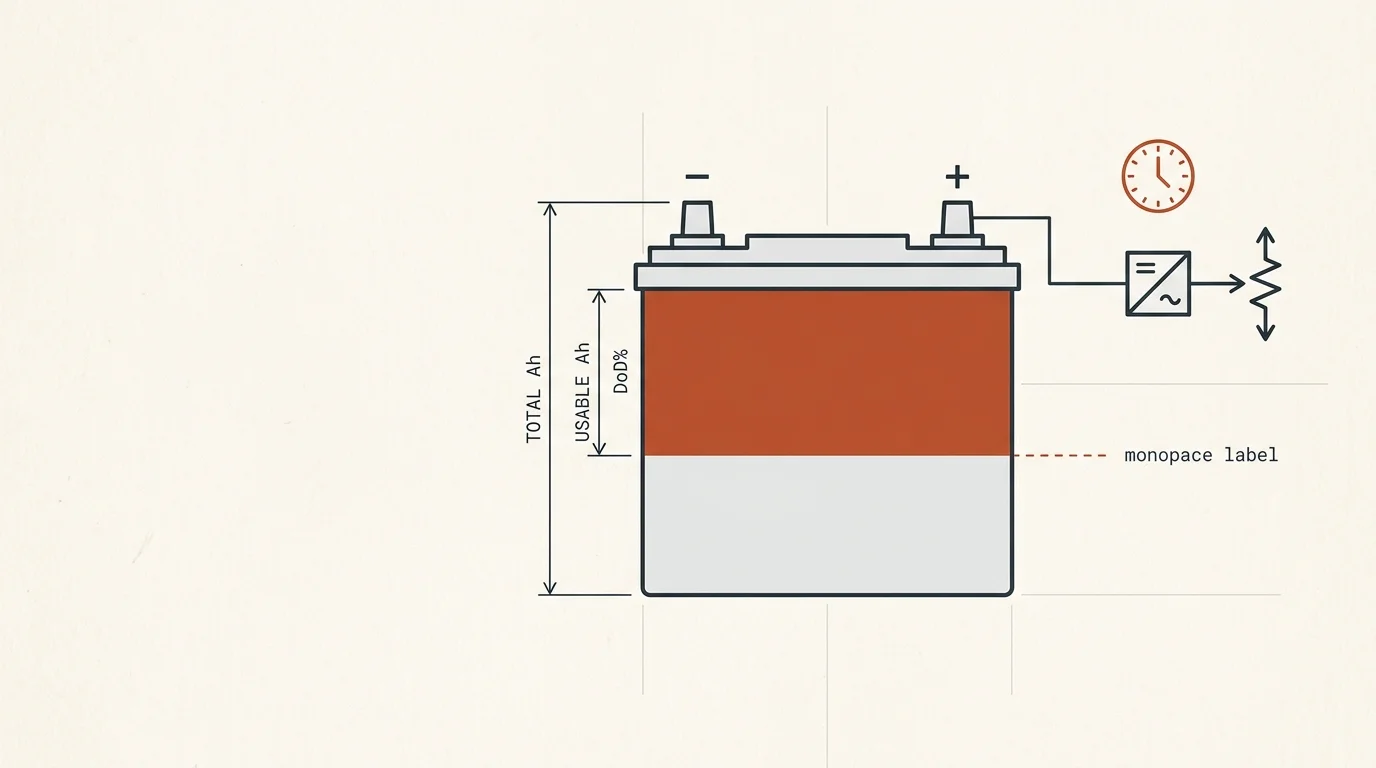
A battery run time calculator answers the question every off-grid user, UPS planner, and DIY electronics enthusiast needs answered: how long will this battery actually last under my specific load? The math is straightforward once you understand it, but getting the inputs right — capacity, discharge rate, efficiency losses, and depth of discharge — is where most people go wrong. Our battery run time calculator handles all of those variables so you get an accurate estimate in seconds.
Enter your battery specs and load details below. Then read on for a complete guide to battery capacity, discharge curves, real-world efficiency factors, and the formulas behind the numbers.
Calculation method and important limitations
Nominal bank energy is voltage × amp-hours, or the entered watt-hours multiplied by the number of batteries. Usable energy applies depth of discharge, retained capacity, and the conditions factor. AC load is adjusted for inverter efficiency and standby draw. For discharge rates above the battery’s rating current, the tool applies a conservative Peukert adjustment. Battery size for the target runtime uses the same assumptions.
Manufacturer references: Victron Energy — battery capacity and Peukert exponent and Victron Energy — discharge floor and default exponents. This is a planning estimate, not an electrical design. Actual runtime varies with battery chemistry, age, temperature, discharge curve, cable loss, load cycling, surge demand, cutoff settings, and manufacturer ratings.
How a Battery Run Time Calculator Works
The core formula behind every battery run time calculator is simple: Run Time (hours) = Battery Capacity (Ah) ÷ Load Current (A). However, this basic equation assumes perfect conditions — 100% efficiency, constant discharge rate, and full capacity availability. In reality, none of those assumptions hold.
Therefore, an accurate calculator applies correction factors for inverter efficiency (typically 85% to 95%), depth of discharge limits (50% for lead-acid, 80% to 100% for lithium), and Peukert’s effect on lead-acid batteries. As a result, the real-world run time is always shorter than the theoretical maximum, and the calculator accounts for that gap.
Battery Run Time Calculator: Key Input Variables
Understanding each input ensures you get a meaningful result from the battery run time calculator rather than an optimistic number that falls short in practice.
Battery Capacity (Amp-Hours)
Capacity is rated in amp-hours (Ah) and tells you how much current the battery can deliver over a specified period. A 100 Ah battery can theoretically deliver 1 amp for 100 hours, 10 amps for 10 hours, or 100 amps for 1 hour. However, the rated capacity is measured at a specific discharge rate — typically the C/20 rate (draining over 20 hours). Drawing current faster than the rated discharge rate reduces the usable capacity, sometimes dramatically.
Furthermore, battery capacity degrades over time. A three-year-old lead-acid battery may retain only 70% to 80% of its original capacity. Lithium batteries hold closer to 90% to 95% after the same period. Consequently, always use the current effective capacity rather than the nameplate rating for accuracy.
Load (Watts or Amps)
Your load is the total power draw of the devices running on the battery. If your devices list wattage, convert to amps using: Amps = Watts ÷ Voltage. For example, a 60-watt laptop charger on a 12-volt battery draws 5 amps. Additionally, remember to add the loads of all devices running simultaneously — the calculator needs total system draw, not individual device draw.
Battery Voltage
Common battery voltages include 6V, 12V, 24V, and 48V for lead-acid and lithium systems. The voltage must match your system configuration. Specifically, two 12V batteries wired in series produce 24V with the same amp-hour rating, while two wired in parallel produce 12V with double the amp-hours. The calculator needs the system voltage, not the individual battery voltage, when multiple batteries are connected.
Depth of Discharge (DoD)
Depth of discharge is the percentage of capacity you can actually use without damaging the battery. Lead-acid batteries should not discharge below 50% regularly — doing so dramatically shortens their lifespan. In contrast, lithium iron phosphate (LiFePO4) batteries tolerate 80% to 100% DoD without significant degradation. As a result, a 100 Ah lithium battery delivers 80 to 100 usable amp-hours, while a 100 Ah lead-acid battery delivers only 50.
Battery Run Time Formulas Explained
Here are the formulas the battery run time calculator uses, from basic to advanced.
Basic Formula
Run Time (hours) = (Battery Capacity × DoD) ÷ Load Current
For example, a 100 Ah lead-acid battery at 50% DoD powering a 10-amp load: (100 × 0.50) ÷ 10 = 5 hours. However, this still ignores efficiency losses and Peukert’s effect.
With Inverter Efficiency
If you are running AC devices through an inverter, the inverter itself consumes power. Therefore, divide the result by the inverter efficiency: Run Time = (Capacity × DoD) ÷ (Load ÷ Efficiency). With a 90% efficient inverter, the same example becomes: (100 × 0.50) ÷ (10 ÷ 0.90) = 50 ÷ 11.1 = 4.5 hours. That 10% efficiency loss costs half an hour of run time.
Peukert’s Effect (Lead-Acid Only)
Peukert’s law describes how high discharge rates reduce the usable capacity of lead-acid batteries disproportionately. The Peukert exponent typically ranges from 1.1 to 1.3 for flooded lead-acid batteries. Specifically, a battery rated at 100 Ah at the C/20 rate may deliver only 80 Ah at the C/5 rate and 60 Ah at the C/1 rate. Lithium batteries are largely immune to this effect, which is one of their key advantages.
Battery Run Time Calculator: By Battery Type
Different battery chemistries produce different real-world run times from the same capacity rating. Here is how the major types compare.
Flooded Lead-Acid
The most affordable option at $100 to $250 per 100 Ah. However, the 50% DoD limit, Peukert losses, and 3- to 5-year lifespan mean you are using only a fraction of the rated capacity. Maintenance includes regular water top-ups and equalization charges. These batteries work well for stationary applications like backup power where weight is not a concern.
AGM (Absorbed Glass Mat)
AGM batteries cost $200 to $400 per 100 Ah and offer sealed, maintenance-free operation with slightly better discharge performance than flooded batteries. They tolerate deeper cycling (down to 60% DoD) and handle high-current draws more efficiently. Consequently, AGM is popular for RVs, marine applications, and UPS systems.
Lithium Iron Phosphate (LiFePO4)
LiFePO4 batteries cost $400 to $800 per 100 Ah but deliver 80% to 100% usable capacity, suffer minimal Peukert losses, and last 2,000 to 5,000 cycles versus 300 to 500 for lead-acid. Therefore, the cost per cycle and cost per usable kWh is actually lower over the battery’s lifetime. Additionally, they weigh 40% to 60% less than equivalent lead-acid batteries.
Lithium-Ion (NMC/NCA)
These are the chemistries found in laptops, phones, and Tesla Powerwalls. They offer high energy density at $300 to $600 per 100 Ah but require more sophisticated battery management systems. Furthermore, they are more sensitive to temperature extremes and overcharging than LiFePO4. For home energy storage, LiFePO4 is generally preferred for its safety and longevity.
Practical Run Time Examples
Here are real-world scenarios calculated with efficiency and DoD adjustments to show what the battery run time calculator produces in practice.
Example 1: Camping setup. A 100 Ah LiFePO4 battery (12V, 80% DoD) powering a 50W LED light, a 30W phone charger, and a 60W fan. Total load: 140W ÷ 12V = 11.7A. Run time: (100 × 0.80) ÷ 11.7 = 6.8 hours.
Example 2: Home UPS backup. Two 100 Ah AGM batteries in parallel (12V, 200 Ah total, 60% DoD) running a 300W modem, router, and computer through a 90% efficient inverter. Effective load: 300W ÷ 12V ÷ 0.90 = 27.8A. Run time: (200 × 0.60) ÷ 27.8 = 4.3 hours.
Example 3: Solar battery at night. A 200 Ah LiFePO4 battery bank (48V, 80% DoD) running household loads of 1,500W overnight through a 95% efficient inverter. Effective load: 1,500W ÷ 48V ÷ 0.95 = 32.9A. Run time: (200 × 0.80) ÷ 32.9 = 4.9 hours. Our cost to build a house calculator includes electrical system budgeting for homeowners planning battery-integrated new builds.
How to Maximise Your Battery Run Time
Several strategies extend the usable time from any battery system.
First, reduce your load. Switching from incandescent to LED lighting, using energy-efficient appliances, and turning off devices when not in use drops the amp draw. Consequently, the same battery lasts significantly longer. A 50% reduction in load doubles your run time.
Second, use DC devices directly. Running 12V or 24V DC devices straight from the battery eliminates inverter losses. As a result, you recover the 5% to 15% efficiency penalty. LED lights, USB chargers, and 12V fans all run natively on DC.
Third, keep batteries at optimal temperature. Both lead-acid and lithium batteries lose capacity in extreme cold. Specifically, a lead-acid battery at 32°F delivers roughly 70% of its rated capacity. Insulating or temperature-regulating your battery bank preserves full performance.
Fourth, size your battery bank correctly. Oversizing by 20% to 30% beyond your calculated need provides a comfortable margin and reduces average depth of discharge, which extends battery lifespan. For homeowners planning whole-house battery backup alongside solar, our home replacement cost calculator covers how energy systems factor into dwelling value.
Frequently Asked Questions
How long will a 100 Ah battery last?
It depends entirely on your load. A 100 Ah LiFePO4 battery at 80% DoD lasts 8 hours at a 10-amp draw, 4 hours at 20 amps, or 1.6 hours at 50 amps. Specifically, divide 80 usable amp-hours by your total amp draw for the approximate run time.
Does battery voltage affect run time?
Voltage affects the amp draw for a given wattage load. A 120W load draws 10 amps from a 12V battery but only 2.5 amps from a 48V battery. Therefore, higher-voltage systems draw fewer amps, which reduces Peukert losses and improves effective run time on lead-acid batteries. However, total energy (watt-hours) remains the same.
How do I calculate battery run time for a UPS?
Determine your total connected load in watts. Divide by the battery voltage to get amps. Apply the inverter efficiency factor (typically 85% to 90%). Then divide usable capacity (Ah × DoD) by the adjusted amp draw. The battery run time calculator above handles all of these steps automatically.
Why does my battery die faster than calculated?
Common causes include degraded capacity from age, higher-than-measured loads (startup surges, background draws), cold temperatures reducing capacity, and inverter efficiency being lower than assumed. Additionally, lead-acid batteries lose capacity progressively with each deep cycle, so a three-year-old battery may deliver 20% to 30% less than its nameplate rating. Our 3D printing cost calculator is another tool that factors in electricity and runtime calculations for power-dependent projects.
The Bottom Line on Battery Run Time
Accurate run time estimation is the foundation of every battery-powered system, from a weekend camping setup to a whole-house backup. Use our battery run time calculator at the top of this page to get a realistic estimate based on your specific battery chemistry, capacity, and load — then size your system with confidence.
All figures and formulas in this guide reflect current battery specifications and industry standards. Your actual run time will vary based on battery age, temperature, and real-world load conditions.