
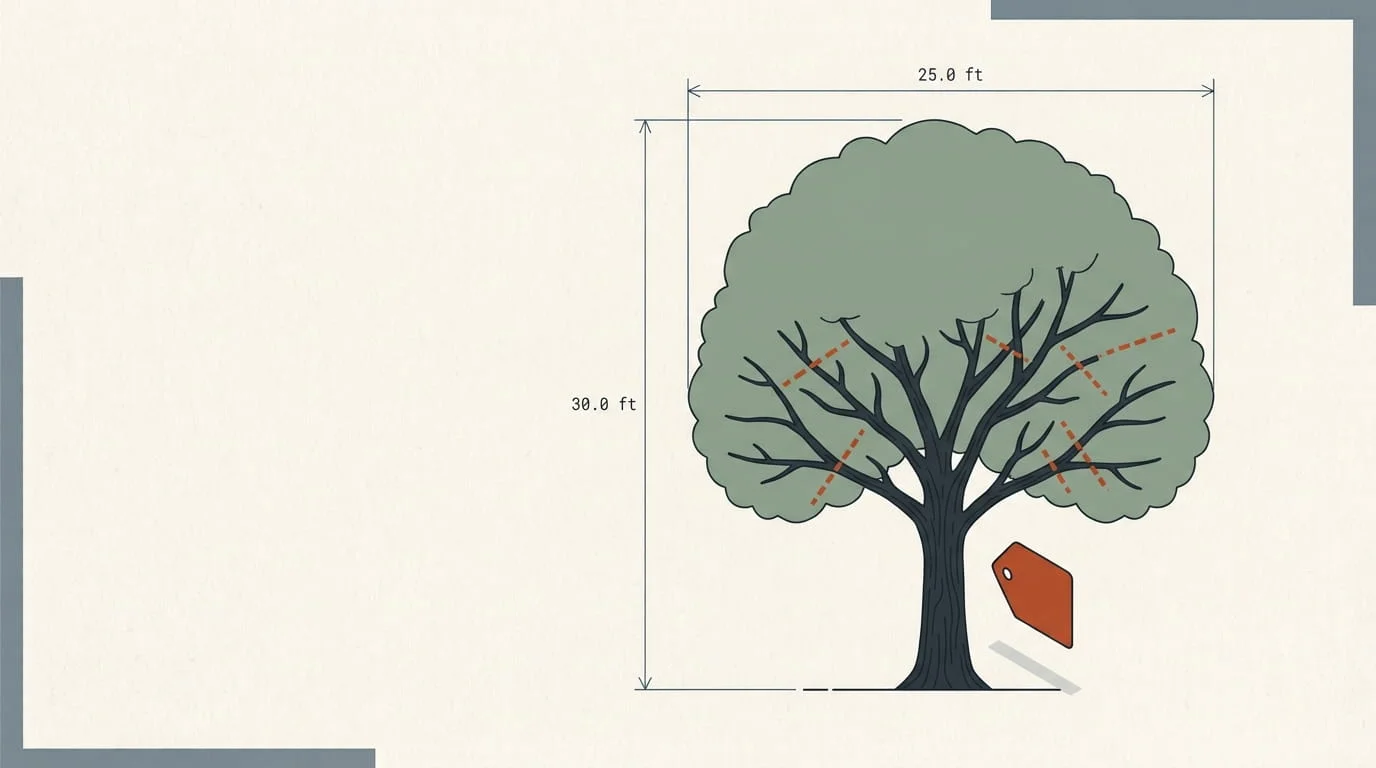
Tree Trimming Cost Calculator
Estimate professional tree-trimming costs in the United States based on tree size, quantity, access, condition, and common service add-ons.
A tree trimming cost calculator gives you a realistic price before any crew visits your property. Because quotes for the same tree routinely differ by several hundred dollars, walking into that conversation without a benchmark usually costs you money.
Below, you’ll find the real 2026 price bands, the modifiers that inflate a quote, and a free tool that builds the breakdown instantly.
How Much Does It Cost to Trim a Tree?
Height is the principal pricing factor, since taller work demands climbing gear or a bucket truck. Based on 2026 industry data:
| Tree height | Cost per tree | Example |
|---|---|---|
| Under 30 ft | $85 – $415 | Ornamental, young fruit tree |
| 30 – 60 ft | $215 – $790 | Mature maple, mid-size pine |
| Over 60 ft | $475 – $1,835 | Full-grown oak, tall conifer |
Consequently, the gap between a small ornamental and a mature shade tree is enormous. A single 70 ft oak can cost more than trimming four small trees combined.
These figures come from LawnStarter pricing data, cross-checked against HomeGuide and NerdWallet.
Tree Trimming Cost by Region
Location applies a direct multiplier to every figure above. Since labour rates and crew availability vary sharply, regional adjustment matters.
| Region | Multiplier | 30–60 ft tree |
|---|---|---|
| Lower-cost / rural | ×0.88 | $189 – $695 |
| Average-cost area | ×1.00 | $215 – $790 |
| High-cost metro | ×1.17 | $252 – $924 |
| Very high-cost coastal | ×1.32 | $284 – $1,043 |
To illustrate, trimming the same mid-size tree costs roughly 50% more on an expensive coastline than in a rural county.
👉 Try the free Tree Trimming Cost Calculator
How Tree Type Affects the Price
Branch density and growth habit both change labour hours. Therefore, species acts as a multiplier on your base figure.
| Tree type | Multiplier | Why |
|---|---|---|
| Small ornamental / palm | ×0.92 | Light branching, quick work |
| Average deciduous | ×1.00 | Baseline pricing |
| Dense hardwood (oak, maple) | ×1.12 | Heavy limbs, slow cutting |
| Tall conifer (pine, cypress) | ×1.16 | Height plus dense branching |
Notably, conifers carry the highest multiplier. Because their branches start low and continue to the crown, crews spend far longer working through the canopy.
Access Surcharges You Should Expect
Where the tree stands changes the price more than most homeowners realise. Since crews price risk alongside labour, restricted positions carry real premiums.
| Access type | Multiplier | What it means |
|---|---|---|
| Open yard | ×1.00 | Bucket truck reaches freely |
| Tight access | ×1.20 | Fences or landscaping block equipment |
| Over roof / structure | ×1.32 | Rigging and controlled branch lowering |
| Near utility lines | ×1.45 | Special coordination and safety measures |
Utility-line work carries the steepest surcharge at 45% above baseline. Furthermore, if branches actually touch power lines, call the utility company before any tree service. Many utilities clear those branches free of charge.
Above all, disclose access conditions when booking. Otherwise, the crew re-prices on arrival and your negotiating position vanishes.
Tree Condition Modifiers
Neglected trees cost more, because overdue pruning means more cuts and heavier limbs.
| Condition | Multiplier | Description |
|---|---|---|
| Healthy / routine | ×1.00 | Regular maintenance pruning |
| Overgrown / overdue | ×1.12 | Several years since last trim |
| Storm-damaged / dead branches | ×1.28 | Hazardous limbs need removal |
| Hazardous / unstable | ×1.42 | Genuine risk during the work |
Hazardous trees therefore cost 42% more than routine maintenance. Rather than deferring, trim on a regular cycle — the compounding surcharge alone usually exceeds the cost of staying on schedule.
Multi-Tree Discounts
Booking several trees at once lowers the per-tree price, since mobilisation is shared across the job.
| Trees booked | Adjustment | Effective saving |
|---|---|---|
| 1 – 3 trees | No discount | — |
| 4 – 7 trees | ×0.91 | 9% off |
| 8+ trees | ×0.86 | 14% off |
Consequently, coordinating with neighbours makes real financial sense. Eight trees across three properties in one visit costs meaningfully less than eight separate call-outs.
Optional Services and Add-On Costs
These rarely appear in an initial phone quote. Nevertheless, most jobs include at least one.
| Service | Cost | What you get |
|---|---|---|
| Debris hauling | $65 per tree, $75 minimum | Branches removed from site |
| On-site chipping | $90 per tree, $100 minimum | Wood chipped into usable mulch |
| Arborist assessment | $250 flat | Professional pruning plan |
| Emergency / same-day | +30%, $250 minimum | Rapid response scheduling |
Regarding chipping specifically, it costs slightly more than hauling yet leaves you free mulch. If you garden, that trade is usually worthwhile.
An arborist assessment deserves consideration on mature or valuable trees. Since certified arborists have no incentive to over-prune, their plan often prevents unnecessary work.
Trimming vs Removal: Which Do You Need?
These services get confused constantly, though they’re priced very differently. Because trimming preserves the tree, it avoids trunk disposal and heavy rigging entirely.
Choose trimming when:
- The tree is structurally sound
- Only specific limbs threaten property
- Growth blocks light, views or walkways
- Deadwood needs clearing for safety
Choose removal when:
- The trunk shows significant decay
- The tree leans dangerously after storms
- Roots damage foundations or pipes
- More than half the canopy is dead
Generally, trimming costs substantially less than removing the same tree. However, repeatedly trimming a failing specimen eventually costs more than removing it once.
Types of Tree Pruning
Not all trimming is the same job. Knowing the terminology helps you compare quotes fairly.
| Pruning type | Purpose | Relative cost |
|---|---|---|
| Crown cleaning | Removes dead and diseased wood | Lowest |
| Crown thinning | Opens canopy for light and airflow | Moderate |
| Crown raising | Lifts lower branches for clearance | Moderate |
| Crown reduction | Reduces overall height and spread | Highest |
Avoid any company offering to “top” your tree. Although topping sounds like a cheap height fix, it strips the canopy indiscriminately, invites decay, and frequently kills mature trees within a few years.
How to Use the Tree Trimming Cost Calculator
Follow these steps for an accurate ballpark.
1 — Estimate the height
Compare against a known reference, such as a two-storey house at roughly 25 feet.
2 — Set the number of trees
Enter everything you want done, since volume discounts trigger at four trees.
3 — Select your region
Choose based on local labour costs rather than property values.
4 — Pick the tree type
Leave it on “average deciduous” if you can’t identify the species.
5 — Choose the access level
Walk the approach first, because equipment access drives a large surcharge.
6 — Rate the condition honestly
Underestimating produces a comforting number no crew will match.
7 — Tick your optional services
Include hauling or chipping if you want the debris gone.
8 — Review the breakdown
Check the per-tree figure separately, then export or copy the estimate.
How to Reduce Tree Trimming Costs
Prices are more flexible than people assume. Try these:
- Book in late winter — dormant season demand drops sharply
- Bundle four or more trees — volume discounts start there
- Skip hauling — keep the wood if you have a fireplace
- Trim on a regular cycle — avoids the overgrown and hazardous surcharges
- Clear the work zone — move vehicles and furniture beforehand
- Avoid emergency calls — unless a limb is genuinely unstable
- Collect three quotes — pricing varies enormously between local firms
Additionally, verify the company carries liability insurance and worker’s compensation. Without both, you’re financially exposed if anyone is injured on your property.
When to Trim Your Trees
Timing affects both cost and tree health. Generally, late winter suits most species best.
- Late winter to early spring — ideal for deciduous trees while dormant
- Summer — acceptable for light corrective work
- Autumn — worst timing, since fungal spores spread readily
- After storms — anytime, for safety-critical damage
Because crews are least busy during dormant months, winter booking often earns a discount alongside the horticultural benefit.
Frequently Asked Questions
How much does it cost to trim a tree?
Costs run $85 to $415 for trees under 30 ft, $215 to $790 for 30–60 ft, and $475 to $1,835 for anything taller. Access, condition and region then adjust those figures.
Is the tree trimming cost calculator free?
Yes, entirely free with no sign-up. Moreover, you can copy the estimate or save it as a PDF before contacting anyone.
How often should trees be trimmed?
Most mature trees need attention every 3 to 5 years. Staying on that cycle also avoids the overgrown-condition surcharge.
Is trimming cheaper than removal?
Usually, yes, since the tree stays standing and no trunk disposal is needed. That said, a structurally failing tree is cheaper to remove once than trim repeatedly.
What if branches touch power lines?
Contact your utility company first. Many clear those branches free, and most tree services won’t work near live lines without utility coordination.
Does insurance cover tree trimming?
Rarely. Most policies treat maintenance pruning as a homeowner responsibility, though storm damage sometimes qualifies.
Get Your Estimate Now
Rather than guessing, enter your tree details and see a costed range immediately. Afterwards, you’ll know straight away whether a quote is fair or inflated.