
Concrete Slab Cost Calculator
Estimate concrete volume, materials, and installed cost for patios, driveways, garage floors, and foundation slabs — using current 2026 U.S. pricing.
- Basic slab installation runs $6–$12 per square foot in 2026
- Every extra inch of thickness adds roughly $0.50–$1.25 per square foot
- Add $1–$2 per square foot for rebar reinforcement
- Orders under 3–4 yards often trigger a short-load delivery fee
- Decorative or stamped finishes add $2–$4 per square foot
Concrete Slab Cost — Estimate Report
| Estimated installed cost | |
| Dimensions | |
| Number of slabs | |
| Total area | |
| Waste factor | |
| Concrete volume needed | |
| Ready-mix concrete (delivered) | |
| Bagged concrete equivalent | |
| Professional installation |
A concrete slab cost calculator answers the two questions every project starts with: how much concrete do I need, and what will it cost? Because contractors quote by the square foot while suppliers sell by the cubic yard, mixing the two units causes most budgeting errors.
Below, you’ll find real 2026 pricing, the volume formula, and a free tool that handles both sides of the maths instantly.
How Much Is a Concrete Slab?
Nationally, professionally installed slabs run $6 to $12 per square foot in 2026. On a standard 20 × 20 ft pad, that means roughly $2,400 to $4,800.
However, that band shifts significantly by region and thickness.
| Slab size | Area | Typical installed cost |
|---|---|---|
| 10 × 10 ft | 100 ft² | $600 – $1,200 |
| 12 × 12 ft | 144 ft² | $865 – $1,730 |
| 20 × 20 ft | 400 ft² | $2,400 – $4,800 |
| 24 × 24 ft | 576 ft² | $3,455 – $6,910 |
| 30 × 40 ft | 1,200 ft² | $7,200 – $14,400 |
Consequently, a two-car garage floor typically lands near the $4,000 mark, whereas a small shed pad rarely exceeds $1,000.
Concrete Slab Prices by Region
Location changes labour rates far more than material costs. Since ready-mix travels poorly, delivery distance also matters.
| Region | Installed $/ft² | Ready-mix $/yd³ | Labour $/ft² |
|---|---|---|---|
| Southeast | $5 – $9 | $135 | $4.00 |
| Midwest | $5.50 – $10 | $140 | $4.50 |
| National average | $6 – $12 | $155 | $5.00 |
| Northeast | $8 – $14 | $165 | $6.00 |
| West Coast | $9 – $16 | $185 | $7.00 |
To illustrate, the same 400 ft² patio costs about $2,800 in Georgia but nearly $5,000 in California. Therefore, always check regional pricing before trusting a national average.
👉 Try the free Concrete Slab Cost Calculator
How Much Concrete Do I Need?
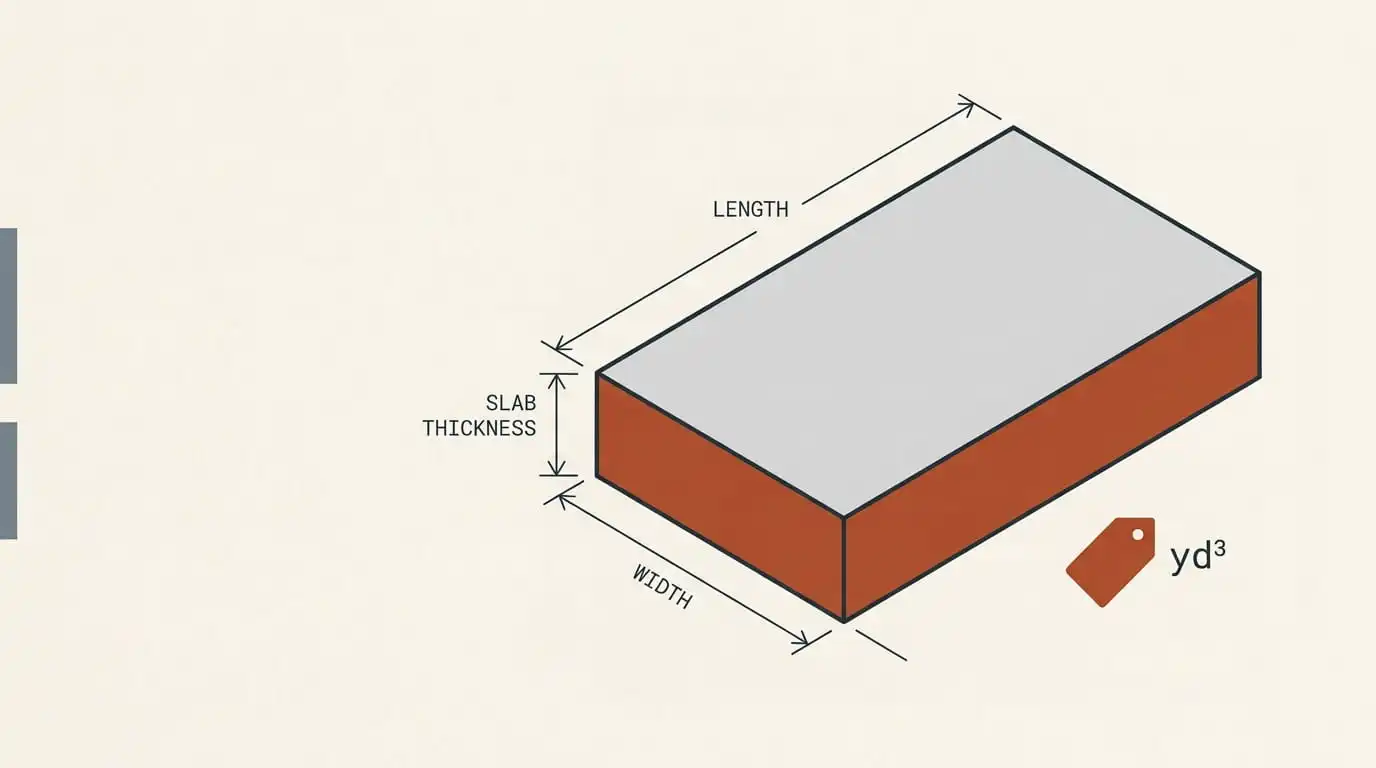
Volume comes first, since every material cost flows from it. The formula is straightforward:
Volume (yd³) = Length (ft) × Width (ft) × Thickness (ft) ÷ 27
Remember to convert thickness from inches to feet by dividing by 12.
Here’s a quick reference for common thicknesses:
| Thickness | Concrete per 100 ft² |
|---|---|
| 4 inches | 1.23 yd³ |
| 5 inches | 1.54 yd³ |
| 6 inches | 1.85 yd³ |
| 8 inches | 2.47 yd³ |
For example, a 20 × 20 ft slab at 4 inches needs 4.94 yd³ before waste. Once you add a 10% allowance, order 5.4 yd³.
Why Waste Factor Matters
Nobody pours the exact calculated volume. Because subgrades settle, forms bow and spillage happens, ordering short is a costly mistake.
Choose your allowance based on site conditions:
- 0% — theoretical only, never order this
- 5% — precise forms on a compacted, level base
- 10% — recommended default for most jobs
- 15% — uneven ground or hand-dug excavation
Running out mid-pour creates a cold joint, which permanently weakens the slab. Meanwhile, over-ordering by half a yard costs under $100. Given that trade-off, always round up.
Ready-Mix vs Bagged Concrete
This decision surprises most DIYers. Although bags feel cheaper at the store, the maths says otherwise past a certain point.
For a 400 ft² slab at 4 inches with 10% waste:
| Method | Cost | Effort |
|---|---|---|
| Ready-mix delivered | ~$840 | One truck, 90 minutes |
| Bagged (80 lb) | ~$1,650 | 245 bags, full weekend |
Each 80 lb bag yields roughly 0.6 cubic feet. As a result, you’d need about 45 bags per cubic yard.
Use bags when:
- Total volume under 1 cubic yard
- No truck access to the pour site
- Small footings, posts or repairs
Use ready-mix when:
- Volume exceeds 1 cubic yard
- The slab must be poured in one continuous session
- A consistent finish matters
Notably, orders under 3–4 yards often trigger a short-load delivery fee of $50–$150. Factor that in before assuming ready-mix wins on price.
How Thickness Affects Cost for Concrete Slab Projects
Thickness drives both material volume and structural capacity. Generally, each extra inch adds $0.50 to $1.25 per square foot.
Match your thickness to the load:
| Thickness | Best for |
|---|---|
| 4 inches | Patios, walkways, shed pads |
| 5 inches | Driveways, light vehicle traffic |
| 6 inches | Garage floors, RV pads, workshops |
| 8 inches+ | Heavy equipment, commercial loads |
Under-speccing is the more expensive error. While a thin driveway saves $400 upfront, cracking within three years costs far more to replace.
How to Use the Concrete Slab Cost Calculator
Follow these steps for an accurate estimate.
1 — Pick a project preset
Select patio, driveway or garage floor to auto-set the correct thickness.
2 — Choose your units
Switch between imperial and metric, since the tool converts your figures automatically.
3 — Enter dimensions
Measure the actual pour area, not the finished visible surface.
4 — Set the slab count
Pouring several identical pads? Enter the quantity rather than recalculating each one.
5 — Select your region
Regional selection prefills realistic mix and labour prices for you.
6 — Choose a waste factor
Leave this at 10% unless your ground is unusually rough or unusually flat.
7 — Adjust prices if quoted
Override the defaults whenever a supplier gives you real numbers.
8 — Compare the three lines
Review ready-mix, bagged and installation costs side by side before deciding.
Costs the Base Estimate Doesn’t Include
Slab pricing covers concrete and finishing only. Unfortunately, several extras appear on nearly every real quote.
Budget separately for:
- Rebar or mesh reinforcement — $1 to $2 per ft²
- Gravel sub-base — $0.50 to $1.50 per ft²
- Excavation and grading — $1 to $3 per ft²
- Vapour barrier — $0.30 to $0.80 per ft²
- Stamped or decorative finish — $2 to $4 per ft²
- Permits — $50 to $500 depending on jurisdiction
- Old slab removal — $2 to $6 per ft²
Additionally, sloped lots and poor access can add 15–25% to labour. Always confirm what a quote actually covers.
Is Dry Pour Concrete Slab Worth It?
Dry pouring means spreading bagged mix, screeding it level, then wetting it in place. Certainly, it looks appealing on video.
Why people try it:
- No mixing equipment required
- One person can manage a small pad
- Slightly less physical effort
Why professionals avoid it:
- Water penetration is uneven and unpredictable
- Compressive strength typically lands 30–50% below a wet pour
- Reinforcement cannot bond properly
- Surface dusting and scaling appear within a year
For a stepping stone or a small ornamental pad, dry pouring is defensible. Nevertheless, avoid it entirely for driveways, garage floors, or anything structural.
How to Reduce Concrete Pad Cost
Costs are more flexible than most people assume. Try these:
- Pour in shoulder season — spring and autumn have shorter contractor queues
- Handle excavation yourself — grading is the cheapest task to DIY
- Simplify the shape — rectangles form faster than curves
- Skip decorative finishes — a broom finish performs identically
- Combine pours — one truck serving patio and walkway saves a delivery fee
- Collect three quotes — slab pricing varies enormously between local crews
Above all, confirm the contractor carries liability insurance before work begins.
Frequently Asked Questions
How much does it cost to pour a concrete slab?
Expect $6 to $12 per square foot installed nationally. A typical 400 ft² pad therefore costs $2,400 to $4,800.
Is the concrete slab cost calculator free?
Yes, completely. Moreover, you can download a PDF report or copy your full specs for a supplier.
How much concrete do I need for a 20 × 20 slab?
At 4 inches thick, you need about 4.94 cubic yards. Adding 10% waste brings that to roughly 5.4 yards.
Can I pour a concrete slab myself?
Small pads under 100 ft² are realistic for a DIYer. However, larger pours need a crew, since concrete sets on its own schedule.
How long before I can use the slab?
Foot traffic is fine after 24–48 hours, while vehicles should wait 7 days. Full cure strength arrives at 28 days.
Does the price include the sub-base?
Rarely. Budget an extra $0.50 to $1.50 per square foot for gravel and compaction.
Price Your Slab Now
Rather than guessing at yardage, enter your dimensions and see volume, material options and installed cost immediately. Afterwards, you can hand the printed spec sheet straight to a supplier.
1 thought on “Concrete Slab Cost Calculator: What You’ll Pay in 2026”